
Siding Installation & Replacement in Millwood, Washington
Siding replacement for Millwood's craftsman-era homes by a Hardie Preferred contractor. Profile matching, permits handled. Free estimates.
$1,000 Off
Your Complete Siding Replacement
Get a Free Estimate
FREE same-day estimates on all exterior projects.








Most towns accumulate their housing a decade at a time. Millwood built nearly all of it in one push. The paper mill started rolling in the 1910s, the company platted a town beside it, and by the 1940s the compact street grid was full — craftsman homes and cottages framed by the same generation of carpenters, sided with the same regional lumber. A century later, that shared birthday has a practical consequence: the walls of Millwood age together. When the paint starts letting go on your south gable, your neighbor's is usually close behind, because it's the same wood carrying the same coat count under the same sun.
Domex Construction re-sides these houses with that history in mind. We're a James Hardie Preferred Contractor that also installs LP SmartSide and vinyl, working under Washington license DAVYDCI833NC, with nine years in business and 32 combined years on the crews. The goal on a Millwood wall is specific: a modern weather barrier without erasing the character that keeps people on these blocks for decades. Estimates are free and happen at the house.
What a Century of Paint and Patches Leaves Behind
Original siding here is usually cedar or fir, run in bevel or drop profiles you can't buy off a shelf anymore. The wood itself is often better than anything milled today — tight-grained old stock — but it's carrying eight or ten paint campaigns, and paint that thick stops acting like a coating. It bridges joints, traps moisture behind itself, and sheds in plates instead of flakes. Stripping a whole house back to sound wood is possible; the labor math usually tips toward replacement once failure spreads past a wall or two.
Then there's the tear-off history. Plenty of these homes were covered once already — asbestos-cement shingles in the fifties, aluminum or vinyl in the eighties — nailed straight over the original wood. Opening a wall like that means removing two skins, handling whatever the mid-century layer turns out to be, and finding out how the original window trim was buried along the way. We price that investigation into the estimate, because on this housing stock it isn't a surprise.
Profile matching is the third reality. Repairs have to land on the original reveal and shadow line or the patch announces itself from the sidewalk, so we keep sources for custom-milled profiles rather than forcing modern dimensions onto a 1920s wall.
Boards That Belong on a 1920s Block
On a grid where nearly every facade dates from the same few decades, the wrong product is obvious immediately — wide vinyl laps on a cottage register like a missing tooth. Fiber cement has gotten genuinely convincing here. Hardie smooth lap in a narrow reveal duplicates the proportions of original bevel siding, shingle panels carry gable ends the way cedar shingles did, and a full trim package — corner boards, frieze, water table, casings at original widths — is what actually sells the period look. Skip the trim detailing and no board on earth saves the elevation.
LP SmartSide is the other serious candidate: engineered wood, deep grain, long lengths that keep seams off small walls, and factory finishes that stretch the repaint cycle. For owners committed to true cedar, we'll install it and state plainly what repainting costs over twenty years against a ColorPlus finish. Millwood is a town of long-term owners who care what their block looks like; our job is to offer a period-correct option at every maintenance level, not to argue you out of the one you want.
The Trees Grew Up With the Houses
The canopy planted when the town was young is now the tallest thing on the grid, and it decides how walls dry. A shaded north elevation under a mature maple stays damp days after an open wall has dried out, which is why peeling paint, moss lines, and soft sill trim nearly always show on the tree side first. Leaf litter loads the gutters every fall; overloaded gutters splash the bottom courses; splash-back plus shade is how century-old wood finally rots. Every Millwood estimate includes walking the drip lines and shade patterns, because flashing and material choices should be made for your worst wall, not your best one.
What Tips a Re-Side Quote Up or Down
Millwood houses are modest in footprint and dense in detail, and the detail is the labor. Window and door count drives flashing hours. Gable treatments, belly bands, and trim reproduction add work a plain ranch never needs. Tear-off is the big swing: one layer of wood strips fast, but wood plus a mid-century overlay — with testing and lawful disposal if that layer proves to be asbestos-cement — is its own line item. Hidden sheathing repair goes into the spec as a written allowance, so the number moves transparently if damage surfaces instead of arriving as a mid-job argument. Material choice matters too: vinyl is the cheapest board on the truck, and the premium products close that gap over decades of service and fewer repaints. After the walkthrough you get a fixed written quote, not a range.
The Job in Five Moves
- Walkthrough and probing. Every wall, every suspect sill, the shade and drip lines — plus a straight answer on repair versus replacement.
- Written specification. Product, profile, reveal, trim package, flashing details, and the hidden-damage allowance, all on paper before you sign.
- Permits through the City of Millwood. Millwood runs its own small city government, so the permit goes through the town's own process, not Spokane County's. We file it and schedule the inspections.
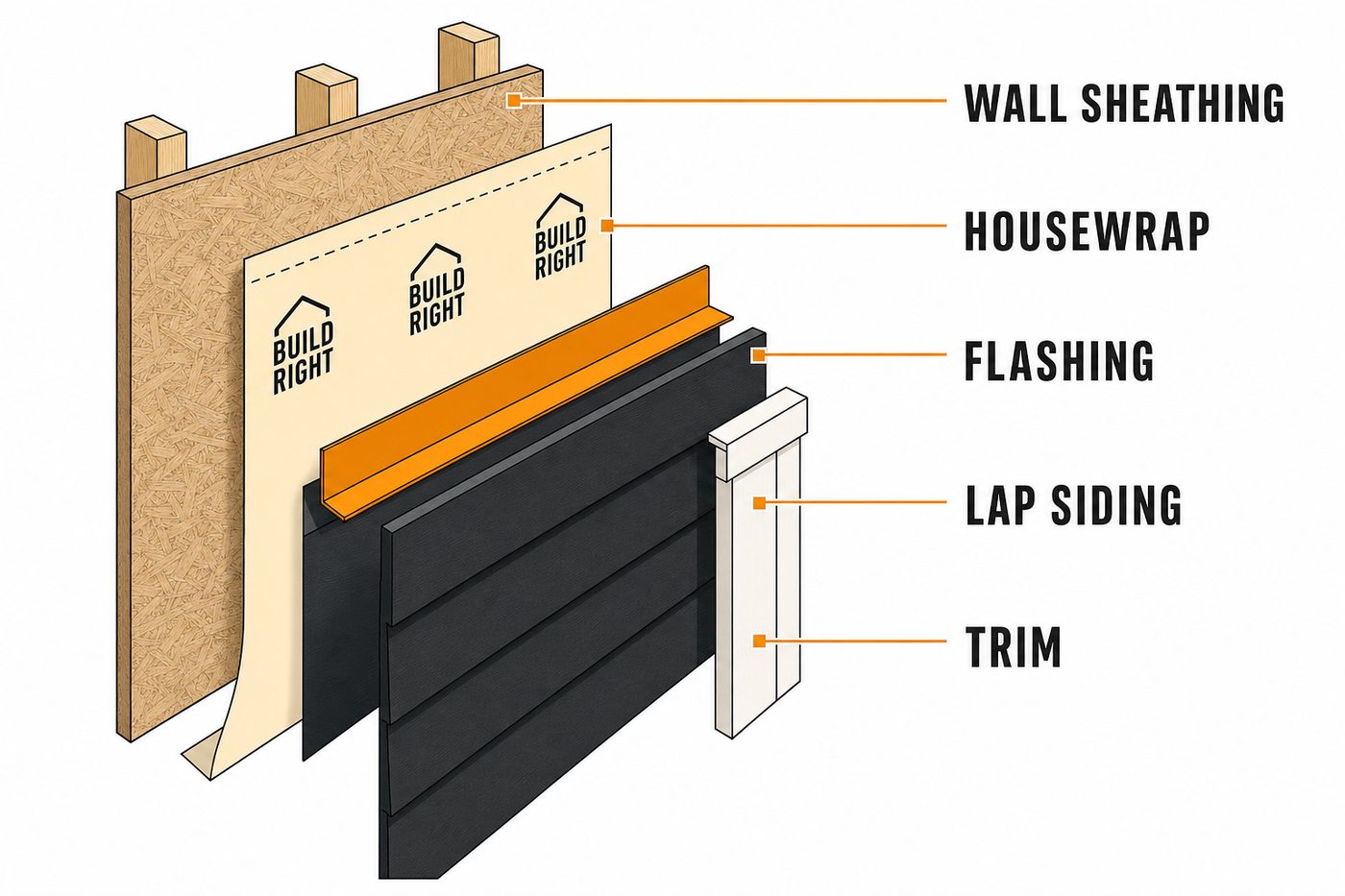
- Tear-off and wall correction. Old layers off, sheathing repaired, modern weather-resistive barrier and flashing installed on a wall that never had either.
- Install and final walk. Boards and trim hung to manufacturer spec, every penetration sealed, the yard picked clean, and the job closed with a slow circuit of the house together.
How Long a Millwood Re-Side Runs
A single-story cottage usually takes about a week of site work; a two-story craftsman with layered tear-off and full trim reproduction can take two or more. Spring and summer slots book first. Shoulder-season installs work fine — boards hang in cold weather, while caulk and touch-up coatings get sequenced into their temperature windows. City inspection points slot into the schedule, and we manage that calendar for you.
Siding Questions From the Mill Town
Can you match my original profile if we're only redoing part of the house?
Usually. Modern stock boards don't match 1910s reveals, but custom milling reproduces most bevel and drop profiles. We mock up a course against the existing wall first — a sixteenth of an inch in the shadow line is visible from the street.
Is repainting ever smarter than re-siding?
If the wood is sound and failure is limited, a proper strip-and-repaint can buy a decade. Once boards cup, joints open, or rot shows at sills and bottom courses, new paint is money spent on a losing wall. We'll say which side of that line your house is on.
What if the layer under my vinyl is asbestos-cement shingle?
It gets tested before anyone disturbs it, and if positive it comes off under the applicable handling and disposal rules as its own priced line item. Common on homes covered in the fifties and sixties, and manageable — it just can't be a mid-job improvisation.
Do I pull a permit through Millwood or Spokane County?
Millwood. The town has kept its own city hall and permitting for a century, so re-side permits go through Millwood's own desk. We handle filing and inspections.
Will fiber cement look out of place on my block?
Not if the proportions are right. Narrow-reveal smooth lap with full trim reads as period from the sidewalk. What looks wrong is wide reveals, skinny corners, and missing casings — the character lives in the trim spec.
Should windows be replaced during the re-side?
If replacement is on your horizon anyway, do it now. The window-to-wall flashing goes in as a single detail instead of two retrofits, and we install windows ourselves, so nothing gets handed off between contractors.
How long will new siding last under all these trees?
Fiber cement and engineered wood both carry multi-decade service lives, shade or not. What the canopy threatens is maintenance: gutters overflowing into bottom courses shorten any product's life. Keep water moving and the boards outlast the repaint cycle.
The Firm Holding the License
Millwood is a town where owners stay put and exterior work gets judged by neighbors for years. Domex Construction is licensed in Washington (DAVYDCI833NC, verifiable through the state Department of Labor & Industries contractor lookup) and fully insured; ask about our workmanship warranty at the estimate, alongside manufacturer coverage on Hardie and LP products. From Millwood our crews cover Pasadena Park across the river, the Valley's West end, the rest of Spokane Valley, and Spokane itself.
Want a straight answer on your walls? Free on-site estimates across Millwood and the west Valley. Give us a call or request an estimate online.
More from Domex in Millwood: Window Replacement in Millwood · Custom Decks in Millwood · Custom Home Builder in Millwood · Siding Installation — Spokane hub