
Siding Installation & Replacement in Palouse, Washington
Siding replacement in Palouse, WA for 1890s-1920s homes. Period profiles, careful tear-offs, Hardie Preferred contractor. Free estimates.
$1,000 Off
Your Complete Siding Replacement
Get a Free Estimate
FREE same-day estimates on all exterior projects.








Most small towns get remodeled by accident — a repair here, a cheap update there. Palouse is getting restored on purpose. The same pull that refilled the 1890s brick storefronts on Main Street with galleries, studios, and small shops has been drawing people to the frame houses on the grid behind it: buyers who choose a 1905 four-square precisely because it's old and intend to bring it back rather than cover it up.
Siding is where that intention meets a hundred and twenty years of weather. Interior trim can wait a decade; a wall that's shedding paint and soaking up meltwater cannot. Domex Construction re-sides these houses under Washington license DAVYDCI833NC, and the aim on nearly every job in town is the same — make the house weather-tight for the next thirty years without making it look like it was built last year.
Re-Siding Without Erasing the House
The original cladding on most of these homes was beveled cedar at a narrow exposure — usually four to five inches to the weather — with corner boards, a water table at the bottom of the wall, and a frieze board up under the eaves. Those proportions are most of what makes an old house read as old — get them wrong and the building looks off even to people who can't say why.
So the first conversation on a Palouse estimate is about profiles, not brands. Fiber cement comes in smooth-face lap at exposures that match the original coursing, and with the trim package rebuilt to the historic pattern, a re-sided wall keeps the shadow lines the street expects. And to be honest about failing wood: once original cedar has been scraped, patched, and repainted through enough cycles, the boards are checked and cupped past saving, and another repaint buys three or four years at best. A period-profile fiber cement re-side often honors the house better than nursing wood that's structurally done — it holds the look and stops the rot cycle at the same time.
Partial approaches are legitimate too: restore sound original siding on the street face, replace the beat-up south and west walls in a matched profile. On a house you plan to keep for decades, that's triage in the right order.
What Comes Off an 1890s–1920s Wall
Tear-off on a Palouse house is archaeology. Under a layer of 1970s aluminum or 1980s vinyl we routinely find the original cedar; under that, board sheathing with gaps between planks, no house wrap of any kind, and framing cut to true dimensions that modern lumber doesn't match. Some of the oldest houses in town are balloon-framed, with wall cavities that run open from sill to roofline — which changes how we air-seal the wall.
Three realities shape every one of these tear-offs. First, layers: two or three generations of cladding means more labor, more disposal weight, and more chances to find damage the outer layer was hiding. Second, lead: paint on pre-1978 houses has to be assumed lead-bearing, so removal is contained and debris leaves the site bagged, not blowing across the garden. Third, surprises worth catching: old wiring at penetrations, sill damage near grade, and openings re-trimmed badly during a previous re-side. We probe suspect areas during the estimate and put repair contingency terms in writing, because on housing this age the question is never if we'll find something — it's how much.
Wind Over Open Ground, Snow Against the Wall
Palouse sits in a river bottom with wheat hills rolling away in every direction, and the wind that combs those hills funnels through town with very little to slow it down. On the exposed western and southern faces, wind-driven rain and sideways snow work at every lap joint and trim seam — which is why our flashing details, butt-joint treatment, and sealant schedule are specced for pressure-driven moisture, not just falling rain.
Winter adds the second local mechanic: snow drifts against the bottom of walls and sits there through freeze-thaw cycling from November into March. Bottom-course clearance above grade, a properly flashed water table, and correct gaps at roof-wall intersections decide which houses shrug that off and which ones grow rot at the shins. Most failing siding we're called about in town fails from the bottom up, on the walls that catch drift.
Material Choices for a Restoration Town
James Hardie fiber cement is the workhorse recommendation for these houses. It takes the narrow-exposure, smooth-face profile the era calls for, doesn't move through freeze-thaw, and the ColorPlus factory finish stretches repaint cycles far beyond what site-painted wood manages here. We're a Hardie Preferred Contractor, which mostly means the flashing and clearance details that make the warranty real are standard practice for our crews.
LP SmartSide earns its place on outbuildings, farm shops, and walls that take impact — it's tougher against hail and thrown gravel, comes in long lengths that reduce seams on big simple walls, and its wood-grain face suits the rural properties outside town.
Vinyl is the budget path and we install it well, but on a historic block we'll say plainly that it reads flat next to original trim. Where it makes sense — rentals, additions, secondary structures — we'll say that too.
Pricing a Re-Side With History in the Walls
Every quote is a fixed number after a walkthrough, and these are the levers that move it. Tear-off depth is the big one in Palouse: each additional layer of old cladding adds labor and disposal. Trim complexity is second — these houses carry far more corner board, water table, frieze, and casing than a modern ranch, and rebuilding it correctly is skilled time. Substrate repair, lead-safe containment, wall height on two-story homes, and material selection fill out the list. A cheap bid on a house like this usually means someone plans to skip the trim rebuild or side over the problem.
How the Job Runs, Start to Finish
- Walkthrough and probing. Every wall, every suspect spot, and a straight conversation about which original material is worth saving.
- Spec on paper. Profile, exposure, trim package, flashing details, color, and repair contingency terms — written so bids can be compared line by line.
- Permits. In-town projects go through City of Palouse permitting; rural properties run through Whitman County. We file and track both.
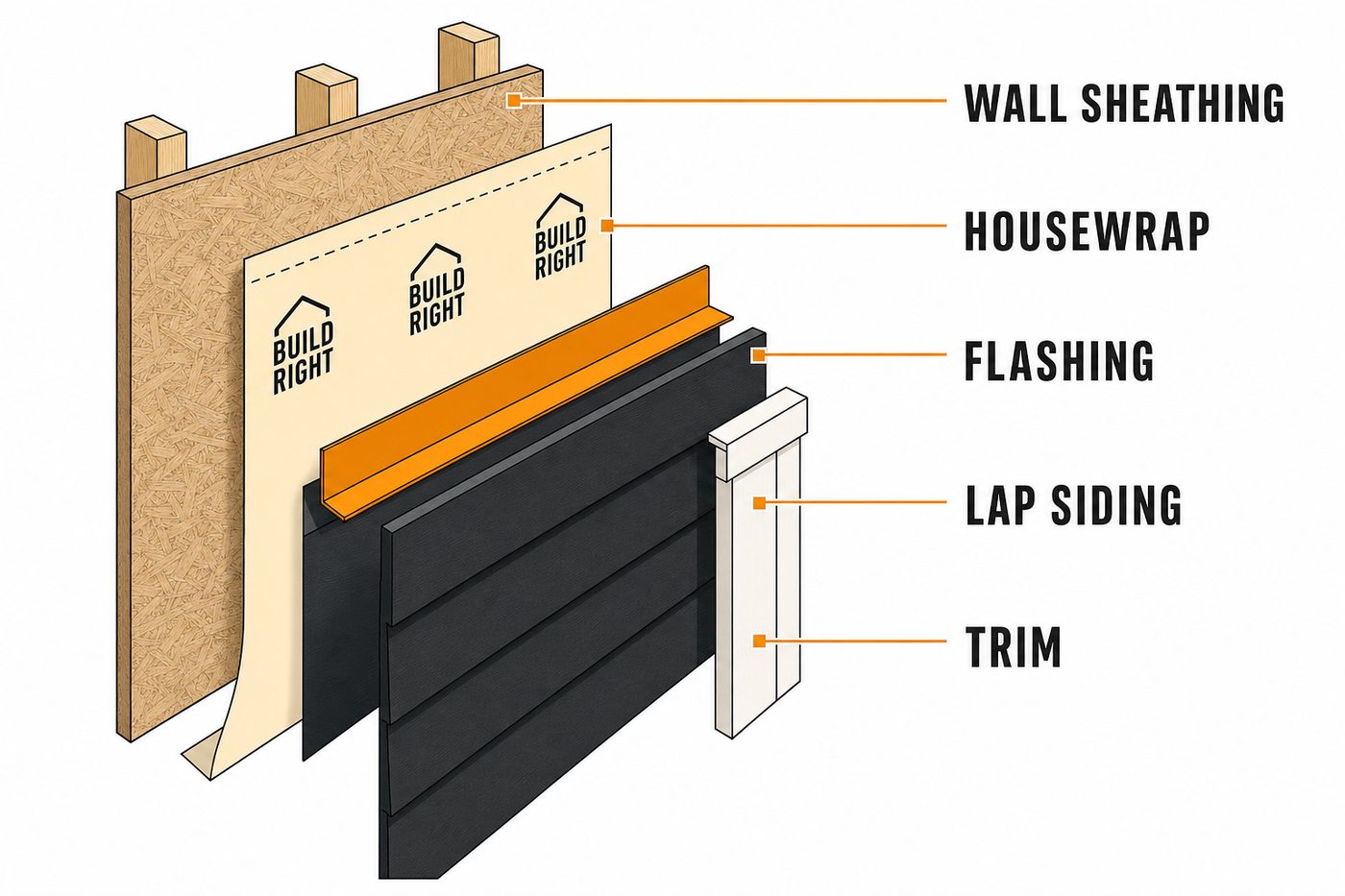
- Tear-off and wall correction. Contained removal, sheathing repair, modern weather barrier over the old board sheathing, flashing detailed for drift and driven rain.
- Install and walkaround. Siding and trim to manufacturer spec, penetrations sealed, site magnet-swept, and a wall-by-wall review with you before the ladders leave.
When the Work Happens
Our crews run out of the Spokane area and cover Whitman County in scheduled trip blocks, so a Palouse project gets booked as a committed window rather than squeezed between local calls. Late spring through fall books first; winter installs are workable because fiber cement hangs fine in the cold, with caulk and touch-up coatings sequenced into their temperature windows. Estimate early — spring inquiries get first pick of slots, and factory-finished material adds order lead time worth planning around.
Siding Questions From Palouse Homeowners
Can you match my original siding profile?
Usually, yes. Narrow-exposure smooth lap in fiber cement covers most houses in town, and the trim package does the rest of the visual work.
Is it worth saving my original cedar?
Sound boards with surface-level paint failure can be worth restoring, especially on the street face. Boards cupped, checked through, or rotted at the ends argue for replacement in a matched profile.
Do I need a permit for re-siding in Palouse?
In-town work runs through the City of Palouse; rural properties go through Whitman County. We handle filing and inspections either way.
What about lead paint?
Assume pre-1978 paint contains lead. Tear-offs use containment, ground protection, and bagged disposal so debris doesn't end up in your soil.
How long does a re-side take?
Most single-family jobs run one to three weeks on site depending on size, tear-off layers, and repair scope.
Will new siding look wrong on a historic house?
Not if profile, exposure, and trim are specced to the era. Re-sides that look wrong almost always lost their corner boards and casings to a wrap-everything approach — the mistake we design around.
Do you work on farms outside town?
Yes. Farmhouses, shops, and outbuildings across rural Whitman County book into the same trip schedule as in-town jobs.
Should windows happen at the same time?
If yours are close to needing it, yes — flashing and trim integrate better and cost less when the wall is already open. We do both.
Who Shows Up, and Under What License
Domex Construction is a Washington-licensed contractor (DAVYDCI833NC — verify it in seconds on the L&I contractor lookup) and fully insured, with 9 years in business and 32 years of combined crew experience. From Palouse we serve Garfield, Colfax, Pullman, Potlatch just across the Idaho line, and the rest of Whitman County.
Restoring a house here on purpose? Get a free on-site estimate and a straight answer about what your walls need. Give us a call or request an estimate online.
More from Domex in Palouse: Window Replacement in Palouse · Custom Decks in Palouse · Custom Home Builder in Palouse · Siding Installation — Spokane hub