
Siding Installation & Replacement in Sagle, Idaho
Siding installation & replacement in Sagle, Idaho by a Hardie Preferred contractor. Snow-country installs done right. Free estimates.
$1,000 Off
Your Complete Siding Replacement
Get a Free Estimate
FREE same-day estimates on all exterior projects.








Sagle isn't a town with one housing type — it's forty square miles of timbered acreage, lake frontage, and highway parcels south of the Long Bridge, and the siding work changes with the parcel. A cabin above Garfield Bay, a manufactured home on a Highway 95 acreage, and a newer custom build with a Lake Pend Oreille view all fail differently and get re-sided differently.
What every Sagle wall has in common is snow. This end of Bonner County sees real accumulation — more than Coeur d'Alene, far more than Spokane — and siding here spends months with snowpack sitting against its bottom courses. That's the detail that decides how long a re-side lasts, and it's the lens we look through on every estimate. Domex Construction works across Sagle under Idaho license RCE-66940, with crews based out of the Spokane–Post Falls corridor.
What to Expect From a Siding Project Here
Most Sagle re-sides follow the same arc: an on-site walkthrough, a written spec, a permit through Bonner County, a few days to a couple of weeks of tear-off and installation depending on the house, and a final walkaround. What makes or breaks the project isn't the arc — it's what happens inside it, and almost all of that is decided before the first board comes off.
Local conditions are why experience matters more here than in a subdivision market. A crew that mostly hangs siding on flat-lot new construction hasn't dealt with a wall that's half plank sheathing and half OSB, or planned bottom-course clearances around where a metal roof sheds its snow, or scheduled caulk and paint work around a Bonner County shoulder season. None of that is exotic to us — it's the normal Tuesday version of work up here. Going into your estimate, the useful mindset is this: you're not buying boards, you're buying the two hundred decisions between the boards and your framing.
What We Find on Sagle Homes
A lot of Sagle housing started as something smaller. Cabins got winterized, additions went on in different decades, and the result is walls that carry two or three eras of construction under one skin — plank sheathing on the original section, OSB on the addition, sometimes no house wrap on either. Tear-off is where that history surfaces, and it's why we probe walls during the estimate instead of quoting off a driveway glance. A re-side bid that doesn't account for substrate correction on a converted cabin isn't a lower price; it's a change order waiting for you mid-job.
The forest is the other local factor. Shade-side walls under fir and ponderosa hold moisture weeks longer than open exposures, which is where we find the moss lines, the peeling paint, and the soft hardboard. Needle litter packs behind trim and holds dampness against end cuts. And woodpeckers treat older wood and hardboard siding as territory — the holes we're asked to patch every year are almost always in those two materials, on the quiet tree-facing walls.
James Hardie vs. LP SmartSide for Sagle
These are the two materials most Sagle re-sides come down to, and the right answer depends on your walls, not on which one we'd rather sell.
Snow and moisture: Hardie's fiber cement doesn't absorb meltwater or move through freeze-thaw cycles, which makes it the safer bet where snowpack sits deep against the house or a wall stays shaded and damp into May. LP handles moisture well when its cut edges are field-sealed properly — that's an installation discipline, and it's the detail we'd check first on any failing LP job.
Impact: LP wins. Falling branches, ice shedding off steep metal roofs, gravel thrown by a plow — engineered wood takes those hits without cracking. On tree-crowded parcels this is a real consideration, not a brochure line.
Maintenance and appearance: Hardie's ColorPlus factory finish holds color under UV bouncing off snow half the year and pushes repainting far down the road; woodpeckers also leave it alone. LP's deep wood-grain texture reads more like real cedar, comes in longer boards (fewer seams on big simple walls), and its ExpertFinish factory color option closes part of the maintenance gap.
Longevity: Both are 30-year-class products when installed to spec. In Sagle specifically, Hardie edges ahead on damp shaded walls and woodpecker pressure; LP edges ahead on impact-exposed walls. Plenty of homes here argue for one on three walls and would've been fine with either — we'll tell you which yours is.
What Drives the Cost of a Sagle Re-Side
We quote fixed prices after a walkthrough, not ranges off square footage — but it helps to know what moves the number. Wall area and stories set the baseline. Tear-off condition is the biggest variable in Sagle: layered old siding, mixed substrates on converted cabins, and hidden rot repair all add labor, which is why our specs state rot-contingency terms in writing instead of surprising you mid-job. Trim complexity and window count matter — every opening is flashing and detail work. Material choice moves the number (fiber cement and engineered wood cost more than vinyl up front and generally earn it back in lifespan here). And access is a genuinely Sagle line item: steep lake-slope lots, long forest driveways, and lakefront walls that need staging all take crew time that a flat subdivision lot doesn't.
Timeline and Scheduling
Lead time depends on season — summer and early fall book first in Bonner County, so estimates in spring get the best pick of install windows. The install itself typically runs from several days on a modest single-story to a couple of weeks on a large or complicated home; tear-off surprises are the usual reason a schedule stretches, which is another argument for the probing we do up front. Winter installs are real here: fiber cement hangs fine in cold, while caulking and finish coatings have temperature windows we sequence around. County inspections slot into the schedule at the stages the permit requires — we manage that calendar, not you.
How the Project Actually Runs
- The estimate. We walk every wall, probe the suspect spots, and look at what your roof sheds where. You'll hear what we'd put on the house and why — and where we'd spend or save. Free, and useful even if you don't hire us.
- The written spec. Product line, color, trim package, flashing details, and rot-contingency terms on paper. If a bid you're comparing doesn't state what happens when rot turns up, that's the question to ask them.
- Permitting. Sagle is unincorporated, so the permit runs through Bonner County. We file it and schedule around its inspection points.
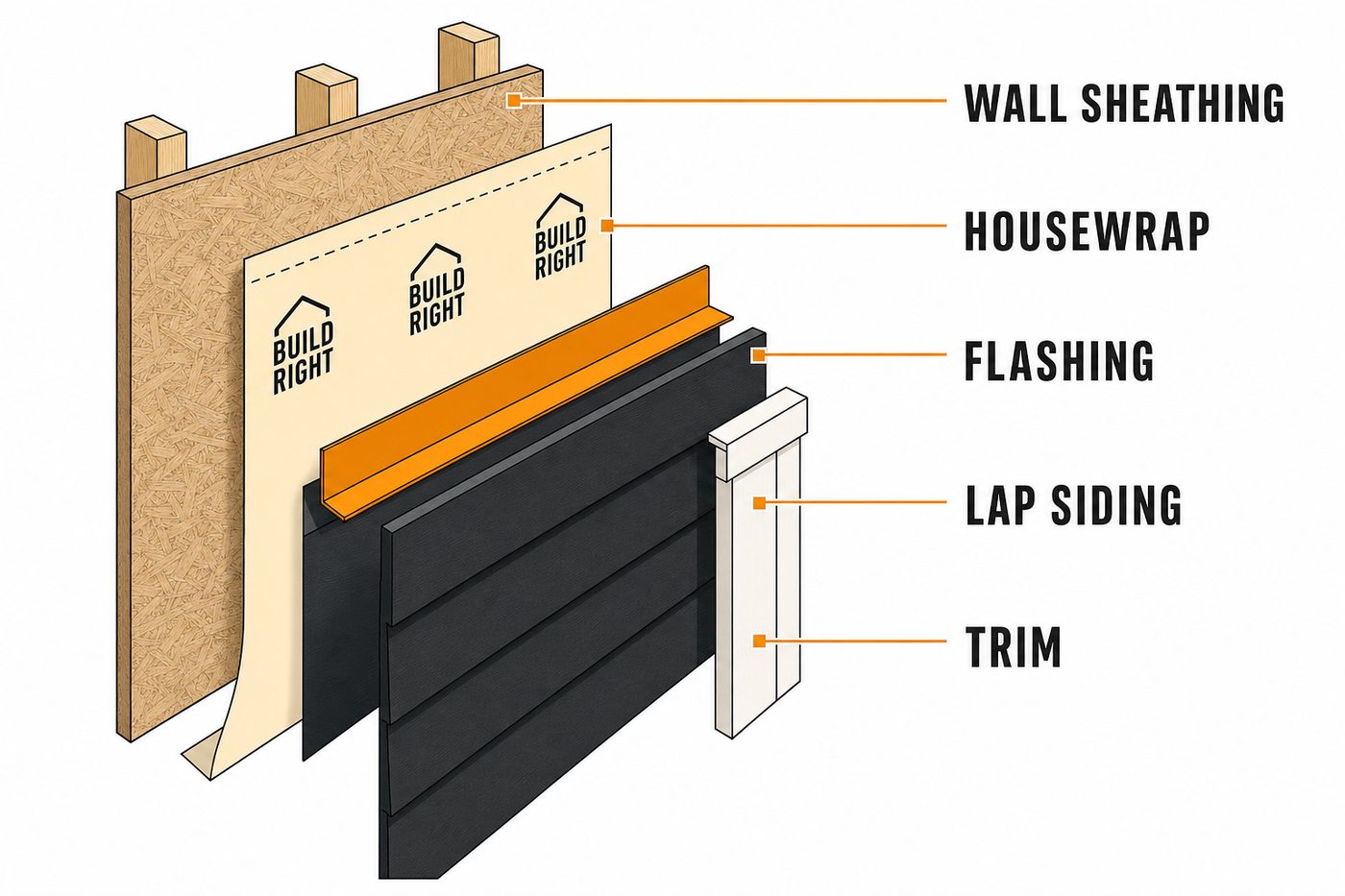
- Tear-off and correction. Old siding off, substrates unified, sheathing repaired, wrap and flashing detailed for snow-country meltwater. This invisible stage is most of what you're paying for.
- Install and walkthrough. Boards hung to manufacturer spec, joints and penetrations sealed, site cleaned, and a wall-by-wall walkaround with you before we call it done.
Questions Sagle Homeowners Ask Us
Should I choose James Hardie or LP SmartSide?
If your worst exposure is damp shade and snowpack, Hardie. If it's impact — branches, roof-shed ice, plow gravel — LP. The comparison section above covers the trade-offs; the walkthrough settles it for your actual walls.
Can siding be installed in winter here?
Yes, with sequencing. The boards go on fine in cold; caulk and coatings wait for their temperature windows. Winter can be a smart time to book — lead times are shorter.
How much rot do you usually find?
On converted cabins and shaded walls, some is the norm rather than the exception — usually at bottom courses, under windows, and behind trim where needles pack in. That's why contingency terms are in the spec up front.
Do I need a permit in Sagle?
Re-siding work here runs through Bonner County. We handle the filing and inspections as part of the job.
Should I replace windows while the siding is off?
If your windows are within five years of needing it, yes — the flashing and trim integration is better and cheaper done once. We install windows too, so it's one crew and one schedule.
Can you install over my existing siding?
Usually we advise tear-off. Layering over old siding hides exactly the substrate and moisture problems Sagle homes are prone to, and it compromises flashing depth at every opening.
How long should new siding last here?
Installed to spec, fiber cement and engineered wood are both 30-year-class materials even in this snow. The failures we tear off early are almost always installation shortcuts, not material limits.
Do you really service Sagle from Spokane?
Yes — Bonner County jobs run in scheduled crew blocks alongside our Sandpoint work, so your project gets a committed window, not day-by-day availability.
Licensing, Warranty & Service Area
Domex Construction is licensed in Idaho (RCE-66940, verifiable through the Idaho Contractors Board) and Washington (DAVYDCI833NC), and fully insured. Our work is backed by a workmanship warranty alongside the manufacturer warranties on Hardie and LP products — ask us for the specifics at your estimate.
Featured Nearby Project
From Sagle we cover the south end of Bonner County — Sandpoint, Ponderay, Dover, Bottle Bay and Garfield Bay, and down Highway 95 toward Athol and Bayview.
Want eyes on your siding before next winter? Free on-site estimates across Sagle and the Sandpoint area. Give us a call or request an estimate online.
More from Domex in Sagle: Window Replacement in Sagle · Custom Decks in Sagle · Custom Home Builder in Sagle · Siding Installation — Spokane hub