
Siding Installation & Replacement in Plummer, Idaho
Siding installation in Plummer, Idaho built for open-country wind and sun. Hardie Preferred contractor, honest material advice. Free estimates.
$1,000 Off
Your Complete Siding Replacement
Get a Free Estimate
FREE same-day estimates on all exterior projects.








Plummer sits up on the open rim above the lake country — a highway-junction town on US-95 where the Palouse rolls up out of the south and the ground finally tips over toward Heyburn State Park and Lake Chatcolet. The lake is ten minutes downhill; the weather is pure Palouse. Timber shelters the walls down in the park — up in town, almost nothing does, and siding here lives a different life than siding at the bottom of the grade.
Domex Construction installs and replaces siding across Plummer and the surrounding end of Benewah County under Idaho license RCE-66940. We're a James Hardie Preferred Contractor, we install LP SmartSide, and we hang a lot of good vinyl — and on Plummer's mix of modest homes, we'd rather match the material to the house and the budget than talk anyone into the most expensive board on the truck.
Wind and Sun Do the Damage Here
Open terrain changes the physics of a wall. Rain in Plummer rarely falls straight down; wind drives it sideways into the weather face of the house, and any gap — a lifted lap, a failed caulk joint, an unflashed window head — becomes an entry point under pressure instead of a spot that merely drips. The same wind cycles siding constantly: it lifts loose vinyl panels, rattles old hardboard laps, and slowly backs out fasteners that were driven proud thirty years ago.
Sun is the quieter half of the equation. With no tree canopy over most in-town lots, south- and west-facing walls take full UV from spring through fall, plus glare bouncing off snow all winter. Paint chalks and fades on those exposures years ahead of the shaded sides, caulk dries out and splits, and dark vinyl from the 1990s can distort in August heat.
The Housing Stock, Taken Case by Case
Plummer is a town of roughly a thousand people, and the homes reflect its working history: older frame houses from the early rail and timber days, mid-century stock added as the highway grew, and a meaningful share of manufactured homes on their own lots. There is no standard Plummer re-side, so we don't bid one.
On the older frame houses, the questions are underneath: board sheathing instead of plywood, little or no weather barrier, and framing that may have shifted over a century. We probe suspect spots at the estimate so the price reflects the wall, not the paint. Mid-century homes often carry hardboard or first-generation vinyl at the end of its service life — usually a straightforward tear-off, but we check window flashing carefully, because that era relied on caulk where modern installs use metal and membrane.
Manufactured homes get their own approach, not a scaled-down version of the stick-built one. Wall framing is lighter, stud spacing differs, and the factory siding often ties into the roof edge and skirting in ways a standard re-side sequence would disturb. We've re-sided plenty of them; the job works when the fastening schedule, trim details, and bottom edge are planned for the structure that's actually there.
Materials Priced Against Reality
Budgets in Plummer are working-family and retiree budgets, and our advice respects that.
Vinyl is a legitimate choice here and we'll say so plainly. Modern heavier-gauge panels in lighter colors handle Plummer sun far better than the builder-grade product of twenty years ago, and correct hanging — centered fasteners, room to move, a nailing pattern tightened for wind zones — is what keeps panels on the wall in a gale. Most vinyl failures we tear off were installation failures first.
LP SmartSide is the mid-range workhorse: engineered wood that shrugs off impact, nails tight enough to stop wind rattle, and comes in long boards that suit the simple wall planes common on homes here. Its cut edges need proper field sealing, which is on the installer.
James Hardie fiber cement is the long-haul option. It doesn't move in heat, burn out in UV the way paint-on-wood finishes do, or care about freeze-thaw, and the ColorPlus factory finish keeps its color on the exposures that punish everything else. On a house you plan to keep for decades, it usually costs less per year than anything cheaper.
We'll tell you at the estimate which of the three your house argues for — and it's often not the same answer on all four walls of a budget.
What Changes the Price
Square footage and wall height set the base, and Plummer helps you there: most homes are single-story on flat, easy-access lots, which trims staging and ladder time that hillside towns pay for. From that base, the movers are tear-off (layered old siding or brittle hardboard adds labor), hidden repair (rotten sheathing or missing weather barrier, covered by written contingency terms rather than a mid-job surprise), opening count (every window and door is flashing work), trim complexity, and material choice. Our quotes are fixed, and they come after we've put hands on the house — not off an aerial photo.
Five Steps, Start to Finish
- Walkthrough and estimate. We check the weather walls, probe soft spots, and look at how wind and sun have treated each exposure. No charge, no sales script.
- Written spec. Material, color, trim package, flashing details, and repair contingency terms on paper before you sign anything.
- Permitting. Plummer sits within the Coeur d'Alene Reservation, and the right permit office can vary by parcel — so we confirm the correct permit path for your parcel with the City of Plummer and Benewah County and handle the filings from there. You don't chase any of it.
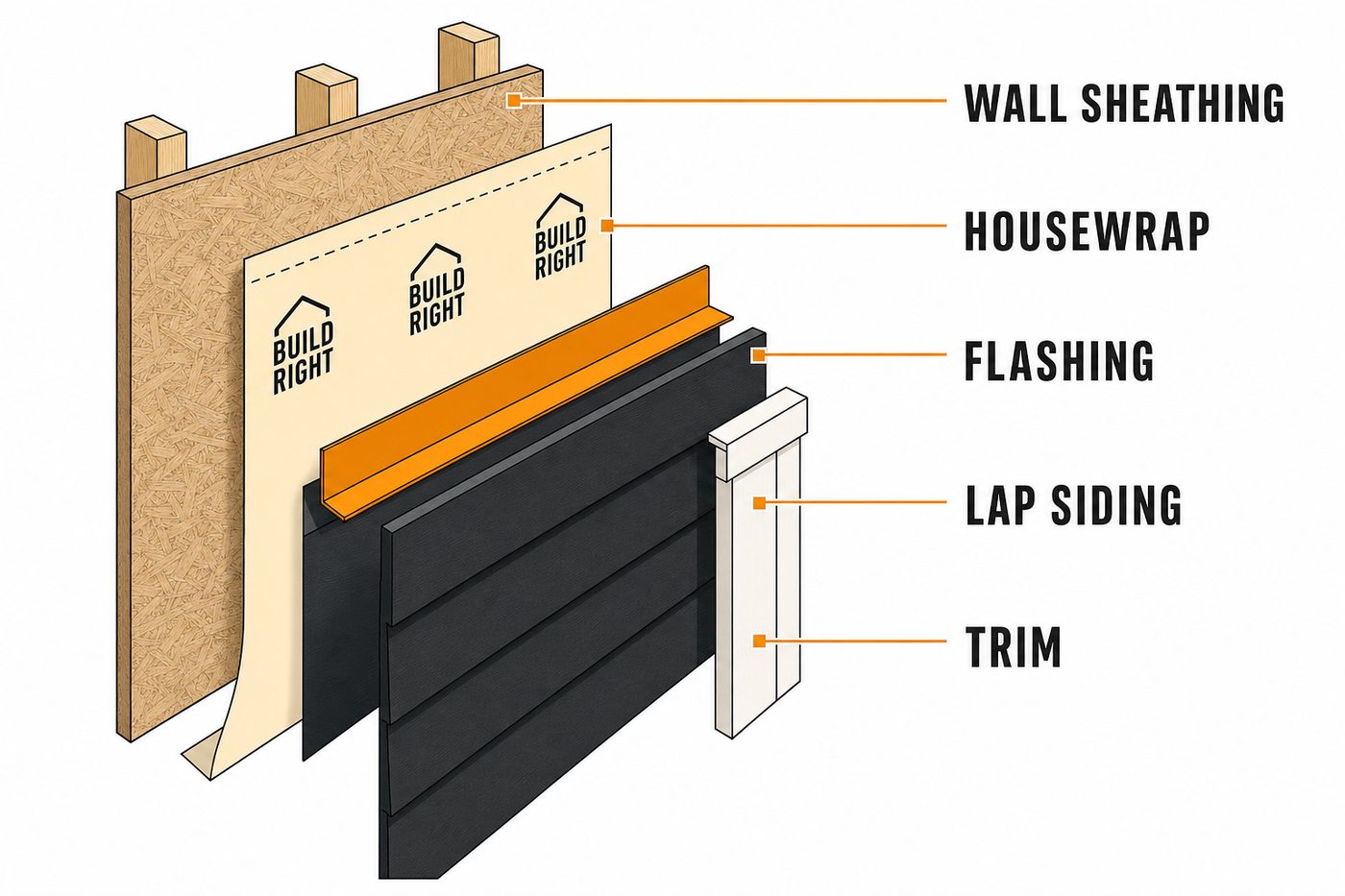
- Tear-off and wall prep. Old siding off, sheathing repaired, modern weather barrier and flashing installed with the wind-driven-rain details this ridge demands.
- Install and review. Panels and trim go on to the manufacturer's wind-zone spec, every penetration gets sealed, and we walk the finished walls with you before the trailer leaves.
Scheduling and How Long It Takes
Most Plummer re-sides run three days to a week and a half — single-story footprints keep installs quick once tear-off is done. Summer and early fall book first, so a spring estimate gets the best choice of install windows. Cold-month work is doable — finish sealants are the only step that waits on warmer days. The one Plummer-specific wrinkle is wind: on the worst gust days we don't fly long panels, so a schedule here carries a buffer day the calm towns don't need. We build it in rather than promising a date we'd have to break.
Questions We Hear in Plummer
Is vinyl siding a mistake in this much wind?
No — badly installed vinyl is. Heavier-gauge panels, correct fastener placement, and a tightened nailing pattern hold fine on open ground. The flapping panels you see around the region almost always trace back to overdriven or misplaced nails.
Can you re-side a manufactured home?
Yes, and we bid it as its own kind of project. Lighter framing, different fastening, and the skirting and roof-edge transitions all get planned before tear-off, not improvised during it.
Which walls fail first here?
South and west. Wind-driven rain plus full sun means paint, caulk, and cheap panels age fastest on those faces. Sometimes the honest scope is a full re-side; sometimes two walls buy you years.
Do I need a permit to re-side in Plummer?
Permit requirements depend on your parcel — town limits, county ground, and reservation parcels don't all route the same way. We confirm the correct permit path for your parcel with the City of Plummer and Benewah County as part of the job.
Hardie, LP, or vinyl on a tight budget?
If the house is a long-term keeper, Hardie or LP earns the gap back in lifespan and repainting cycles. If the budget is firm, good vinyl installed correctly beats stretched finances — and we'll build the spec either way without pressure.
Will you find rot under the old siding?
On the older frame houses, sometimes — usually at bottom edges and under windows on the weather side. Our specs state repair terms in writing before work starts so the discovery doesn't become a dispute.
Is Plummer too far out for you to take seriously?
No. We work a 100-mile radius from the Spokane–Coeur d'Alene corridor, and Benewah County projects get committed multi-day windows so the drive never becomes your problem.
Licensed Work, From a Company You Can Look Up
Domex Construction carries Idaho license RCE-66940 — verifiable through the Idaho Contractors Board — plus Washington license DAVYDCI833NC, and full insurance. Nine years in business, 32 years of combined crew experience, and a workmanship warranty you should ask us about at the estimate, alongside the manufacturer warranties on Hardie and LP products.
From Plummer we cover Worley, Tensed, De Smet, the Heyburn State Park area, and the rest of Benewah County along the US-95 corridor.
Want a straight answer on what your walls need? Free on-site estimates across Plummer and Benewah County. Give us a call or request an estimate online.
More from Domex in Plummer: Window Replacement in Plummer · Custom Decks in Plummer · Custom Home Builder in Plummer · Siding Installation — Spokane hub