
Siding Replacement in Ponderay, Idaho
Siding replacement in Ponderay, Idaho built for Bonner County snow. Vinyl, LP SmartSide & James Hardie, tiered honestly. Free on-site estimates.
$1,000 Off
Your Complete Siding Replacement
Get a Free Estimate
FREE same-day estimates on all exterior projects.








Builder-grade vinyl and a Bonner County winter is a mismatch on a timer. Ponderay's houses mostly went up quick and practical — small-lot homes built over the last couple of decades, manufactured homes on their own parcels, older places from the years when Highway 95 was the town's whole front door — and much of that stock wears the lightest siding the original budget allowed. The panels weren't a bad buy at the time. They were specified for an average American winter, and the north end of Lake Pend Oreille doesn't have one of those.
Domex Construction re-sides homes across Ponderay under Idaho license RCE-66940. We're a James Hardie Preferred Contractor that also installs LP SmartSide and vinyl, and that range matters here for one reason: we can lay out all three tiers straight, because we earn our living installing every one of them.
The Timer on Entry-Level Vinyl
Cold is the first problem. Thin vinyl goes brittle below freezing, and Ponderay spends a long stretch of every year down there. A shovel handle bumped against the skirt of the house, ice letting go off a metal roof, gravel thrown by the plow — impacts that summer vinyl shrugs off leave winter vinyl cracked, and every crack becomes a water entry that freeze-thaw works wider through October, November, and again from February into April.
Snow does the slower damage. Berms build against north walls and sit into March, holding meltwater against bottom courses that were never detailed for weeks of wet contact. Water rides in behind J-channel at windows and doors, freezes, and pries. The panels are moving the whole time, too — vinyl expands and contracts more than any other cladding, so a forty-degree swing between a sunny January afternoon and a clear night makes tight-nailed panels oil-can and loose ones rattle and unlock. On many Ponderay homes we inspect, the siding isn't old so much as used up: fifteen winters of that cycle on a product rated for gentler arithmetic.
Three Honest Tiers, and When Each One Wins
We don't steer every estimate toward fiber cement. The right tier depends on your plans for the house, and we'll tell you which one we'd buy in your position.
Vinyl to vinyl makes sense more often than premium-siding marketing admits. If you're holding the place as a rental, selling within about five years, or you simply need weathertight walls at the lowest responsible cost, a heavier-gauge vinyl panel with insulated backing — installed this time with correct expansion gapping and real flashing at the openings — is a legitimate answer. Stepping up from the bottom-shelf panel to a thicker, foam-backed profile costs surprisingly little and removes most of the brittleness problem.
LP SmartSide earns its price when impact is the enemy. Engineered wood absorbs plow gravel, hail, and roof-shed ice without cracking, and its 16-foot boards mean fewer seams on the plain rectangular walls most Ponderay houses have. For a family planning to stay, LP is usually the strongest cost-per-decade on this housing stock, and it still reads like real wood from the street.
James Hardie is the ceiling, worth reaching for where snow piles deep or shade keeps a wall damp — fiber cement absorbs essentially no meltwater and ignores freeze-thaw. If the budget only covers Hardie on the weather walls, we'll spec a wall-by-wall mix without apology. Protecting the two walls that take the punishment beats stretching a thin product across all four.
Corridor Grime and the Case for Factory Finish
Ponderay carries the area's retail strip, and living near it shows up on siding. Traffic film, winter road spray carrying de-icer, and dry-summer dust all settle on walls facing the corridor. Site-painted siding lets that grime key into chalking paint, where it hangs on and shortens every repaint cycle. Factory finishes change the equation: Hardie's ColorPlus and LP's ExpertFinish are baked-on coatings that road film rinses off rather than bonds to, and through-colored vinyl has no paint layer to chalk in the first place. Color choice is part of the same conversation — mid-tone colors hide road film between rinses far better than bright white or deep charcoal. On the right finish, a garden hose in May is your entire maintenance program.
What Moves the Price
Ponderay re-sides tend to be among the most affordable in Bonner County, for structural reasons: modest square footage, single-story and story-and-a-half heights, flat lots that make material staging easy, and simple rooflines with few bump-outs. From that baseline the number moves with tear-off condition — layered old siding or soft sheathing adds labor — plus window and door count, trim package, and the material tier you land on. Manufactured homes raise scope questions about wall framing and sheathing that we answer at the walkthrough, not mid-project. Every quote is a fixed written price after we've walked the walls, with rot-repair terms spelled out before you sign.
The Job, Step by Step
- Walkthrough and straight talk. We inspect every wall, probe the suspect spots, and tell you which tier fits your plans — including the times the cheaper option is the right call.
- Written spec. Material, profile, color, trim, flashing details, and exactly what happens if tear-off exposes rot. On paper first.
- Permit. Ponderay is an incorporated city, so the permit runs through the City of Ponderay rather than the county desk. We file it and build the schedule around its inspection points.
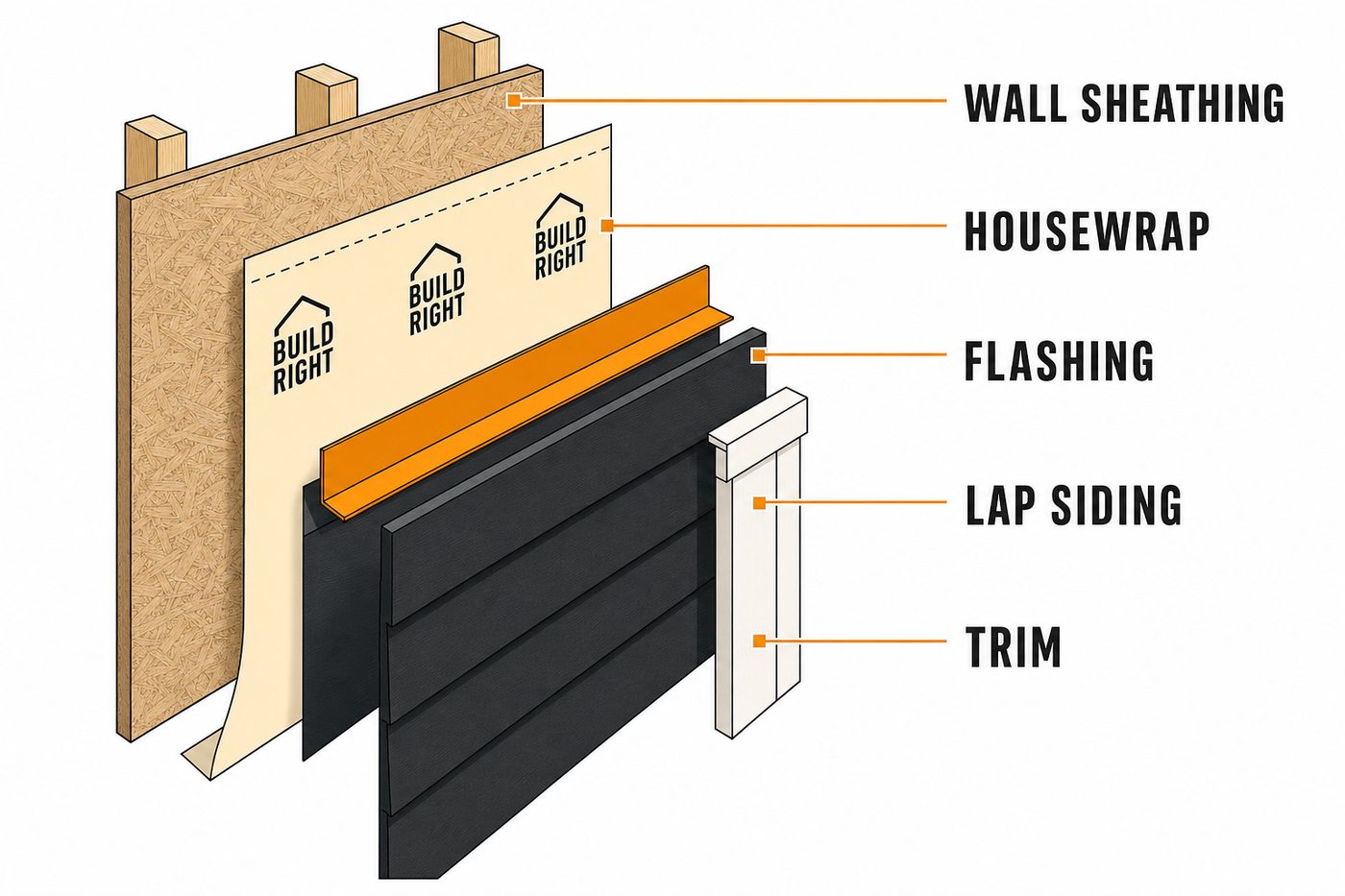
- Tear-off and prep. Old siding off, sheathing repaired, house wrap and flashing detailed for snow contact and meltwater paths.
- Install and walkaround. Siding hung to manufacturer spec — that spec is what keeps the product warranty alive — then a wall-by-wall review with you before the trailer leaves.
How Long It Takes
Most Ponderay homes are compact enough that tear-off through cleanup fits inside a week; rot repair or a heavy trim package adds days. Material lead time is usually the longer wait, so the calendar depends mostly on when you call — spring calls get summer installs, and fall calls often catch shorter winter lead times. Cold-weather installation works fine for the siding itself; caulk and touch-up coatings get sequenced into their temperature windows.
Ponderay Siding Questions
Is Hardie worth it on a modest house?
Often on two walls rather than four. The wall that catches roof-shed snow and the wall that never sees sun are where fiber cement pays; the sheltered walls can carry LP or good vinyl. Mixing tiers is normal practice for us, not a compromise.
A few panels are cracked — repair or re-side?
If the profile is still manufactured, spot repairs are cheap and reasonable. The catch is fade — new panels read as patches against fifteen-year-old color. Cracking on multiple walls means the material has gone brittle everywhere.
Can you re-side a manufactured home?
Yes, and we do it regularly here. Wall framing, sheathing, and opening details differ from site-built houses, so the spec is written case by case after we've opened up a test spot — not guessed from the driveway.
Do I need a permit for re-siding in Ponderay?
The job runs through City of Ponderay permitting, and we handle the filing and inspections as part of the contract.
Is insulated vinyl worth the upcharge?
For the R-value alone, no — the gain is modest. For rigidity, yes: the foam backing is what lets a vinyl wall take a snowblower's throw or a stray hit without dimpling, which is exactly the failure this climate causes.
Will you install over my existing siding?
We almost always advise tear-off. Covering the old layer hides the sheathing damage this climate creates and steals flashing depth at every window and door.
What if I just buy the cheap panel again?
It'll look fine on day one, and you'll be back on this page in a decade. If the budget is fixed, we'd rather move you to a thicker vinyl and simplify the trim than repeat the thin-panel cycle.
Should windows happen at the same time?
If yours are close to done, yes — flashing integrates cleaner and cheaper while the walls are open, and we install windows with our own crews.
Licensed Where You Can Check It
Domex Construction holds Idaho contractor license RCE-66940 — verify it yourself through the Idaho Contractors Board — plus Washington license DAVYDCI833NC, and we're fully insured. Nine years in business, 32 years of combined crew experience, and a workmanship warranty we'll explain in plain terms at your estimate. From Ponderay we also serve Sandpoint, Kootenai, Dover, and Sagle, so your job runs inside a regular Bonner County crew rotation rather than a one-off trip.
Ready to get ahead of next winter? Free on-site estimates anywhere in Ponderay. Give us a call or request an estimate online.
More from Domex in Ponderay: Window Replacement in Ponderay · Custom Decks in Ponderay · Custom Home Builder in Ponderay · Siding Installation — Spokane hub