
Custom Deck Builders in Ponderay, Idaho
Deck builders in Ponderay, Idaho. Compact decks designed to earn their footprint, framed to full Bonner County snow spec. Free estimates.
$1,000 Off
Your Complete Siding Replacement
Get a Free Estimate
FREE same-day estimates on all exterior projects.








Most Ponderay deck projects start with a tape measure and a slightly worried homeowner in a small backyard. The lot is compact, the setbacks are close, the shed and the trampoline already claim their corners — and the question isn't "how big can we go," it's "how do we get a real outdoor room without giving up the yard." That's a design problem before it's a construction problem, and it's the one we like best.
Domex Construction designs and builds decks across Ponderay under Idaho license RCE-66940. The same crews frame decks up at Sandpoint and out on Sagle's slopes, which shapes how we build here: town-lot sized, but specced for the same snow.
Making a Small Footprint Live Large
An oversized deck on a small lot is a common regret — it swallows the lawn and still feels cluttered, because size was standing in for planning. A compact deck that works is planned around what happens on it. We lay out zones before we draw framing: the grill gets its landing zone out of the door path, the table gets clear chair pull-back on all sides, and the traffic lane from door to stairs stays unblocked. A 12-by-14 platform organized this way outperforms a 16-by-20 that wasn't.
Stairs are the biggest space decision on a tight lot. Run them off the side instead of straight out the front and you hand several feet of yard back to the lawn; wrap a corner and the bottom step lands where the path already goes. We also treat the air under the deck as square footage. On a raised deck, skirting with an access panel, a gravel bed with fabric under it, and a dry side sheltered from roof-shed snow turns the underside into storage for the mower, bikes, and the snowblower — storage a small lot badly needs. Bench seating with hinged lids does the same job on low platforms where nothing fits underneath.
Framed for Sandpoint Snow, Every Time
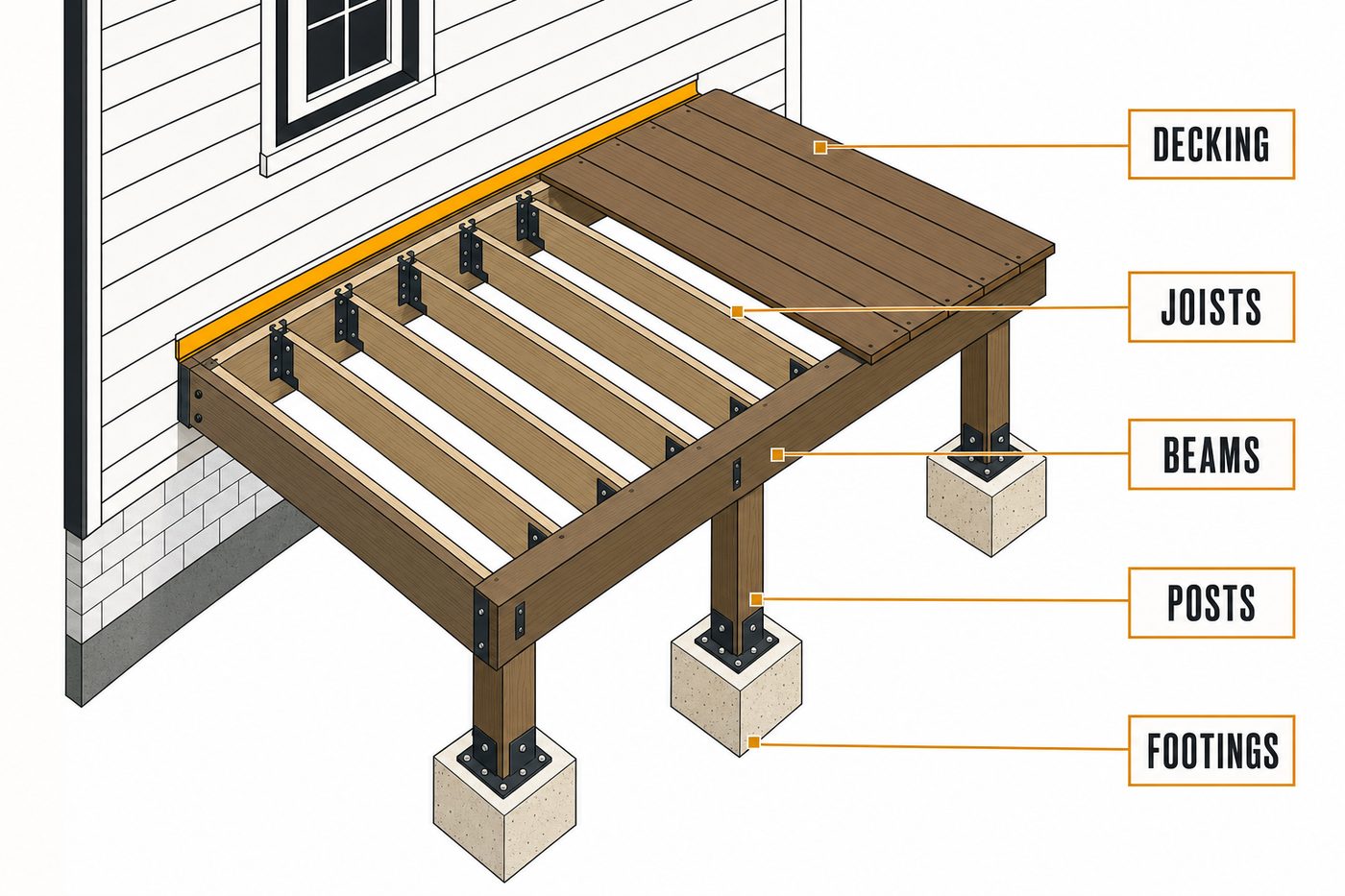
Here's the part of the conversation where we stop flexing to the budget. Ponderay carries the same roof-crushing, deck-loading winters as the rest of this end of Bonner County — snow loads far past anything Spokane designs for — and a deck holding a season of settled, ice-crusted snowpack is carrying serious weight for months without a break. So the structure gets one spec at every price point: footings dug below frost depth so freeze heave can't rack the frame, beams and joists sized for real ground-snow numbers rather than a generic span table, a ledger bolted and flashed so meltwater can't reach the house's rim joist, and hardware rated for the load path at every connection.
Budget trims come out of the surface, the railing style, or the square footage — never out of the frame. A smaller deck built to full spec beats a bigger one built to a milder climate's numbers, and we'll say that plainly at the design meeting if the wish list and the budget are arguing.
Spending Smart on the Surface
Decking is where value engineering is legitimate, so here's the honest matrix. Pressure-treated wood is the lowest cost of entry and structurally sound for decades — its price is your labor, a wash-and-reseal cycle you must actually keep up, because our freeze-thaw pattern splinters and checks neglected boards fast. Composite costs meaningfully more up front and then mostly leaves you alone: no sealing, no splinters, and colorfast against the UV that bounces off snow half the year. On a south-facing platform with no shade, composite runs hot underfoot in July — worth knowing on small lots without tree cover. Railings follow the same logic: a treated-wood rail is the value pick and repaints forever; metal balusters between wood posts cost a step more, skip the repainting, and thin out the visual bulk on a small yard. We build both, and the spread between them is a number we put in front of you, not an upsell script.
Reading the Quote
Square footage matters less than people expect; height, stairs, and railing length matter more. A ground-hugging platform needs no rail and minimal stairs, so it's the cheapest build per foot. Raise the deck to door height and code brings railing with it — priced by the linear foot — plus a longer stair run and deeper structural posts. Footing count and digging conditions set the concrete line. Surface material swings the total more than any other single choice. What doesn't change between quotes is the frame spec, which is why two Domex bids for different budgets will differ on decking and rail but read identically underneath.
Order of Operations
- Design meeting. In your yard with a tape, working out zones, stair placement, and sightlines — and whether under-deck storage is worth capturing on your lot.
- Fixed-price spec. Drawings, framing plan, material and railing selections, and the load numbers we're building to, in writing.
- Permit through the City of Ponderay. Decks here are permitted city work with inspection points; we file, schedule, and meet the inspector.
- Footings and frame. Dig, pour, cure, then beams, joists, and ledger flashing — inspected before anything gets covered.
- Surface, rail, walkthrough. Decking down, railing set, hardware checked, site cleaned, and a final walk with you on your new square footage.
Season and Schedule
A typical compact Ponderay deck runs about a week of on-site work once footings cure, with permit review and inspections adding calendar time we manage around. Spring fills the build calendar first — everyone wants the deck by the Fourth — so a winter design meeting gets you an early-season slot and the whole summer on the finished deck. Fall builds are underrated: the ground is dry for digging, the schedule is looser, and the deck is simply there when the snow melts. We pour footings whenever frost conditions allow and sequence around the freeze rather than parking the project all winter.
Deck Questions We Field in Ponderay
Do I have to shovel my deck all winter?
Not for the structure's sake — it's framed to carry the season's load. Shovel paths you actually use, keep the stair treads clear for footing, and use a plastic shovel on composite so the surface doesn't scar.
How close to my property line can the deck go?
Setbacks in city limits determine that, and they matter on Ponderay's smaller lots. We check your parcel's numbers with the City of Ponderay during design so the plan is drawn legal from the start rather than trimmed at permit review.
Is composite worth it on a tight budget?
If the budget genuinely can't reach it, a treated deck you maintain is a fine deck. The mistake is choosing wood for the up-front price and skipping the upkeep — five neglected winters here will make that surface look twenty years old.
Can you replace just the boards on my existing deck?
Sometimes. We inspect the frame first: if the footings are shallow or the joists were sized for milder loads, new boards on that structure is money on a bad foundation, and we'll show you exactly why before quoting either path.
Will a deck work attached to my manufactured home?
Yes, with the right structural approach — often a freestanding frame alongside the home rather than a bolted ledger, depending on what the wall can carry. We settle that on site, not with an assumption.
How long do footings take before you can frame?
Concrete needs cure time measured in days before it takes load, and inspections slot in around the pour. It's the least visible week of the project and the one that decides whether the deck is still level in ten years.
What's the maintenance schedule on composite here?
A wash in spring when the snow lets go, and clearing debris out of the gaps so drainage keeps working. No sealing, no staining. The railing hardware gets a once-over each year, which takes minutes.
Check Us Before You Hire Us
Domex Construction carries Idaho license RCE-66940, verifiable through the Idaho Contractors Board, along with Washington license DAVYDCI833NC, full insurance, nine years in business, and 32 years of combined crew experience. Deck crews serving Ponderay run the same rotation through Sandpoint, Kootenai, Dover, and Sagle, so your build gets committed consecutive days on site.
Got a backyard that needs to earn its keep? Free design estimates across Ponderay. Give us a call or request an estimate online.
More from Domex in Ponderay: Siding Installation in Ponderay · Window Replacement in Ponderay · Custom Home Builder in Ponderay · Custom Decks — Spokane hub