
Siding Installation & Replacement in Cheney, Washington
Siding replacement in Cheney, WA by a James Hardie Preferred contractor. Rentals and family homes, wind-ready installs. Free estimates.
$1,000 Off
Your Complete Siding Replacement
Get a Free Estimate
FREE same-day estimates on all exterior projects.








One failure pattern shows up in Cheney more than anywhere else we work: siding damage that nobody watches long enough to catch. A student rental turns over every June. Each new set of tenants inherits the bulge in the hardboard behind the bike rack, assumes the wall has always looked like that, and never mentions it to the landlord. Five turnovers later a property manager finally pushes a thumb through a soft spot, and by then meltwater has been running down the sheathing for years. What would have been a two-board repair in 2020 is a framing repair now.
That pattern shapes how we bid siding here. Cheney is an Eastern Washington University town of roughly 13,000, twenty minutes southwest of Spokane on open ground where the channeled scablands meet the edge of the Palouse — and its housing splits three ways: rentals run on spreadsheets, 1950s–90s single-family neighborhoods, and newer subdivisions pushing out from the edges. Domex Construction re-sides all three under Washington license DAVYDCI833NC.
Landlord Math and Homeowner Math
A rental owner is buying durability per dollar across a holding period. The questions that matter: how many tenant cycles before the wall needs attention again, how the material takes a bicycle handlebar or a moving-day couch corner, and if a damaged section can be patched without repainting the whole elevation. For hard-used properties, LP SmartSide earns its keep — engineered wood shrugs off impacts that crack fiber cement and punch through vinyl, and a single damaged course can be swapped without the repair advertising itself.
An owner-occupant is usually buying thirty years and a house they like pulling up to. Hardie fiber cement with a ColorPlus factory finish is the spec we quote most for those projects — the color holds under Cheney's high-glare summers, the material doesn't move through freeze-thaw, and it never turns into deferred maintenance because there's almost nothing to defer. We'll tell you plainly which side of this ledger your project sits on, even if the honest answer is the cheaper one.
Where the 1950s–90s Stock Is Giving Up
Cheney's mid-century neighborhoods carry two materials at the end of their service lives. Hardboard from the 1970s–90s fails from the edges inward: butt joints swell, bottom edges wick water and mushroom, nail heads pull moisture into the core, and paint hides all of it until the surface goes soft. If your hardboard has been painted twice since 2000 and still shows wavy shadows at the joints, the swelling is under the paint, not gone.
Early vinyl is the other one. First-generation panels from the 1980s went brittle in the sun decades ago; they crack at fastener slots, and Cheney's wind peels loose courses off the wall a panel at a time. Worse, much of that vinyl went up over bare board sheathing with no house wrap, so every gap the wind opens becomes a water path with nothing behind it. Tear-offs on these houses routinely expose sheathing that was never protected a single day of its life.
Wind Is the Design Constraint on This Ground
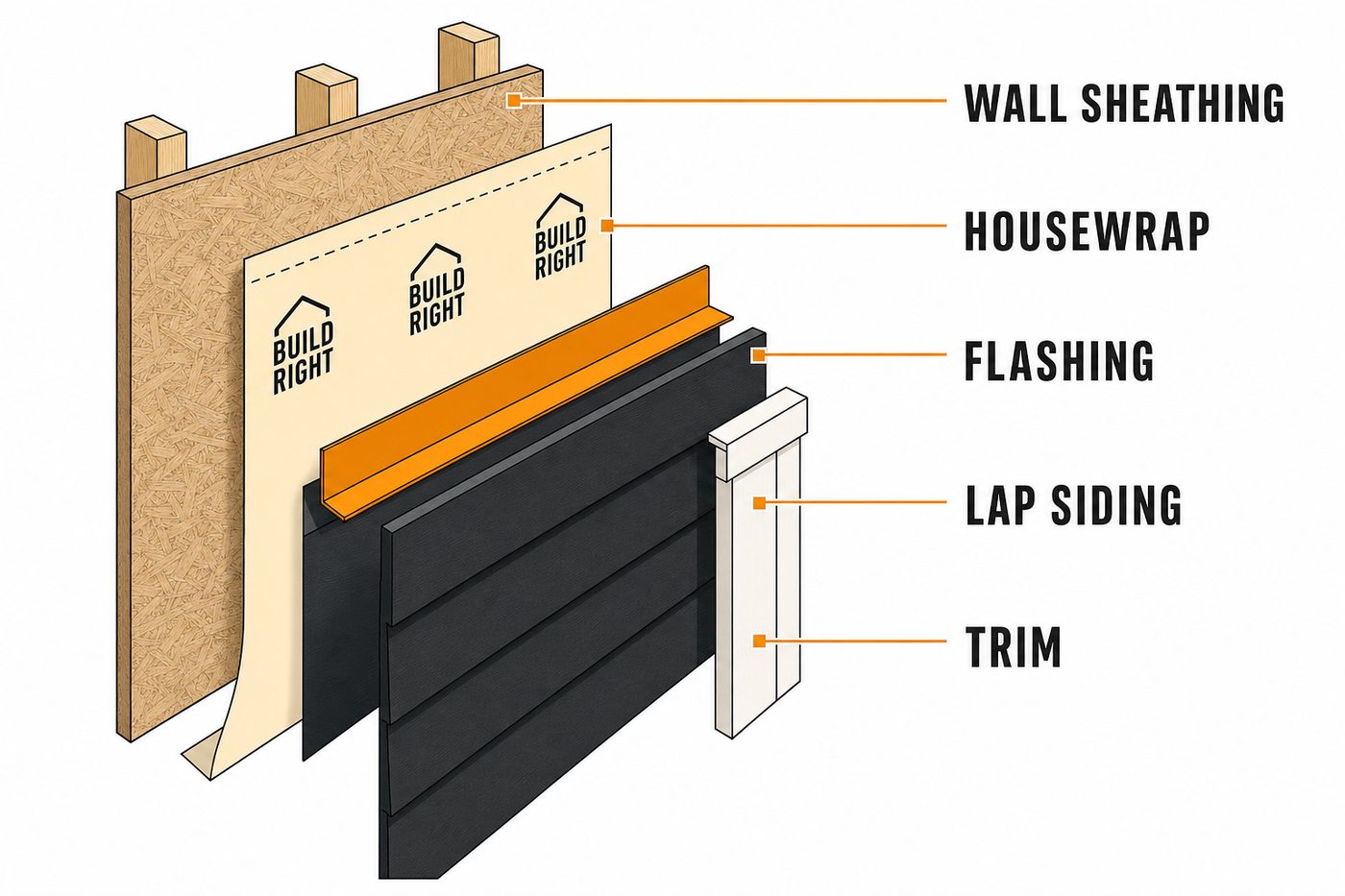
There's no tree cover between most of Cheney and the weather. The town sits exposed, and wind here doesn't just gust — it drives fine snow horizontally and packs it into any gap facing southwest. So the install changes: fastening on tightened schedules rather than the minimums written for calm sites, vinyl courses locked and pinned so panels can't unzip in a storm, house wrap seams taped rather than merely lapped, and trim ends sealed so wind-driven powder snow can't pack behind them and melt against the sheathing during a thaw. Drifting matters at the bottom of the wall too — snow that would lie flat elsewhere stacks against foundations here, so we hold bottom-course clearances that account for the drift line, not just the grade line.
Picking a Material for Cheney Walls
As a James Hardie Preferred Contractor we hang a lot of fiber cement, and on owner-occupied Cheney homes it's usually the right call: dimensionally stable through freeze-thaw, indifferent to sun, factory color that outlasts field paint. LP SmartSide is the impact-and-abuse answer — rentals, walls beside driveways and bike racks, anywhere the siding will get hit. Vinyl remains the lowest entry cost and, hung tight with locked courses and proper wrap behind it, performs honestly; the vinyl failures around town are almost all installation shortcuts meeting wind. All three are legitimate. The building, the owner's economics, and the exposure pick the winner.
What Sets the Number
A few variables do most of the moving on a Cheney re-side, and we price them after walking the building rather than guessing from the street. Tear-off condition leads: layered siding, unprotected sheathing, and hidden rot repair are labor, and on long-deferred rentals they can be the bulk of the job — our written specs state the rot contingency up front instead of springing it mid-job. Square footage and stories anchor the price; every window and door adds flashing hours. Material sits where you'd guess: vinyl lowest, engineered wood mid, fiber cement top. And multi-unit logistics are their own line: staging around tenant parking, sequencing occupied buildings, and coordinating with a manager who isn't on site all add crew hours a single ranch never needs.
Five Steps, No Mystery
- Walkthrough and estimate. Expect us to push on the hardboard, pull back a loose vinyl course, and look behind things — a bid priced off a drive-by is a bid that changes later. Free, and for landlords it comes with photos and a scope you can approve remotely.
- Written spec. Material, color, trim package, flashing detail, and contingency terms on paper before anyone commits.
- Permitting. City of Cheney issues the permit for re-side work inside city limits; filing it and meeting the inspector are our job, not yours.
- Tear-off and correction. Old cladding off, damaged sheathing replaced, then wrap taped and every opening flashed against wind-driven snow. On occupied rentals we sequence elevation by elevation so tenants keep access.
- Install and walkaround. Siding fastened to manufacturer spec, penetrations sealed, site magnet-swept, and a final wall-by-wall review with you or your manager.
When the Work Happens
Owner-occupied projects book heaviest May through October, so spring estimates get first pick of install slots. Rental owners think differently: the June–August turnover window is tempting but tight, and a re-side scheduled during the academic year on a partially vacant building often runs smoother. Winter work is real too — cold doesn't bother the cladding itself, and sealant work gets slotted into warm spells. The one Cheney-specific schedule factor is wind: on the worst days we don't fly 12-foot boards off scaffolding, and we build that slack into the calendar up front.
Asked in Cheney
Do I need a permit to re-side a house in Cheney?
Inside city limits, yes — the job goes through City of Cheney permitting, with filing and inspection scheduling part of our scope.
What siding survives the wind here best?
Any of the three we install, if the fastening and edge sealing are done for an exposed site. The wind failures we're called out to fix are nearly always loose-hung vinyl or unsealed trim, not the wrong material.
I own rentals near campus. Is vinyl still the right call?
Sometimes. If your holding period is short and the walls don't take abuse, tight-hung vinyl pencils. If units turn over hard every year, LP SmartSide's impact resistance and patch-ability usually cost less over a decade than repeated vinyl repairs.
Can you work on occupied units?
Yes — we sequence by elevation, keep entries clear, and coordinate notice through your property manager. Tenants lose a parking strip for a few days, not access to the building.
What do you usually find under old hardboard?
Swollen joints and wet bottom edges at minimum. On buildings that turned over for years without anyone reporting the bulges, sheathing rot at the drip lines is common — which is why contingency terms sit in the spec before we start.
Can siding go on in winter?
Yes. Cold doesn't stop the cladding; caulk and touch-up paint are what need warmth, and we plan the job so they land in their windows.
Should windows be replaced at the same time?
Worth pricing. Window flashing ties directly into the wall's wrap layer, so doing both in one mobilization means the tie-in gets built rather than retrofitted. We install both, and one schedule covers it.
The Paperwork That Protects You
Domex Construction carries Washington contractor license DAVYDCI833NC — verify it yourself through the Washington L&I contractor lookup — and full insurance. Nine years in business, 32 years of combined crew experience, James Hardie Preferred Contractor status, and a workmanship warranty you should ask about at the estimate. From Cheney we cover Medical Lake, Airway Heights, Four Lakes, and the rest of Spokane's West Plains.
Landlord or homeowner, the estimate is free and the numbers get written down. Call and get eyes on your walls before another winter works on them unwatched.
More from Domex in Cheney: Window Replacement in Cheney · Custom Decks in Cheney · Custom Home Builder in Cheney · Siding Installation — Spokane hub