
Siding Installation & Replacement in Colville, Washington
Siding installation in Colville, WA specced for Stevens County winters. Hardie Preferred contractor, WA licensed. Free estimates: call today.
$1,000 Off
Your Complete Siding Replacement
Get a Free Estimate
FREE same-day estimates on all exterior projects.








Colville sits in a river valley between the Kettle Range and the Selkirks, seventy miles and one honest climate step north of Spokane. Winter arrives earlier here, holds colder, and stacks more snow — and a siding spec that performs fine on a Spokane ranch is quietly undersized for a house that spends four or five months with snow banked against its lowest boards. You can read that difference in what we tear off around town: bottom courses gone punky, paint sheared from south walls by freeze-thaw, hardboard swollen fat at every edge that was never sealed.
Domex Construction installs and replaces siding across Colville and Stevens County under Washington license DAVYDCI833NC. We're a James Hardie Preferred Contractor, we also hang LP SmartSide and vinyl, and after nine years of north-country work we know exactly where a long winter goes looking for shortcuts in a wall.
Detailing a Wall for Five Months of Winter
Snow against siding is the design problem here, and it isn't one Spokane-calibrated habits solve. Manufacturers require ground clearance under the bottom course; in Colville the relevant line isn't grade — it's the top of the snow that gets shoveled off the walk and piled against the house from December through March. We plan starter courses, weep details, and flashing heights around where snow actually sits on your lot.
Meltwater is the second half of the problem. On a February afternoon the sun is strong enough to melt the snowbank touching your wall; by six o'clock that water is ice again, and any of it that slipped behind a lap or through a failed caulk joint freezes in place and pries. Freeze-thaw cycling runs long here — well into April and back again by late October — so every penetration, every window head, every roof-to-wall junction gets flashed as if water will find it, because over enough winters it will. Kick-out flashing where a roof edge dies into a wall is the cheapest rot prevention on the whole job, and it's missing from half the houses we look at.
The Grid, the Ranch Blocks, and the Farm Places
Colville's housing splits three ways, and the siding conversation is different on each.
The blocks near downtown carry early-1900s homes from the town's mill-era boom — fir and cedar clapboard under many generations of paint, often with an addition grafted on along the way. These walls frequently have board sheathing and no weather barrier at all. Original wood can sometimes be saved with serious prep and paint; once rot has moved into the bottom three feet, replacement with a modern assembly — wrap, flashing, fiber cement — is the sounder investment.
The mid-century neighborhoods that ring the old grid are the busiest part of our Colville work. Hardboard siding from that era is reaching the end everywhere at once, and this climate accelerates it: the material drinks meltwater at nail heads and cut edges, swells, and sheds paint no matter how often it's redone. If your hardboard is bubbling at the bottom edges, painting again buys time, not a fix.
Then there's everything outside town — farmhouses, shop buildings, and acreage homes from every decade. Mixed substrates, T1-11 on outbuildings, wind-driven snow on open ground, and long driveways that matter for staging. We quote houses and outbuildings together when it makes sense; a shop wall is still a wall.
Choosing Siding That Can Winter Here
Fiber cement is the default recommendation for most Colville walls, and the reason is physics rather than brand loyalty: James Hardie board doesn't absorb the meltwater cycle, doesn't move with freeze-thaw, and its ColorPlus factory finish stands up to the doubled UV load of sun bouncing off snowpack half the year. On a wall that will touch snowbanks every winter of its life, a material that treats water as a non-event is worth the premium.
LP SmartSide earns its place on impact exposure. Plow gravel along road-facing walls, ice sliding off metal roofs, a firewood round that gets away from someone — engineered wood absorbs that abuse where fiber cement can chip, and its longer boards mean fewer field joints on big simple farmhouse walls. It does demand disciplined edge sealing at every cut, which is an installer habit, not a product feature.
Vinyl still has a budget role, but deep cold is its weakness: at the temperatures a Colville January delivers, vinyl turns brittle and cracks on impacts it would shrug off in July. It also expands and contracts more than any other option, so nailing technique decides its lifespan. We'll install it, and we'll tell you plainly where on your house it's a risk.
What Changes the Price
Wall area and story count set the floor. Above that, the big Colville variables are tear-off layers — older homes in the grid often have two generations of siding stacked — and hidden repair, since sheathing rot behind failed hardboard is common enough that our written specs include contingency terms instead of mid-job surprises. Window and door count adds flashing labor at every opening. Material choice moves the number in the direction you'd expect, and rural access — staging a tall farmhouse, working around outbuildings, a quarter-mile driveway — shows up as crew time. We give fixed written quotes after walking the house, not per-square guesses over the phone.
The Job, Step by Step
- Walkthrough and probing. We check the suspect zones — bottom courses, under windows, roofline junctions — and talk through material options against your actual exposures. Free, no obligation.
- Written spec. Everything on paper before you sign — the exact product and color, how each opening gets flashed, and what happens if we find rot.
- Permitting. In-town projects run through the City of Colville; rural parcels go through Stevens County. We file and manage either.
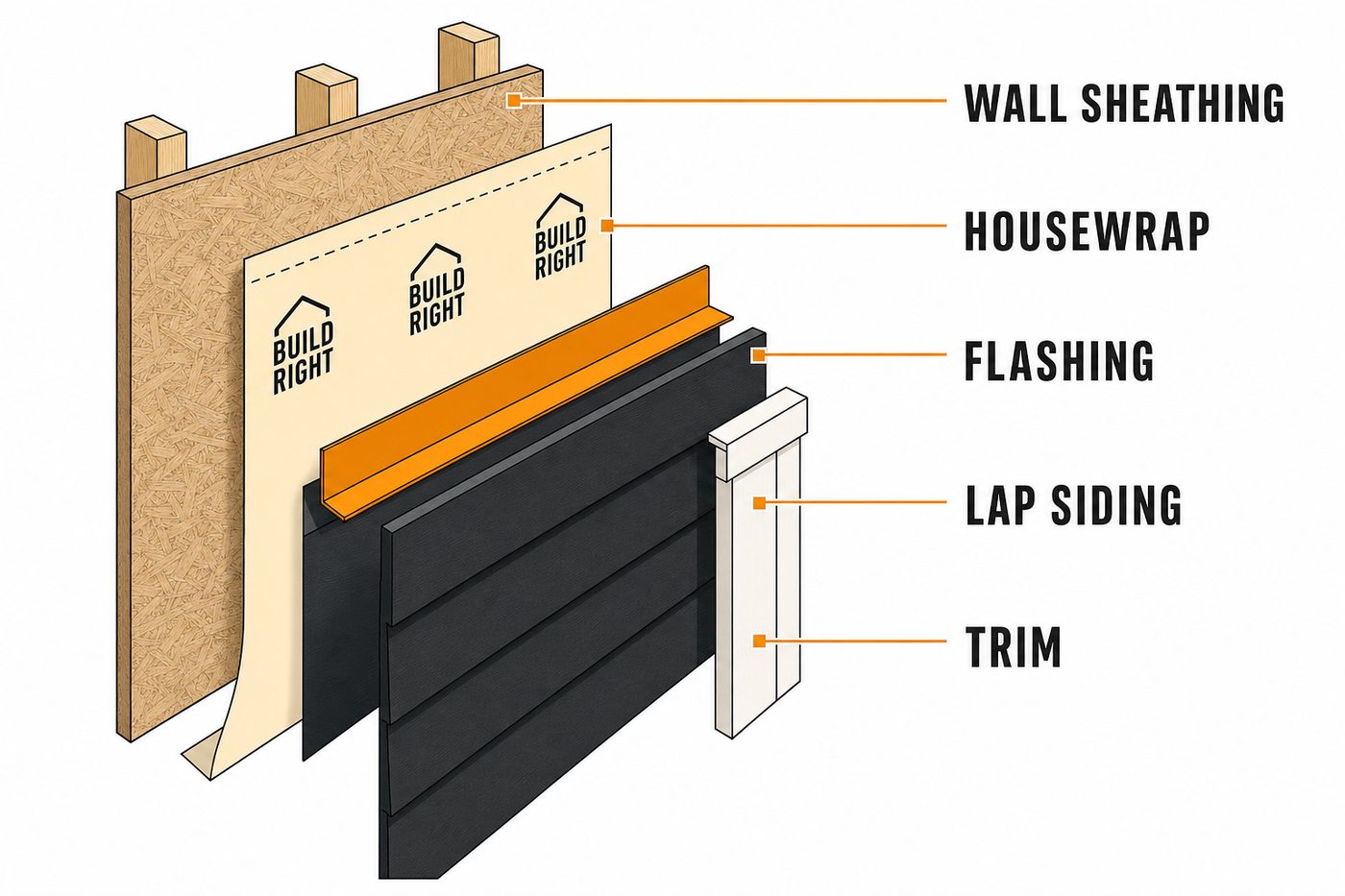
- Tear-off and correction. Old material off, sheathing repaired, wrap and flashing built for meltwater and snow contact. This stage is most of the job's real value.
- Installation and walkaround. Boards to manufacturer spec, penetrations sealed, site magnet-swept, and a wall-by-wall review with you at the end.
How Scheduling Works From Spokane
Our crews are based in Spokane, and we're straightforward about what that means: Colville projects are booked as committed multi-day blocks, with the crew dedicated to your house from tear-off through walkaround. Nobody is driving up for a half day and disappearing. Those blocks are planned ahead, and summer and early-fall dates get claimed first.
Asked Around Colville
Can siding go on in winter here?
Fiber cement and engineered wood install fine in cold. Caulks and touch-up coatings need temperature windows, so winter jobs get sequenced — boards now, finish details when the weather allows. Winter booking usually means shorter waits.
Do I need a permit to re-side my house?
Inside city limits, the City of Colville handles it; outside town, Stevens County does. Either way the filing is our job, not yours.
My hardboard keeps blistering. Repair or replace?
Spot repair on failing hardboard is throwing money at a material that's done. If it's isolated damage on otherwise sound board, repair works; widespread edge swelling means replacement is the honest answer.
Is vinyl a bad idea this far north?
Not automatically, but cold-weather brittleness and thermal movement are real. On budget-driven projects we'll spec it carefully; on walls with impact exposure we'll steer you elsewhere.
How much clearance should siding have from the ground?
Manufacturer minimums are the starting point, but in Colville we also plan for where shoveled snow sits against the house; that line governs the bottom-of-wall detailing.
Will you side a shop or detached garage?
Yes. Outbuildings quote well alongside the house because the crew and staging are already on site.
What turns up under old siding on these homes?
On the mill-era grid: board sheathing with no weather barrier and rot at bottom courses. On mid-century homes: moisture damage behind hardboard. Our specs carry contingency terms so findings become line items, not standoffs.
The Company Behind the Crew
Domex Construction holds Washington contractor license DAVYDCI833NC — verifiable through the state Department of Labor & Industries lookup — and is fully insured. We're a James Hardie Preferred Contractor with nine years in business and 32 years of combined field experience across the team. Hardie and LP carry their own product warranties; ask us at the estimate how our workmanship warranty backs up the installation itself.
From Colville we work north to Kettle Falls, south through Addy to Chewelah, out to Arden, and across rural Stevens County parcels in every direction.
Want a straight answer on your siding before the next hard winter? Free on-site estimates throughout Colville and Stevens County. Give us a call or request an estimate online.
More from Domex in Colville: Window Replacement in Colville · Custom Decks in Colville · Custom Home Builder in Colville · Siding Installation — Spokane hub