
Window Replacement in Colville, Washington
Window replacement in Colville, WA for long, cold winters. Efficient glass, tight installs, WA licensed. Free in-home estimates from Domex.
$1,000 Off
Your Complete Siding Replacement
Get a Free Estimate
FREE same-day estimates on all exterior projects.








Most of the older houses in Colville were framed when the town's economics ran on timber and its heating ran on cheap fuel. A mill-era home from the 1910s got single-pane glass in weighted sashes because glass was expensive and heat was not; the mid-century neighborhoods that followed got aluminum sliders and big picture windows for the same reason. That math has fully reversed. Glass is now the cheap part, and every winter you pay the old trade all over again through the furnace, the wood stove, or the propane tank.
Domex Construction replaces windows throughout Colville and Stevens County under Washington license DAVYDCI833NC. Our job on these houses isn't just swapping frames — it's closing a heating leak that was designed in a century ago.
The Furnace Pays for Old Glass
Colville's heating season runs noticeably longer and colder than Spokane's — the valley holds cold air, and the calendar for real heating stretches from October into April. Over that span, single-pane and early double-pane glass is the biggest thermal hole in most walls. A window transfers heat many times faster than the insulated framing around it, so on a house with fifteen or twenty aging openings, the windows can move more heat out of the building than entire walls do.
That's why window replacement pencils out better here than in milder towns: the same upgrade offsets more heating hours. That's also why orientation comes up at estimates. South-facing glass in Colville collects genuinely useful winter sun, and a glass package tuned to admit that gain performs differently than one tuned for a west wall that overheats in July. One spec for the whole house is simpler; the right spec per elevation is warmer and cheaper to live with.
Two Generations of Openings
The century homes on the old grid come with their own rules. Rough openings framed in full-dimension lumber, sash-weight pockets hiding uninsulated voids beside every window, and a hundred-plus years of settling that leaves few openings square. On these houses we usually recommend full-frame replacement over inserts: pulling the window back to the rough opening lets us insulate the weight pockets, correct the out-of-square framing, and flash the opening properly — none of which an insert can reach. An insert into a rotted or hollow old frame is a new window installed on top of the original problem.
The mid-century stock asks a different question. Aluminum-framed sliders from the '50s through the '70s are honest about their failure: the frame itself conducts cold straight through, which is why they sweat and frost over on January mornings. The frames around them, though, are often still sound, so inserts can be a legitimate option — the decision hinges on what we find when we pull trim and check the sill. Condensation staining on the drywall below a window is the tell that water has been getting past the assembly, and that pushes the answer toward full-frame.
Glass and Frames Specced for January
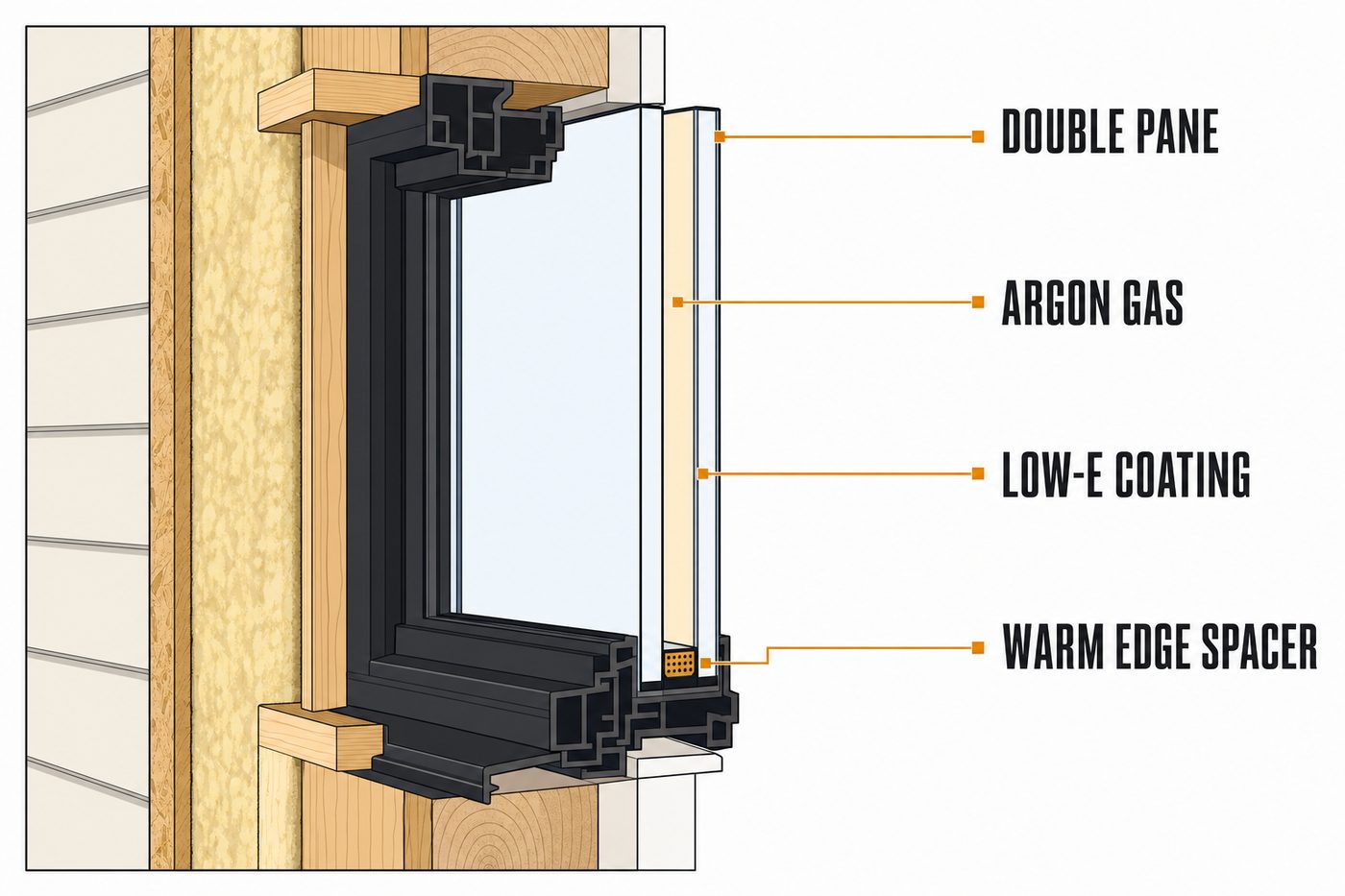
For this climate we quote low-E, argon-filled double glazing with warm-edge spacers as the working baseline, and we run the triple-pane conversation seriously rather than as an upsell. Triple glazing costs more and rarely justifies itself in a mild climate; in a Colville heating season it closes the comfort gap you can feel — warmer interior glass, less cold radiating off big openings, quieter rooms — and it earns its keep fastest on north walls and bedrooms. Warm interior glass also fights condensation directly, since moisture films on the coldest surface in the room.
On frames: vinyl remains the value play and modern multi-chamber vinyl performs well, but fiberglass frames move less across our big annual temperature swing, hold seals longer, and take dark colors without distortion. Wood-interior options exist for the historic homes where it matters. What we won't do is put a bargain frame into a wall that sees twenty-below nights and call it equivalent.
Farmhouse and Acreage Realities
Outside town the window conversation changes again. Farmhouses standing in open ground take wind-driven cold with no neighboring houses to break it, so air-sealing quality around the frame counts as much as the glass itself — a top-tier window installed with gaps behind the trim still whistles. Many rural homes heat with wood or propane, where the cost per lost BTU is easy to see on a bill or in a woodpile, and owners tend to feel the payback quickly. We also see a lot of additions out here with mismatched, builder-grade windows tacked into walls of different eras; bringing those openings up to one standard is often the highest-value part of the whole project.
From Measure to Final Bead
- In-home estimate. We measure every opening, check sills and trim for water history, and walk the orientation question with you. Free, and specific to your house rather than a catalog pitch.
- Spec and order. Windows are manufactured to your openings' measurements — insert or full-frame, glass package per elevation, written down before deposit.
- Permitting. City of Colville for in-town homes, Stevens County for rural parcels; we handle whichever applies, including egress sizing where bedroom windows are involved.
- Installation. Openings are opened, corrected, insulated, flashed, and sealed one at a time — your house is never left open to the weather overnight.
- Finish and review. Interior trim, exterior sealant, operation check on every unit, and a room-by-room review with you at the end.
What Sets the Quote
Window count and sizes carry the base number. Full-frame replacement costs more than inserts because it's more surgery — and on century homes it's usually the version worth paying for. Glass package and frame material move the price in step with performance. The wildcard on older Colville homes is rot repair around openings, which is why we check sills at the estimate instead of discovering them on install day, and why repair terms go into the written spec. Custom sizing for out-of-square openings adds cost on the front end and prevents shim-and-caulk improvisation on the back end.
Lead Times and the Drive North
Two clocks run on a window project: manufacturing and scheduling. Windows are built to order, which typically means weeks between deposit and delivery. On the scheduling side, we're direct about geography — the crew comes up from Spokane, so we schedule Colville installs as dedicated multi-day crew blocks instead of scattered single days. Once your windows arrive and your block starts, the crew stays on your project until every opening is closed, sealed, and trimmed.
What Colville Homeowners Ask First
Insert or full-frame for my 1915 house?
Almost always full-frame. It's the only way to insulate the sash-weight voids, square the openings, and flash properly. Inserts on century homes preserve problems.
Is triple-pane worth it here?
More often than in Spokane. The longer, colder heating season and the comfort difference on north-facing rooms make it a rational spec, not a luxury one. We price both so you can see the gap.
Why do my aluminum windows frost over inside?
The frame conducts cold straight through the assembly, so interior moisture condenses and freezes on it. That's a design limit of the era, not a maintenance problem — replacement is the fix.
Can windows be replaced in winter?
Yes. We work one opening at a time, so the house is exposed for minutes per window, not hours. Winter slots are often easier to book.
Do I need a permit?
In-town replacements go through the City of Colville and rural ones through Stevens County; requirements differ; we manage the filing either way. Bedroom windows also have to meet egress sizing, which we factor into the order.
Can I replace windows in phases?
Yes, and many owners do — worst elevation first, usually north or windward. We'll help sequence it so each phase stands on its own.
Will new windows stop the condensation on my glass?
Warmer interior glass surfaces dramatically reduce it. If a house has an underlying humidity source, we'll say so, because no window cures that alone.
Licensing and the People Doing the Work
Domex Construction is licensed in Washington (DAVYDCI833NC — look us up through the state L&I contractor registry) and fully insured. The company is nine years old; the team behind it carries 32 years of combined trade experience. Window work often pairs with our siding projects, since flashing integrates best when both happen together — bring it up at the estimate, along with any questions about our workmanship warranty.
We replace windows across Colville, Kettle Falls, Chewelah, Addy, Arden, and the rural reaches of Stevens County.
Tired of paying the old glass tax every winter? Free in-home estimates across Colville and Stevens County. Give us a call or request an estimate online.
More from Domex in Colville: Siding Installation in Colville · Custom Decks in Colville · Custom Home Builder in Colville · Window Replacement — Spokane hub