
Siding Installation & Replacement in Hayden, Idaho
Hayden ID siding installation by a James Hardie Preferred contractor. Replace failing 90s hardboard and vinyl the right way. Free estimates.
$1,000 Off
Your Complete Siding Replacement
Get a Free Estimate
FREE same-day estimates on all exterior projects.








Remodeling in Hayden moves in waves, and the biggest one is breaking right now. The subdivisions that carried the town's growth through the 1990s and early 2000s were sided in bulk — hardboard on the earlier streets, first-generation vinyl on the later ones — and because whole neighborhoods went up in the same two or three build seasons, whole neighborhoods are reaching re-side age in the same two or three years. Our Hayden estimate requests arrive in clusters: one homeowner calls in June, and by October we've walked four more houses on the same loop.
Domex Construction has spent nine years working this exact cycle across Kootenai County. We're a James Hardie Preferred Contractor, we install LP SmartSide and vinyl as well, and Hayden sits directly on our daily routes north out of Coeur d'Alene. Idaho license RCE-66940, fully insured, and the estimate costs you nothing but a walk around your own house.
Where the Original Siding Is Losing
The hardboard era fails from the bottom up. Water finds the lowest edge of each course and every butt joint, the compressed fiber swells, and the paint film cracks and sheds because the material underneath won't stop moving. Freeze-thaw compounds it — Hayden cycles through freezing dozens of times each October-to-April stretch, and every cycle levers swollen joints a little further apart. By year twenty-five you can read the damage from the sidewalk: wavy bottom edges, raised nail heads, paint that quits within a couple of years of every repaint.
First-generation vinyl fails differently. Three decades of UV leaves it brittle, so panels that once flexed now crack at any contact — a basketball, a string trimmer, a ladder rail. South and west walls fade unevenly, and on the open side of town, where gusts come off the Rathdrum Prairie with nothing to slow them, fatigued panel locks let go and courses end up in the yard after a windstorm.
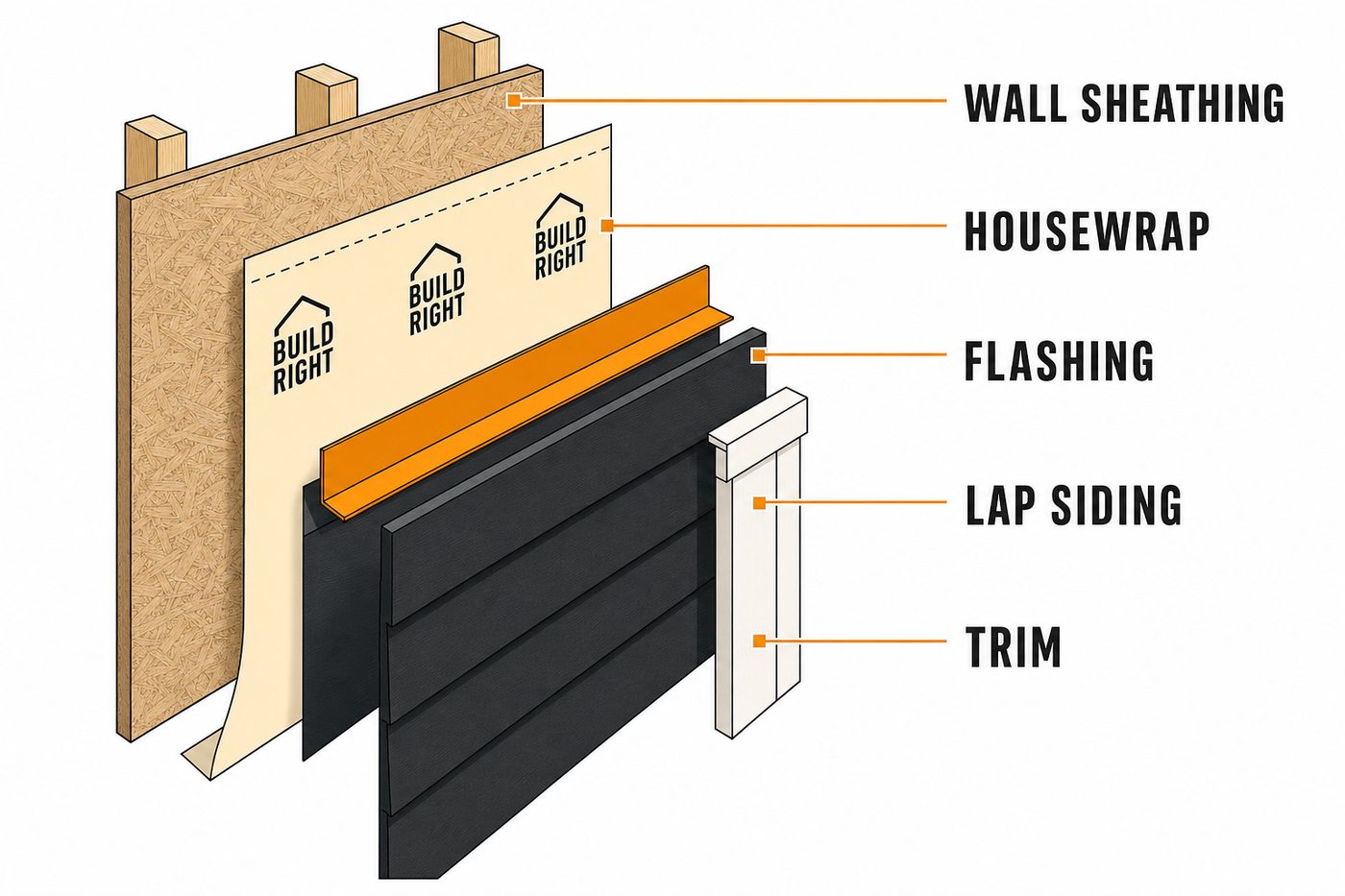
Under both materials we find the same builder-era shortcuts: joints that depended on caulk instead of flashing, house wrap that stops short of openings, an occasional wall with no wrap at all. A fair amount of what looks like material failure on these houses is really installation failure, which is worth keeping in mind while you choose the replacement.
Reading Your Lot Before Picking a Material
Hayden has two exposures, and the right product depends on which one your walls face.
East of town, toward Hayden Lake, the tree cover thickens as the ground rises. Shaded north and east walls there stay damp long after open lots have dried out, mildew lines creep along bottom courses, and woodpeckers work the wooded properties every spring. Fiber cement is the strong answer on those walls: Hardie doesn't absorb meltwater, holds no interest for woodpeckers, and its ColorPlus factory finish tolerates damp shade that punishes site-painted product. LP SmartSide performs there too, but only with every field-cut edge sealed — an installation discipline, and the first thing we inspect on any failing LP wall.
West of Government Way the town opens toward the prairie, and the enemies flip from moisture to sun and wind. Unshaded walls bake through 90-degree summer afternoons, so color retention and thermal stability lead the spec. Hardie holds its finish under that UV load; LP's longer board lengths mean fewer butt joints across big, simple subdivision walls, and engineered wood shrugs off hail and wind-blown debris that cracks brittle panels. Vinyl stays the budget path on these homes, and we install it — in a heavier gauge, fastened correctly, because thin vinyl on a windy west exposure is how the original ended up on the lawn.
Most Hayden houses mix both exposures, so the walkthrough decides more than the brochure does. We look at which walls are doing the hard living and let those walls drive the material call.
What the Project Feels Like From Inside the House
Hayden is an owner-occupied town, and most of our customers are home while we work — kids, dogs, home offices. A re-side is loud but short. Expect tear-off vibration strong enough to rattle pictures hung on exterior walls (take them down first), a dumpster staged in the driveway, and crews keeping consistent daytime hours we agree on before day one. Every evening ends with a site pick-up and a magnet sweep for fasteners, because a yard where kids run barefoot is no place to leave nails. Doors stay usable, utilities stay on, and nobody has to be home for the exterior work itself.
What Moves the Estimate
We quote a fixed price after walking the house, and a handful of levers set the number. Wall area and story count form the base. Material tier moves it next — vinyl, then LP, then Hardie, with factory-finish options adding cost that repaint-free decades tend to pay back. Opening count matters because every window and door means flashing and trim labor, and the steep gables on some 2000s-era plans add staging time. The genuine wildcard is what tear-off reveals: hardboard houses hide sheathing damage at bottom courses and under windows, so our specs put rot-repair contingency terms in writing before work starts. One advantage of this market — flat subdivision lots with easy access keep the surprises on the wall, not in the logistics.
How Long It Takes
A typical 1990s two-story with straightforward lines runs about a week of on-site work; larger custom homes toward the lake, with more corners and taller walls, stretch to two or beyond. The wait before the job is what homeowners underestimate: summer and early-fall slots book first, so getting measured in spring means choosing your dates instead of taking what's left. Cold-season installs are routine here — fiber cement and engineered wood hang fine in freezing weather, and we hold caulking and touch-up paint for above-freezing stretches. Re-side permits run through the City of Hayden; we file, schedule the inspections, and keep the paperwork off your desk.
The Steps We Follow
- Walkthrough estimate. We circle the house, probe suspect hardboard, note what sun and wind have done to each exposure, and give you a recommendation with a fixed price.
- Written specification. Everything in writing before you sign — exact product line and color, how trim and openings get detailed, and what happens if we uncover rot.
- Permit filing. Submitted to the City of Hayden, inspections built into the schedule.
- Strip and repair. The old cladding comes down, damaged sheathing gets replaced, and wrap plus flashing go on right — the stage that decides how long the new siding lasts.
- Installation and walkaround. Boards fastened to manufacturer spec, penetrations sealed, site swept, and a final lap around the house with you.
Hayden Siding FAQs
My neighbor has the same floor plan — will my price match theirs?
Close, but rarely identical. Same plan, different exposure: their west wall may be sound while yours took the wind, or your shaded side hid rot theirs didn't have. The walkthrough is what makes the number real.
Is upgrading from vinyl to Hardie worth it on a 90s house?
Usually, yes. You're paying for tear-off and labor either way; the material step up buys fire resistance, color stability, a much longer service life, and — on a street where re-sides are spreading — resale standing. We price both so the gap is a fact, not a guess.
Do I need a permit to re-side in Hayden?
Yes — re-sides in city limits go through the City of Hayden. We file the application and manage every inspection; you never touch the paperwork.
Can siding go on in winter?
Yes. Boards install fine in the cold; sealants and touch-up paint get slotted into warm spells. Winter booking usually means shorter lead times, too.
Woodpeckers keep hitting my house near the lake. Will new siding stop them?
Fiber cement will — they leave it alone. If woodpecker holes are part of why you're re-siding, that alone can settle the material question.
Should I just repaint my hardboard instead?
If the boards are still flat and dry, paint buys time. Once edges swell, paint fails from underneath no matter how good the prep — from that point on, repainting is paying twice.
Can you install over the existing siding?
We advise against it. Layering hides exactly the sheathing problems this housing stock is known for and shallows out the flashing at every opening.
Licensing and Where We Work
Domex Construction holds Idaho contractor registration RCE-66940 — verify it with the Idaho Contractors Board before hiring us or anyone else — and carries full insurance, with a workmanship warranty you should ask about at the estimate. From Hayden our siding crews cover Coeur d'Alene, Dalton Gardens, the Hayden Lake shoreline, Rathdrum, and Post Falls.
Ready to find out what your walls actually need? Free on-site estimates across Hayden. Give us a call or request an estimate online.
More from Domex in Hayden: Window Replacement in Hayden · Custom Decks in Hayden · Custom Home Builder in Hayden · Siding Installation — Spokane hub