
Siding Installation & Replacement in Mead, Washington
Siding replacement in Mead, WA for cedar and hardboard-era custom homes. Hardie Preferred Contractor, Spokane County permits handled. Free estimates.
$1,000 Off
Your Complete Siding Replacement
Get a Free Estimate
FREE same-day estimates on all exterior projects.








The climb from Spokane up to Mead is only a few hundred feet, but siding feels every one of them. Winters run noticeably colder against the Mt. Spokane foothills, snow lands earlier and hangs on later, and the freeze-thaw swings of late winter cycle harder up here than downtown. A wall that would coast along on a city lot works overtime in Mead, and after thirty such winters the difference shows from the driveway — failing paint, open joints, soft bottom edges.
Domex Construction replaces siding across Mead and the surrounding orchard country — Green Bluff, Colbert, Chattaroy, and the north edge of Spokane — as a James Hardie Preferred Contractor licensed in Washington (DAVYDCI833NC). Most of our Mead calls come from the custom and semi-custom homes built between the 1980s and early 2000s, and most start the same way: the original cladding has run out of road.
Cedar and Hardboard Are Timing Out Together
The homes from Mead's main building decades wear one of two skins. The higher-spec custom builds got cedar — good material, honestly installed, but now three or four decades and half a dozen repaint cycles in. Cedar at that age cups, checks along the grain, splits at fasteners, and opens at butt joints, and each open joint is a path for meltwater to reach the sheathing. Repainting stops helping once the wood itself starts moving.
The semi-custom homes more often got hardboard, a compressed wood-fiber product that depends entirely on its paint film. When the film fails, the board drinks. Bottom edges wick snowmelt, swell, and stay swollen — you can spot failing hardboard by the wavy shadow line along the lowest course. No coating rescues a swollen board; that's a replacement conversation, not a maintenance one.
Both materials are hitting end-of-life at once, which is why Mead re-side calls come in clusters — if a neighbor just tore theirs off, yours are probably the same age.
One House, Two Climates
Stand in a typical Mead yard and the problem is visible from the lawn. The north face sits under ponderosa shade, where siding stays damp for days after a storm and snow leans against the bottom courses well into spring. Those walls fail wet: peeling paint, an algae film, soft spots behind trim, rot at the water table. The south face gets the opposite treatment — open exposure, hard UV bouncing off snow all winter, dry 90-degree heat all summer. Those walls fail dry: chalking finishes, checking cedar, caulk joints torn apart by expansion and contraction.
An estimate that treats the two faces the same misses the job, so we probe bottom courses and flashing on the wet side and read joint movement and finish condition on the sun side — the corrections differ wall by wall.
Materials for Owners Who Aren't Going Anywhere
Mead is a hold-forever market. People buy up here to stay, and that changes the material math — a product that costs more up front and skips two repaint cycles wins over a thirty-year horizon.
James Hardie fiber cement is our usual recommendation on these homes. It doesn't absorb meltwater, doesn't move through freeze-thaw, and the ColorPlus factory finish stands up to the UV load on open south walls. On damp, pine-shaded north faces that ruin wood-based products, it's the most forgiving thing you can hang.
LP SmartSide earns its place on Mead's custom homes for a different reason: appearance. Its embossed grain reads closer to original cedar than anything else in its class, which matters on a house with deep eaves, built-up corner boards, and trim proportions worth preserving. It also ships in long lengths, so big gable walls carry fewer seams. Its cut edges need proper field sealing in a climate like this — an installation-discipline item, and we treat it as one.
Vinyl is the budget path and we install it where it fits, but on a detailed custom home it rarely sits well against the existing trim, and wide temperature swings work its joints hard. We'll say plainly which of the three your house argues for.
Mead Permits Run Through Spokane County
Mead is unincorporated — there's no city permit counter — so building permits and inspections for siding work go through Spokane County. Scope determines what a re-side triggers — sheathing repair and window swaps change the picture. We file, fold the county's inspection points into the schedule, and keep the paperwork off your desk.
What Moves the Number
We quote a fixed price after walking the house, not a per-square guess, and a few things reliably move it. Wall height and complexity come first — two-story gables and vaulted great-room walls need staging a rambler doesn't. Tear-off condition is second: rot at bottom courses, under window heads, and behind trim adds repair labor, so our specs state contingency terms in writing before demolition starts. Trim package is third, because Mead's custom homes carry more corner, fascia, and band detail than tract housing, and every foot of it gets measured, cut, and flashed. Material tier and factory finish round it out. Tall gable ends on sloped ground can add staging time; we flag that at the estimate, not mid-job.
The Job, Start to Finish
- Walkthrough and probing. We check shaded bottom courses, hardboard edges, and flashing points, then talk through what we'd install and why. Free.
- Written spec. Products, colors, trim, flashing approach, and what happens if rot turns up — in writing before you sign.
- Spokane County permit. Filed by us, with inspections built into the schedule.
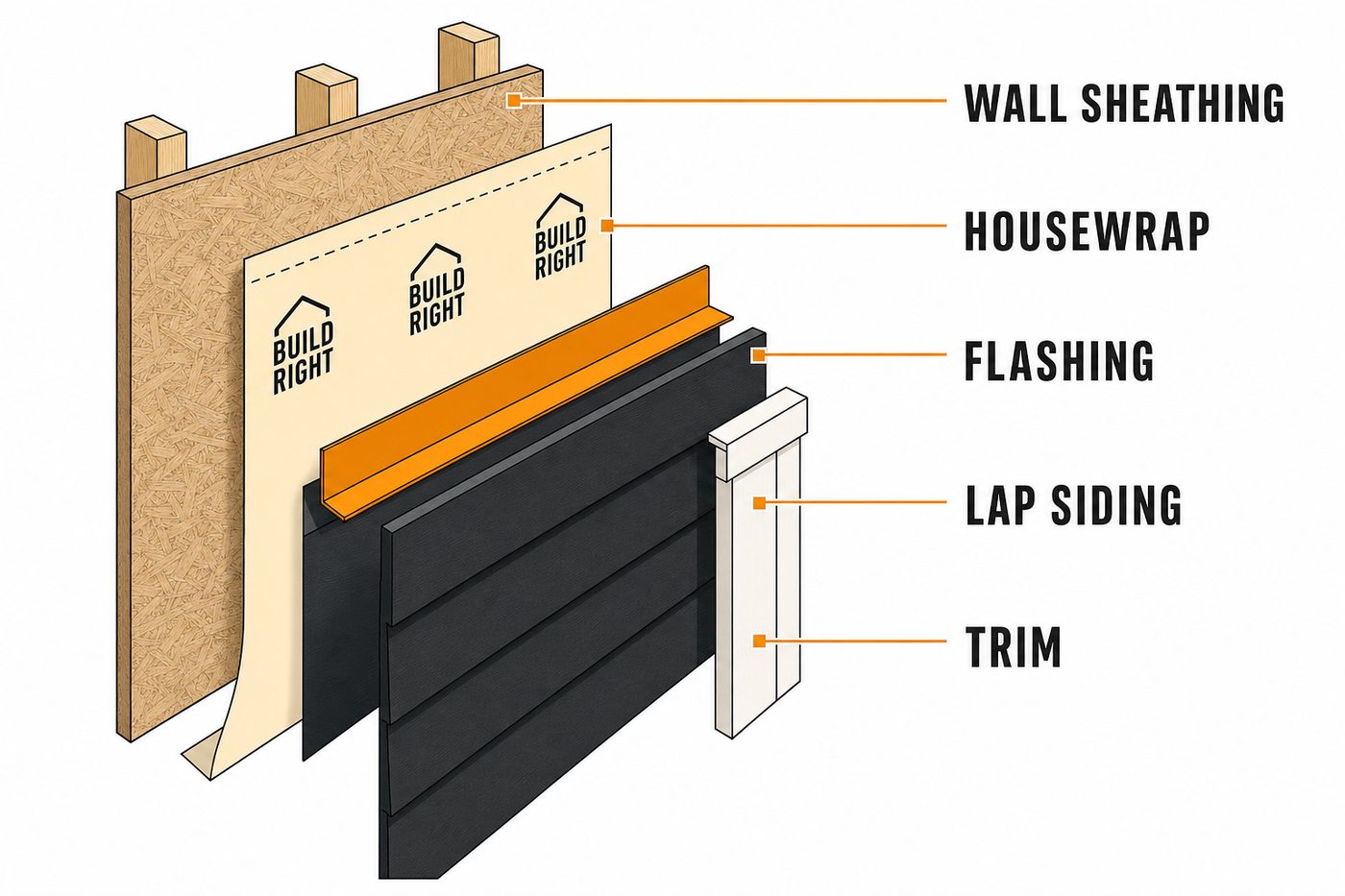
- Tear-off and correction. Old cladding off, sheathing repaired, weather barrier and flashing detailed for snowmelt and pine-shade moisture.
- Installation and walkaround. Boards to manufacturer spec, every penetration sealed, the yard cleaned, and a slow lap of the house with you.
When to Book It
Mead's colder pocket shortens the season for caulking and coatings, so the comfortable install window runs tighter than in town — spring estimates get first pick of summer and fall slots. Cold-weather installs happen too — fiber cement hangs fine in winter. Expect a handful of working days for a smaller one-story home, two to three weeks for a large custom; it's tear-off findings, not install speed, that stretch a schedule.
Answers for Mead Homeowners
My cedar looks rough — repaint or replace?
Press a screwdriver into the bottom courses and check fastener lines for splits. If the wood is sound and joints tight, paint buys time. If boards are cupping, splitting at nails, or soft anywhere, paint is money spent delaying the same decision.
How do I know my hardboard is done?
Sight down the lowest course. Swollen, wavy bottom edges and mushrooming around nail heads mean the board has taken on water. Once it swells, it doesn't recover.
Who issues the permit if Mead isn't a city?
Spokane County. All of Mead is unincorporated, so the county building department handles permits and inspections — we file and manage that as part of the job.
Can new siding match the original cedar look?
LP SmartSide gets closest, with deep grain and long board lengths, and we rebuild trim proportions to match what the house had. Hardie's textured lines suit these homes well too.
Should the shaded north wall get different treatment?
Same product, more careful detailing — generous ground and roofline clearances, tightened flashing, correct gaps where snow sits.
Is winter installation realistic up here?
Yes. Boards go up fine in the cold; sealants and finish coatings need warmer days, so we stage the job around them. Lead times are usually shorter too.
Do you find much rot on Mead homes?
On pine-shaded walls and behind failed hardboard, some is typical — usually at bottom courses and below windows. Contingency terms go in the spec up front so none of it arrives as a surprise.
Is it worth replacing windows during the re-side?
If yours are within a few years of needing it, yes — flashing and trim integrate better and cheaper in one pass, and we run both trades with one crew.
The Company on the Other End of the Estimate
Domex Construction has been at this nine years, with 32 years of combined field experience on the crew, and holds James Hardie Preferred Contractor status, earned through installation standards. We're licensed in Washington (DAVYDCI833NC, verifiable through the L&I contractor lookup) and Idaho (RCE-66940), fully insured, and we back installations with a workmanship warranty — ask for specifics at your estimate.
From Mead we cover Colbert, Chattaroy, Green Bluff, north Spokane, and the parcels up toward the Mt. Spokane foothills.
Done repainting a losing battle? Free on-site estimates across Mead and the north county. Give us a call or request an estimate online.
More from Domex in Mead: Window Replacement in Mead · Custom Decks in Mead · Custom Home Builder in Mead · Siding Installation — Spokane hub