
Custom Deck Builders in Mead, Washington
Custom deck builders in Mead, WA. Sloped-lot footings, foothill snow-load framing, composite or cedar. Spokane County permits handled. Free estimates.
$1,000 Off
Your Complete Siding Replacement
Get a Free Estimate
FREE same-day estimates on all exterior projects.








On a flat lot, you decide where the deck goes. On most Mead lots, the ground decides first. The acreage north of Spokane rolls toward drainages or climbs toward the Mt. Spokane foothills, the best sightline usually runs off the downhill side of the house, and the flattest spot in the yard is rarely the one worth standing on. Deck design here starts with a walk of the grade — where the slope breaks, where soil changes, where roof snow lands — and the layout follows.
Domex Construction builds custom decks in Mead and its north-county neighbors — Colbert, Chattaroy, Green Bluff, north Spokane — under Washington license DAVYDCI833NC, fully insured, with free on-site estimates. Because Mead is unincorporated, every permitted deck goes through Spokane County; we handle that from filing through final inspection.
Downhill Decks Are Foundation Projects First
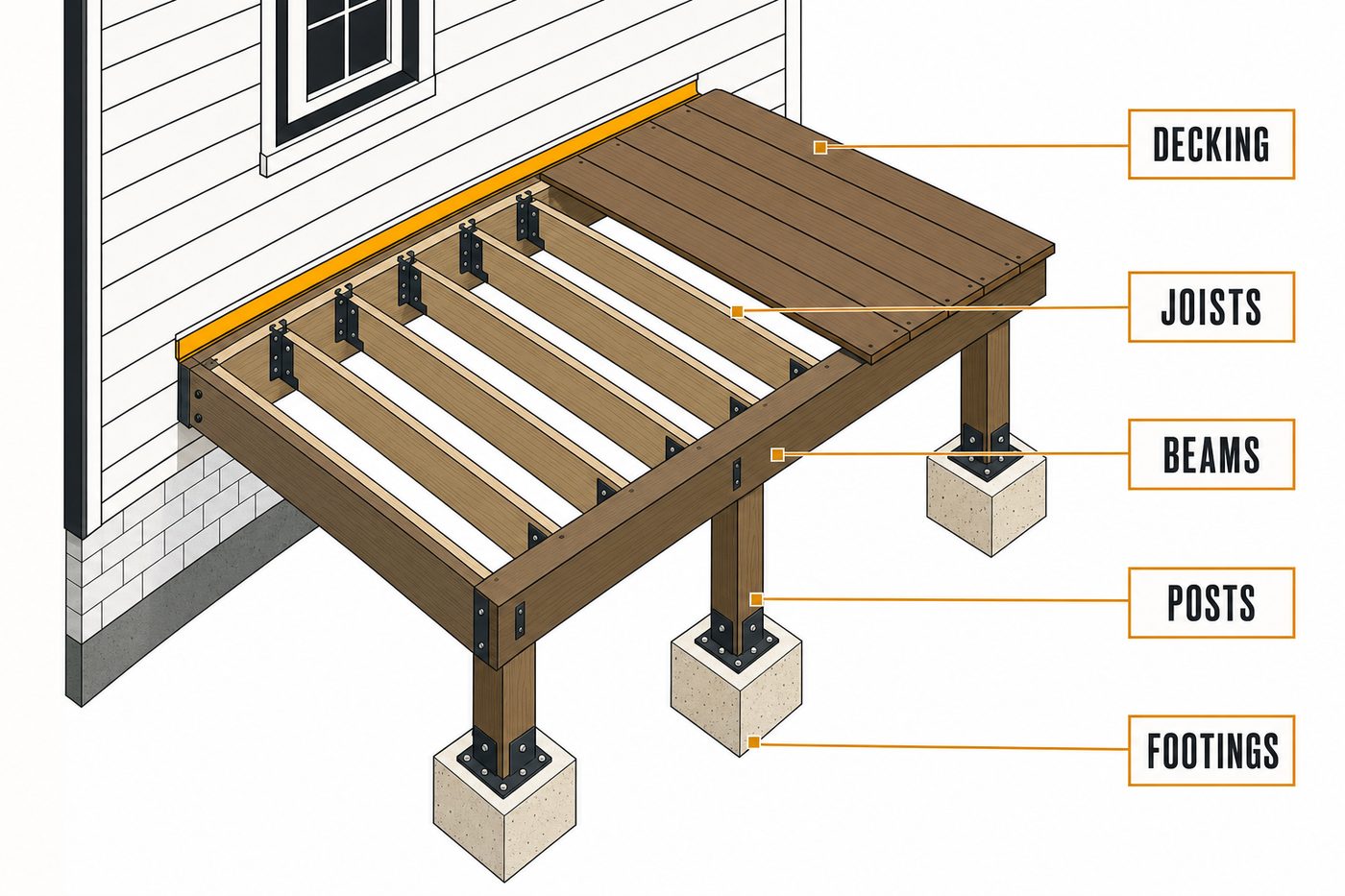
The view deck most Mead owners want — pushed off the back of the house, floating over the falling grade — is really a small foundation project wearing deck boards. The downhill posts can run eight, ten, twelve feet, and each one concentrates a serious load onto a single pad, so footings get sized to load and soil, not poured at a one-size guess. On broken grades we step the footing line down the slope in benches instead of chasing one depth across it, and tall structures get diagonal bracing so the frame resists sway instead of slowly loosening itself.
Depth matters as much as size. Footings must bear below frost depth per Spokane County code, and up here frost drives deeper than a fair-weather builder expects — a shallow pad heaves a little every winter until the frame on it is out of level and out of square. The leaning older decks around the north county almost all trace back to that shortcut. Get the holes right and everything above them stays boring for decades.
Framed for Foothill Snow, Not City Snow
Design snow load isn't one number across the county — it climbs with elevation, and a parcel toward the Mt. Spokane side of Mead carries a meaningfully higher requirement than a lot in central Spokane. We size beams, joists, and spans to the load your site actually carries, because a deck up here spends months holding compacted snow that nobody clears.
Two site details feed the framing plan. First, roof-shed zones: a metal or steep roof dumps its snow in a concentrated line, and if that line lands on the deck, the framing under it gets designed for the impact and the pile — or the deck gets shifted out of the drop path entirely. Second, the ledger, the bolted connection between deck and house. It gets through-fastened to structure and flashed so meltwater sheds away from your wall, because an unflashed ledger feeds every spring thaw directly into the rim joist. On tear-offs of 90s-era decks, that's the rot we find most.
Decking That Can Handle Shade and Needles
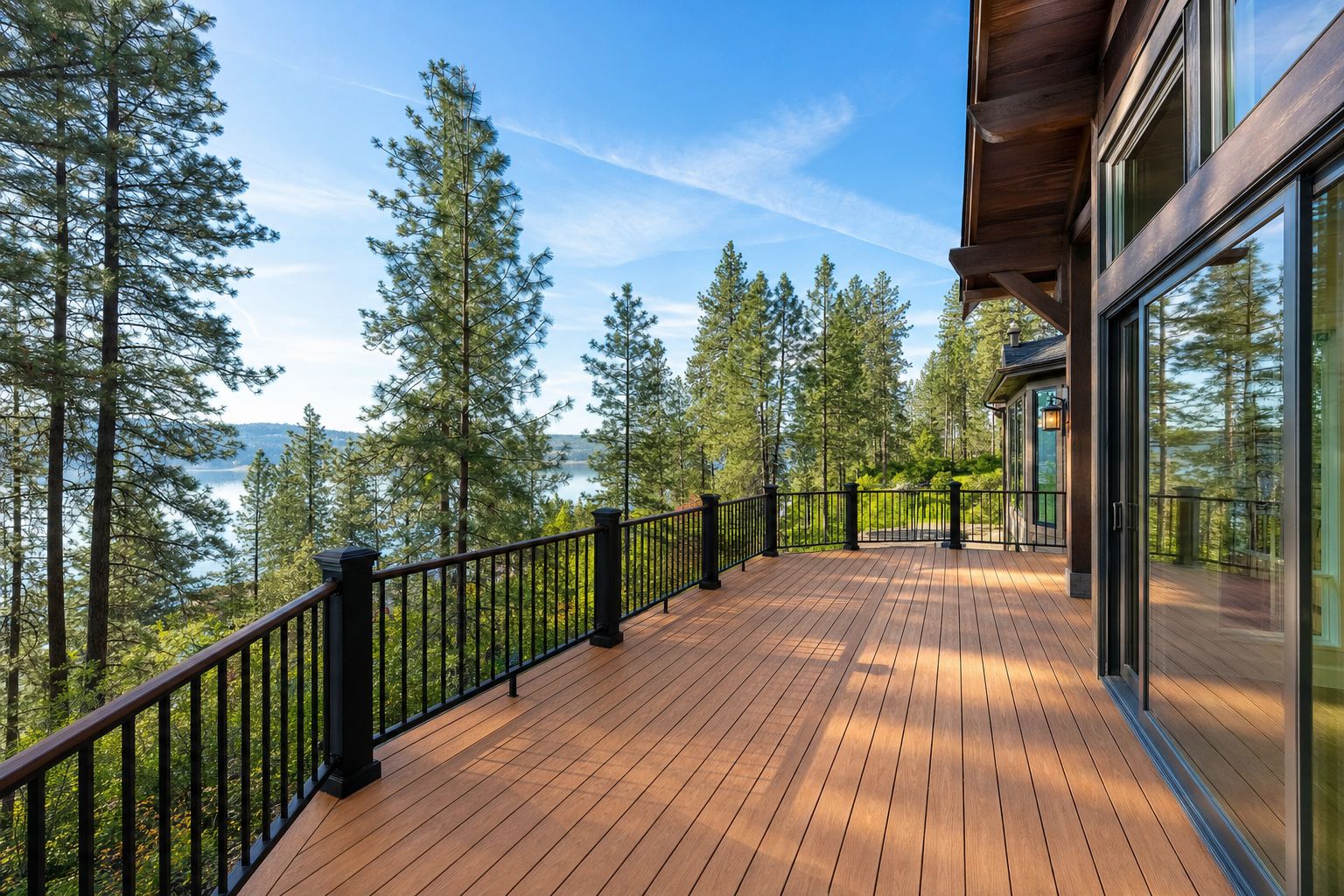
Ponderosa cover is part of why people love these lots and part of what their decks live with: needle litter working into every gap by October, and shade that keeps boards damp long after a storm.
Cedar under those conditions is a commitment, not a mistake. It looks and feels right on a custom home, but shaded boards hold moisture, finishes break down fast, and the wash-and-recoat cycle comes around every year or two if you want wood tone instead of gray. Owners who enjoy that upkeep get a deck they love; owners who won't get a gray, checking surface by year five.
Composite is the fit for most shaded Mead lots. It doesn't rot, needles sweep off instead of staining into a failing finish, and maintenance is essentially a spring wash. It isn't magic — unwashed shade will grow a mildew film on any surface, and composite costs more up front — but it deletes the refinishing calendar entirely. Under either surface, we detail the structure for debris: board gaps that let litter fall through, open fascia details that don't trap it, and stair treads that shed instead of pack.
Elevation, Access, and What They Do to Cost
Deck pricing in Mead is mostly a function of geometry. Every foot of height adds post length, bracing, railing, and stair structure, and stairs on a slope are small projects of their own — landings, more footings, sometimes a switchback. Footing count and depth follow the framing plan and the grade. Railing selection swings budgets more than people expect: a cable or slim metal rail that keeps the view open costs real money next to wood balusters. Materials move the number in the obvious direction, composite over cedar. And access is a genuine line item on acreage — if the mixer truck can't reach the footing line down a slope, concrete travels by pump or wheelbarrow, and that's labor. Our number is fixed after the site walk, not shouted from the driveway.
Five Stages, Two County Inspections
- Site walk. Grade, soil, sun and shade, roof-shed lines, and how you actually plan to use the space. Costs you nothing either way.
- Design and spec. Framing and footing plan, decking and railing selections, connection details — in writing, with engineering brought in where the structure or the county calls for it.
- Spokane County permit. We file it; the county inspects footings before pour and framing before boards go down, and we schedule both.
- Structure. Footings poured below frost depth, posts and beams set, bracing and ledger done to the drawings.
- Surfaces and walkthrough. Decking, railings, stairs, cleanup, and a final walk with you across every connection and board line.
Timing the Build
The calendar's fixed point is the ground: footings dig and pour until hard freeze, which arrives earlier in Mead than in the city. Get holes in before winter locks up and framing and decking continue happily through cold weather; miss that window and the start moves to thaw. Spring fills the schedule first — everyone wants the deck by July — so fall and winter callers get the best slots. Build time runs about a week for a simple single-level platform to several weeks for a tall, multi-level, or stair-heavy structure, plus county inspection scheduling at the two hold points.
Deck FAQs for the North County
Do I need a permit for a deck in Mead?
Almost always, and it comes from Spokane County — Mead has no city government. We handle filing and both inspections as part of every build.
My backyard drops off hard. Can I still get a deck?
Yes — that drop is where the best view decks come from. It becomes a structural project: engineered footings, tall braced posts, stepped foundation lines. Slope adds cost, not impossibility.
Is composite worth it under pine trees?
For most owners, yes. Shade and needle litter are exactly the conditions that eat wood finishes, and composite takes the recoat cycle off your list. Cedar remains a fine choice if you'll maintain it.
Does the deck need to hold snow all winter?
It's designed to. We frame to the site's assigned snow load — higher near the foothills than in the city — so the structure carries an uncleared winter without help. If you clear a daily path, use a plastic shovel.
Can you salvage my existing deck's frame or footings?
We'll look, but usually no. Most 80s–2000s footings up here are shallow, undersized for modern spans, or placed for a worse layout. New structure on old shortcomings inherits the shortcomings.
How late in the year can you start?
If footings go in before hard freeze, we build through winter. After freeze-up, we design and permit through the cold months so your build starts the day the ground allows.
Attached to the house or freestanding?
Either can be right. Attached needs a properly bolted and flashed ledger — the detail most often botched on the decks we replace. Freestanding avoids the wall connection and sometimes wins on complicated houses.
Who's Building It
Domex Construction is an exterior remodeling contractor — decks, siding, windows — nine years in business with 32 years of combined crew experience, licensed in Washington (DAVYDCI833NC, verifiable through L&I) and Idaho (RCE-66940), and fully insured. Ask us about the workmanship warranty while we're on site. Because we also work on walls, the house side of your deck — ledger flashing, siding cuts, trim — gets treated as envelope work, not an afterthought.
From Mead we build in Chattaroy, Colbert, Green Bluff, north Spokane, and up the foothill roads beyond.
Want the level ground your lot never gave you? Free on-site deck estimates anywhere in the Mead area. Give us a call or request an estimate online.
More from Domex in Mead: Siding Installation in Mead · Window Replacement in Mead · Custom Home Builder in Mead · Custom Decks — Spokane hub