
Window Replacement in Mead, Washington
Window replacement in Mead, WA: view glass upgrades, rotted 80s wood frames, condensation fixes. Spokane County permits handled. Free estimates.
$1,000 Off
Your Complete Siding Replacement
Get a Free Estimate
FREE same-day estimates on all exterior projects.








Ask a Mead homeowner what bothers them about the house and the answer usually starts in front of the great-room glass. Builders here in the 80s and 90s framed generous openings — picture units and mulled assemblies aimed at the foothills or out over the orchard flats toward Green Bluff — and glazed them with the best glass 1988 could offer. Which is to say: aluminum-spacer double panes, sometimes single panes with storms, running U-factors two or three times worse than anything sold today. Beautiful openings. Terrible physics.
That mismatch drives most of our Mead window work. Domex Construction replaces everything from a single fogged unit to a whole-house package across Mead, Colbert, Chattaroy, Green Bluff, and north Spokane — Washington license DAVYDCI833NC, fully insured. The goal on big glass: keep the opening the architect drew, fix everything inside it.
The Opening Stays. The Glass Grows Up.
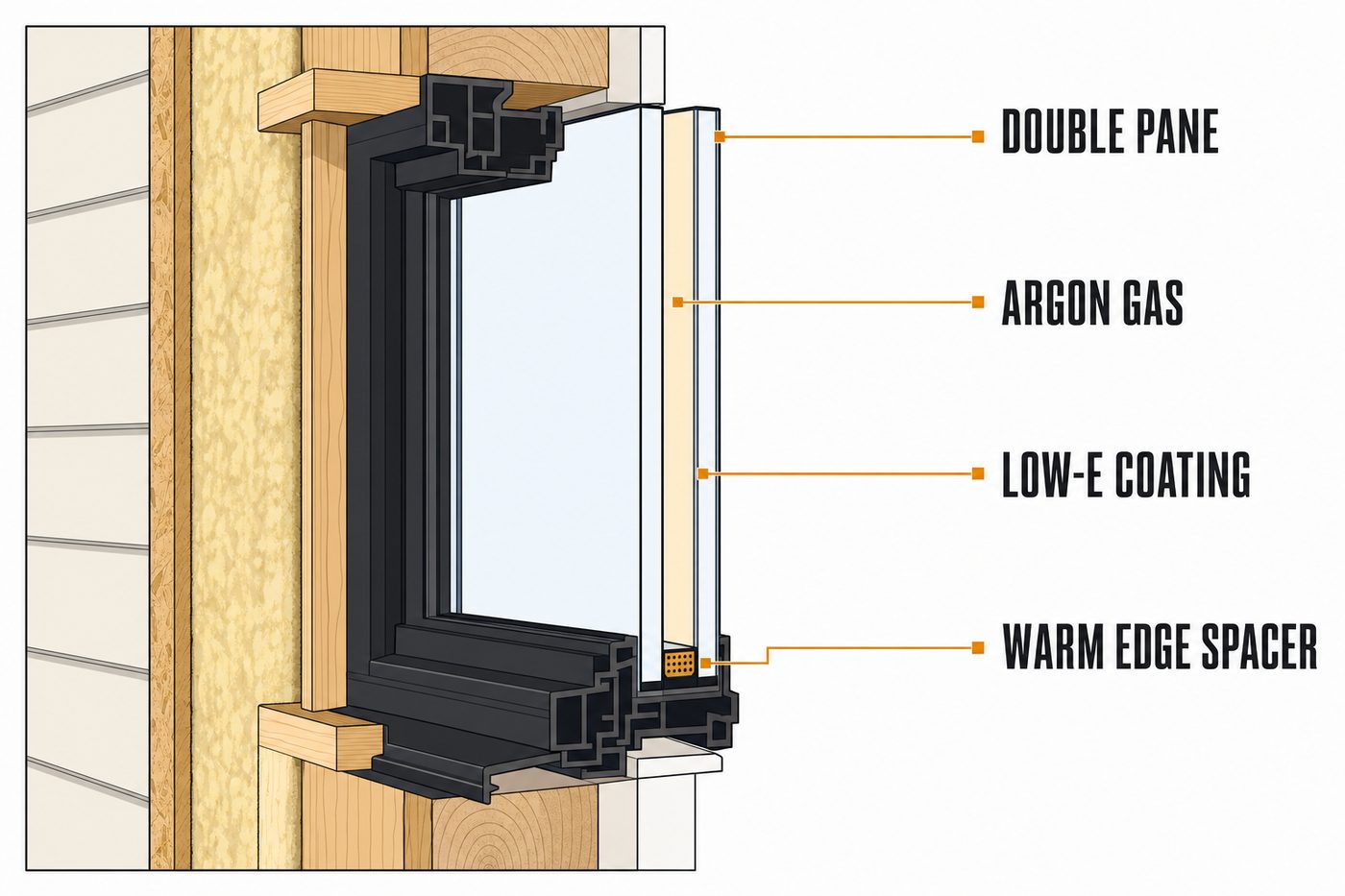
Nobody in Mead wants smaller windows — the view is why the lot cost what it did. So view-glass replacement is about the package, not the size. A modern unit in that same rough opening carries low-E coatings tuned to its orientation, argon fill between panes, and a warm-edge spacer instead of the aluminum channel that turned the perimeter of your old glass into a cold bridge. South- and west-facing view walls get a coating biased toward solar control, so the room stops cooking on 95-degree afternoons. North-facing glass gets the lowest U-factor we can spec, because in Mead's climate that wall faces the coldest air the property will see.
Big units also change the mechanics of install day. A ten-foot mulled assembly is heavy, and it has to be carried, set, and shimmed without racking the frame — a racked frame binds sashes and stresses glass seals from day one. We staff and stage large-unit jobs accordingly.
Where the Wood Gave Up
The other side of Mead's 80s and 90s stock is wood windows, and forty winters have found their weak points in a consistent order: the sill first, then the bottom rail of the sash, then the joinery at the lower corners. Snow sits on a sill in a way rain never does — hours become weeks — and once the paint film cracks, meltwater reaches end grain and the rot works inward where you can't see it. Dark staining at the sill corners, a bottom rail that gives under a thumbnail, glazing beads letting go: all of it means the decay is ahead of the appearance.
This is where the insert-versus-full-frame call gets made, opening by opening. A sound frame can take an insert unit — less cost, trim preserved. A rotted frame cannot; wrapping decayed wood in new vinyl hides the problem while it keeps eating. Those openings get a full-frame tear-out to solid material, with a sill pan and flashing done right. On most Mead houses the honest answer is a mix, and we'll tell you which windows are which.
The Condensation Question
Mead sits in a colder pocket than city Spokane, and homeowners see the evidence on their glass every winter: sweating panes, frost feathers at the edges, water pooling on sills, mildew spotting the sash bottoms. The physics is straightforward — indoor humidity finds the coldest surface in the room, and on an old window that's the glass edge over its aluminum spacer, which in a Mead January drops well below the dew point of normal household air.
Replacement fixes the surface-temperature side of the equation: warm-edge spacers and better center-of-glass numbers keep the interior pane above dew point through far colder nights. One honest caveat: tighter windows also cut the accidental air leakage that used to carry humidity out of the house, so a humid-running home may need bath fans actually used, or an HRV conversation. Better to cover that up front than have mist surprise you on new glass at the first cold snap.
Frames Worthy of a Custom Home
Mead owners tend to keep their houses for decades, so we walk through frame tiers in terms of what each asks of you over that span.
Vinyl is the practical floor — good thermal numbers, no maintenance, the best value on standard-size openings. Its limits show on very large units, where thicker profiles and lower stiffness argue against it.
Fiberglass is the workhorse for Mead's big view glass. It expands and contracts at nearly the same rate as the glass it holds, which matters in a place that swings from below zero to the upper 90s; seals stay seated and slim profiles keep sightlines close to the originals. Paintable, and structurally suited to large spans.
Wood-clad — wood interior, aluminum or fiberglass exterior — belongs in custom homes with real interior millwork, where a vinyl jamb would read as a downgrade from the fir and oak around it. The cladding takes the weather so the wood never repeats the rot cycle.
How the Work Goes
- Assessment. Every opening probed and measured; insert candidates separated from full-frame cases; glass packages matched to orientation. Free.
- Written spec. Brand, series, glass and spacer package, and install method per opening, in writing.
- Permitting. Mead has no city building office, so any required permit is a Spokane County filing — ours to handle.
- Install. One opening at a time: out, panned, set, shimmed, foamed, flashed, sealed.
- Walkthrough. Operation, locks, and screens checked with you unit by unit; trim and sealant inspected.
What Sets the Price
Unit count matters less than unit character. Large and mulled assemblies cost more per opening than bedroom double-hungs — more glass, more structure, more labor. Full-frame openings cost more than inserts: demolition, rot correction, exterior flashing. Frame tier moves the number in the order you'd expect, vinyl to fiberglass to wood-clad. Glass upgrades — triple-pane, laminated, specialty coatings — add per unit. Everything gets a fixed figure after the assessment, with any rot-repair contingency priced in the spec, not sprung later.
Lead Times and Install Days
Replacement windows are built to measure, so the calendar has two parts: fabrication and install. Standard orders run a few weeks from a manufacturer; large custom units and wood-clad lines run longer, and we give you the current picture at spec time rather than a guess. Install itself moves fast — a typical whole-house swap runs a few days, and winter installs are routine because only one opening is ever open. Cold-weather foams and sealants are stocked on the truck from October on.
Questions We Hear on Estimates
Will insert windows shrink my view? Slightly — an insert sits inside the existing frame, so you trade an inch or two of glass at the perimeter for a cheaper, less invasive install. On prized view openings we usually recommend full-frame to preserve every inch.
My glass is foggy but the frame seems fine. Options? Fogging means the insulated glass unit's seal failed. Sometimes the glass unit alone can be swapped; on 30-year-old windows we usually advise against paying twice, since the spacer and frame tech around the new glass is still 1988's.
Why do my windows sweat worse than my friend's in Spokane? Colder outside air, same indoor humidity. Mead's elevation pocket pushes glass-edge temperatures below dew point more nights per winter, so identical windows condense more up here.
Does replacing windows in Mead take a permit? Depends on scope — like-for-like swaps and opening changes are treated differently. Because Mead is unincorporated, anything required goes through Spokane County, and we handle the filing.
Can you install in January? Yes. One opening at a time, each exposed briefly, with cold-rated foam and sealant. Winter scheduling is often faster.
Vinyl or fiberglass for a big picture window? Fiberglass. Its stiffness and glass-matched expansion rate suit large spans; vinyl's economy case is strongest on standard sizes.
Should I do the whole house or phase it? Phasing works — worst openings first, usually the big glass and anything rotted. Doing it in one pass costs less per unit and gets the house to one standard. We'll price both ways.
Licensed, Insured, and Around Next Winter
Domex Construction carries Washington license DAVYDCI833NC (verifiable through the state's L&I lookup) plus Idaho RCE-66940, full insurance, nine years in business, and 32 years of combined crew experience — and because we're an exterior contractor, not a window-only outfit, the flashing and siding integration around each opening is done by people who work on walls for a living. Ask about our workmanship warranty at the estimate.
From Mead we serve Green Bluff, Colbert, Chattaroy, north Spokane, and the foothill parcels toward Mt. Spokane.
Tired of sweating glass and a cold great room? Free window assessments across Mead. Give us a call or request an estimate online.
More from Domex in Mead: Siding Installation in Mead · Custom Decks in Mead · Custom Home Builder in Mead · Window Replacement — Spokane hub