
Custom Deck Builders in Colville, Washington
Custom deck builders serving Colville, WA. Frost-depth footings, snow-rated framing, composite or wood. Free estimates: book your summer build.
$1,000 Off
Your Complete Siding Replacement
Get a Free Estimate
FREE same-day estimates on all exterior projects.








The deck calls from Colville tend to start the same way: it's the first genuinely warm evening of the year, somebody carries dinner out to a gravel patch or a sagging back stoop, and decides this is the last summer they're doing that. Summers up here are short and they're good — long northern daylight, dry heat, cool evenings — and a yard in the Colville valley earns a better outdoor room than gravel and a couple of camp chairs.
Domex Construction builds custom decks across Colville and Stevens County under Washington license DAVYDCI833NC. We build them for both halves of the local year: the summer you'll live on the deck, and the six months of frost and snow that will try to wreck it.
Design for the Summer You Actually Get
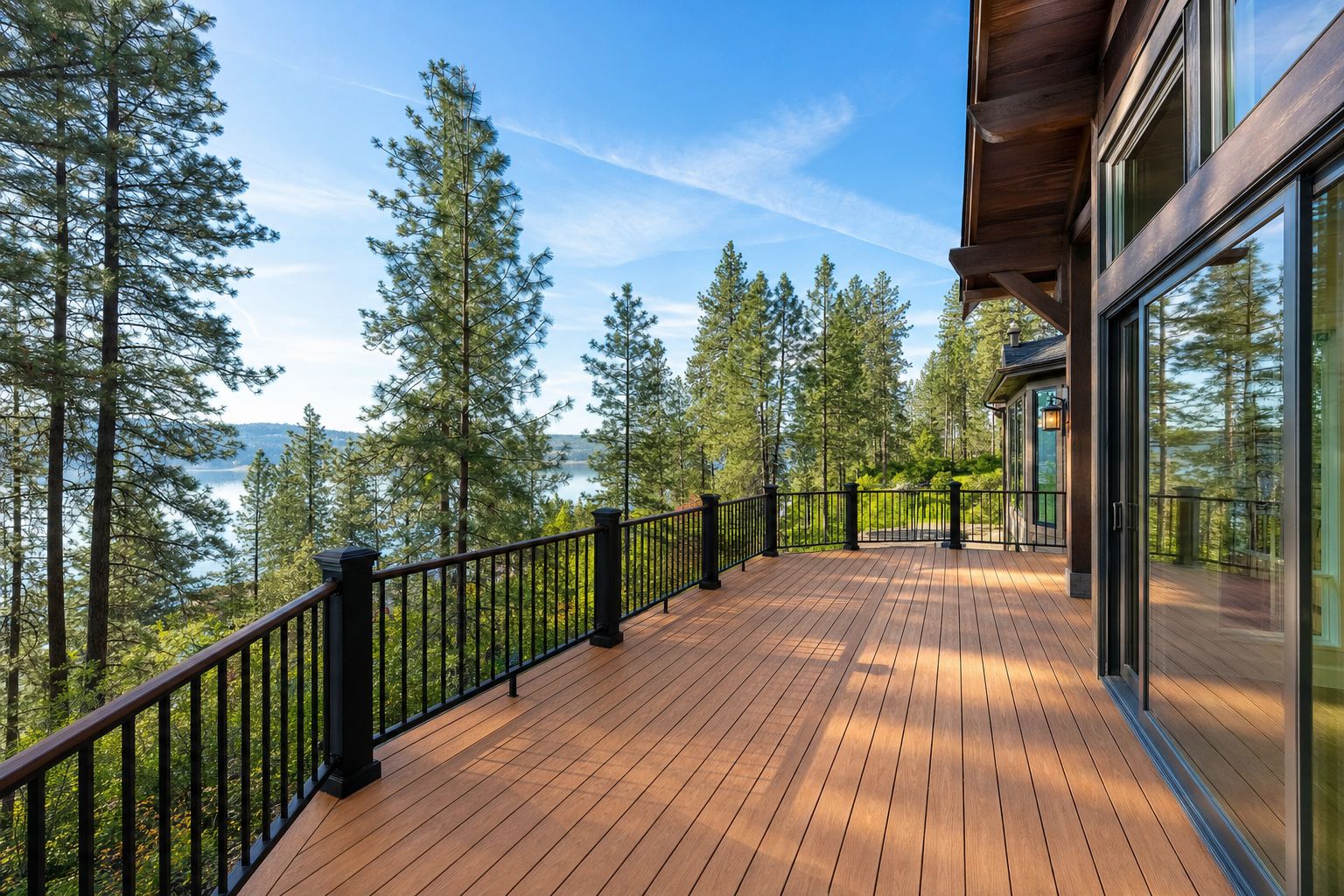
A short season changes what a deck should be. When the good months run roughly May through September, a deck that's only pleasant in perfect weather wastes half of them — so we design around how the space will really get used. West and southwest exposure captures the long evening light that makes northern summers worth it, but bare westward decking bakes at five o'clock in July; a partial cover or a pergola turns that from a trade-off into the best seat in the county. We size for the actual events — the long-table family dinner, the grill station that shouldn't crowd the seating, the hot tub that needs its own framing plan.
A covered section deserves special mention this far north. Roofing part of the deck stretches usable weeks into April and October, keeps the grill running year-round, and gives snow somewhere not to land — the upgrade clients most often tell us they're glad they made.
Footings Below Frost, Framing Rated for Snow
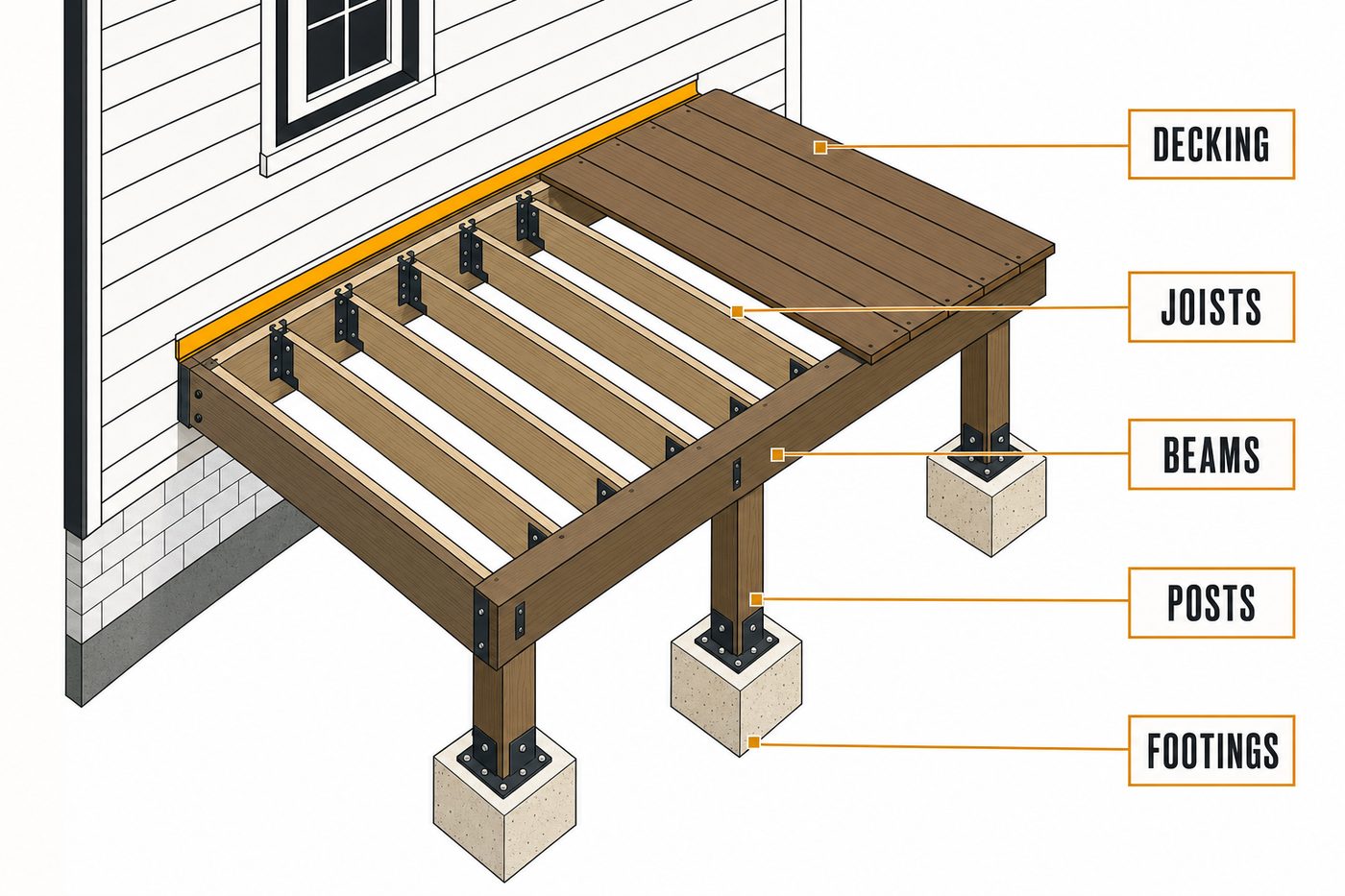
Under the design sits the part of the job Stevens County actually inspects, and it's less forgiving here than it is seventy miles south. Frost reaches deeper in this valley than in Spokane, and a footing that doesn't get below local frost depth will heave — the deck racks, railings loosen, and stairs pull away from their landings a season or two in. We dig to what Colville's climate requires, and we schedule the footing inspection with the county or the city before anything gets buried.
Snow load is the other structural conversation. A Colville deck can carry a winter's worth of accumulated snowpack, and drifted snow off a roof concentrates load in ways a bare span table doesn't show. That governs joist sizing and spacing, beam spans, and post placement — and it makes the ledger connection to the house the most consequential detail on the whole build. A lag-bolted ledger without proper flashing is the classic failure we're called to replace: water gets behind it, the rim joist rots quietly, and the deck's attachment to the house weakens exactly where the load is highest. Ours get through-bolted structural connections and flashing detailed like a roof edge, because that's what the joint is.
Drainage finishes the structural picture: decking gapped and framing sloped so meltwater leaves instead of ponding, and grade set so spring runoff moves away from footings rather than pooling under the structure all March.
Decking That Shrugs Off Freeze-Thaw
Materials fail differently in a hard freeze-thaw climate, and the honest comparison runs like this. Wood — cedar or pressure-treated — costs less up front and looks the way many people want a deck to look, but every check and end grain drinks meltwater that then freezes and splits the board wider each cycle. Keeping wood sound here means sealing on a schedule, and the dry window for doing that work is short. Some owners happily take that trade; plenty regret it by year five.
Composite and PVC decking is the low-argument choice for this climate: it doesn't absorb the freeze-thaw cycle, doesn't need the annual maintenance window, and takes snow-shoveling without splintering. It costs more per foot and demands correct gapping, since it moves with temperature across our big annual swing — an installation detail, and one we don't skip. Down at the hardware level, hot-dip galvanized and stainless fasteners and connectors are cheap insurance where snow sits on framing half the year; corroded hangers are a thing we find during teardowns, not a theoretical risk. Railings follow the same logic — powder-coated aluminum stays maintenance-free where painted wood balusters become an every-few-summers chore.
Where Deck Budgets Go
Size and height drive the base cost — a walk-out deck on a daylight basement carries taller posts, more bracing, and stair runs a grade-level platform doesn't. Material choice is the biggest lever after that, with composite's premium buying out future maintenance. Covered sections, hot-tub framing, built-in benches, and lighting each add their own line. Site conditions matter on rural parcels: slope, soil, and access for concrete all show up in the footing work. Demolition of an existing failing deck is its own item — though when an old frame is worth saving, we say so, because re-decking sound framing keeps real money in your pocket.
Five Stages, Sketch to Railing
- Site visit and design talk. We look at sun, snow-shed off the roof, grade, and how you want to use the space, then sketch options against your budget. Free estimate, no pressure attached.
- Written proposal. Dimensions, framing plan, materials, railing spec, and price — fixed, on paper.
- Permit and engineering. Permits come from the City of Colville in town or Stevens County on rural parcels, with plans sized to local snow-load and frost-depth requirements. We handle drawings and filing.
- Footings and framing. Holes dug below frost depth, inspected, poured; then the structure — ledger flashing, beams, joists, hardware — built to the plan and inspected again where required.
- Decking, railing, walkthrough. Surface down with correct gapping, railings set, stairs finished, site cleaned, and a final walk with you before the trailer leaves.
Book Early — the Season Is Short for Us Too
Straight talk about scheduling: we work out of Spokane, and Colville builds run as committed multi-day blocks — the crew comes up and stays on your deck from footings through railing rather than trickling in a day at a time. The short summer compresses the building calendar, and May-through-September blocks fill first. Homeowners who call us in late winter get their pick of dates; July callers often join next spring's list. Fall builds are a genuine option, though — footings and framing go in fine before hard freeze, and a deck finished in October is ready the first warm evening of May.
Deck Questions We Hear in Colville
How deep do footings need to go here?
Below local frost depth, which is deeper than Spokane's — the exact requirement is set by the county and confirmed at inspection. Shallow footings are the number-one cause of the heaved, racked decks we replace.
Do I need a permit for a deck?
Most decks, yes — through the City of Colville in town or Stevens County outside it. We produce the drawings and run the process.
Composite or cedar for this climate?
Composite wins on freeze-thaw durability and maintenance; cedar wins on up-front cost and looks if you'll keep up the sealing schedule. We build both and will price both.
Can I shovel snow off a composite deck?
Yes — a plastic-edged shovel and no metal blades. A properly framed deck can also simply carry its snow until spring.
My old deck wobbles. Rebuild or repair?
Depends where the failure lives. Rotten ledgers, heaved footings, or undersized framing mean rebuild; weathered boards on a sound frame can mean re-decking. We'll tell you which you have, in writing.
Can you build in fall?
Fall is one of our favorite windows — ground's workable, schedule's looser, and you're first in line for spring. Concrete and hard freeze don't mix, so footings just need to beat the deep cold.
Do you build covered decks and hot-tub decks?
Yes to both. Covers are designed to the same snow-load standard as the house roof, and hot tubs get dedicated structural support planned from the first sketch.
Why Homeowners Up Here Hire Us
Domex Construction carries Washington contractor license DAVYDCI833NC, verifiable through the state L&I lookup, and full insurance. Nine years in business, 32 years of combined experience across the crew, and a habit of putting specs, contingencies, and prices in writing before work starts. Ask about our workmanship warranty when we come out.
We build decks in Colville and throughout Stevens County — Kettle Falls, Arden, Addy, Chewelah, and the rural parcels between them.
Want to spend next summer on a real deck instead of planning one? Design estimates are free, on site, anywhere in Stevens County. Give us a call or request an estimate online.
More from Domex in Colville: Siding Installation in Colville · Window Replacement in Colville · Custom Home Builder in Colville · Custom Decks — Spokane hub