
Custom Deck Builders in Sagle, Idaho
Custom decks in Sagle, Idaho built for lake slopes and heavy snow: engineered footings, view railings, composite or cedar. Free estimates.
$1,000 Off
Your Complete Siding Replacement
Get a Free Estimate
FREE same-day estimates on all exterior projects.








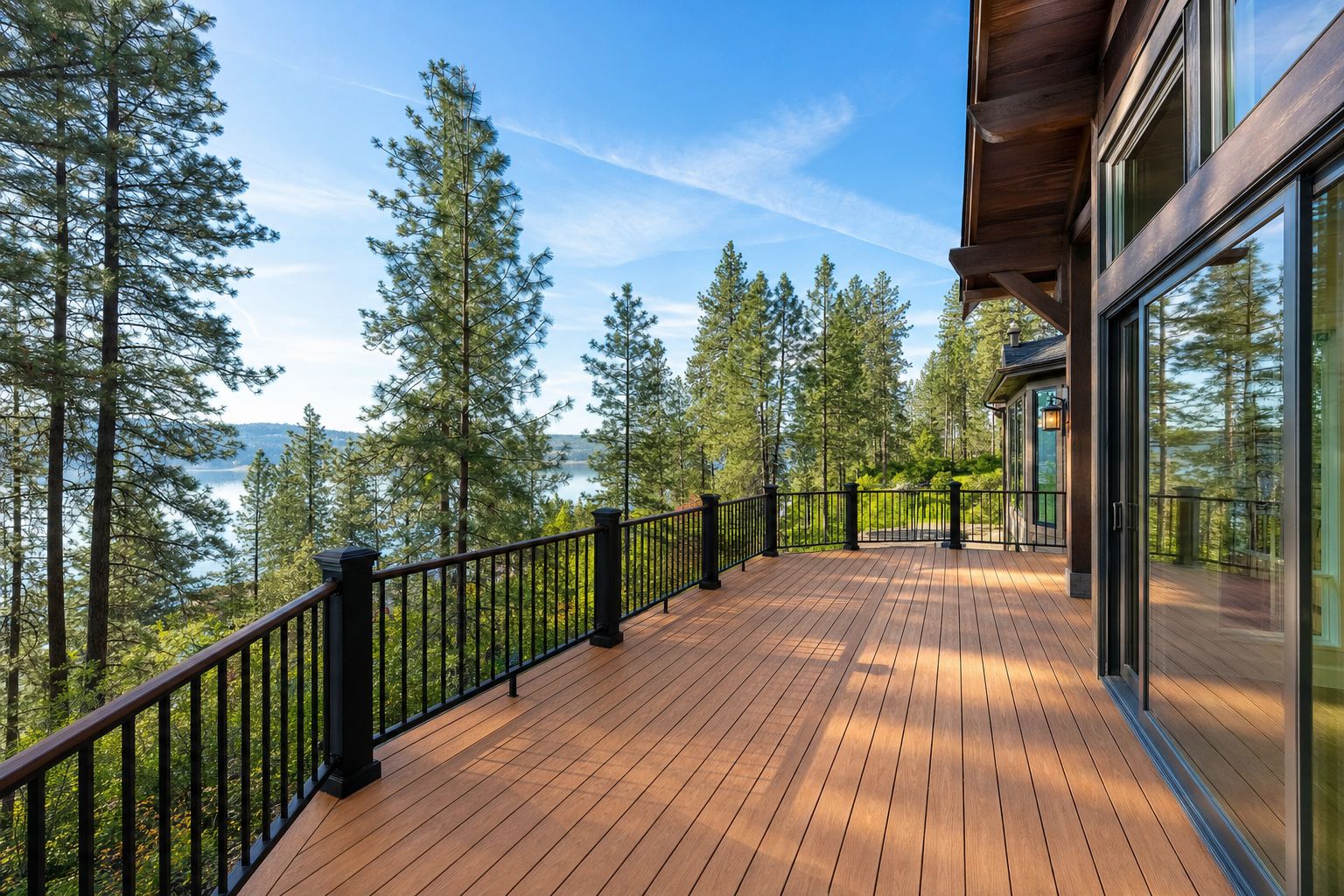
Sagle's ground has a lean to it. Between Highway 95 and the shoreline, most parcels tilt toward Lake Pend Oreille — sometimes gently, sometimes at a grade you notice in your knees — and level outdoor ground is the one thing the lot didn't come with. A deck is how you get it. On the hillsides over the bays, the deck isn't an accessory to the house; it's the room where the property actually gets lived in from May to October, and the platform you shovel a path across the rest of the year.
Building that platform on falling grade, under a snow load heavier than anything Spokane or Coeur d'Alene designs for, is a structural job before it's a carpentry job. Domex Construction builds decks throughout Sagle under Idaho license RCE-66940; crews come over from our Spokane–Post Falls base in blocks of booked days, so the build runs continuously once it starts.
The Slope Sets the Rules
On flat ground, a deck frame is straightforward. On a Sagle hillside, three things change before the first joist is cut.
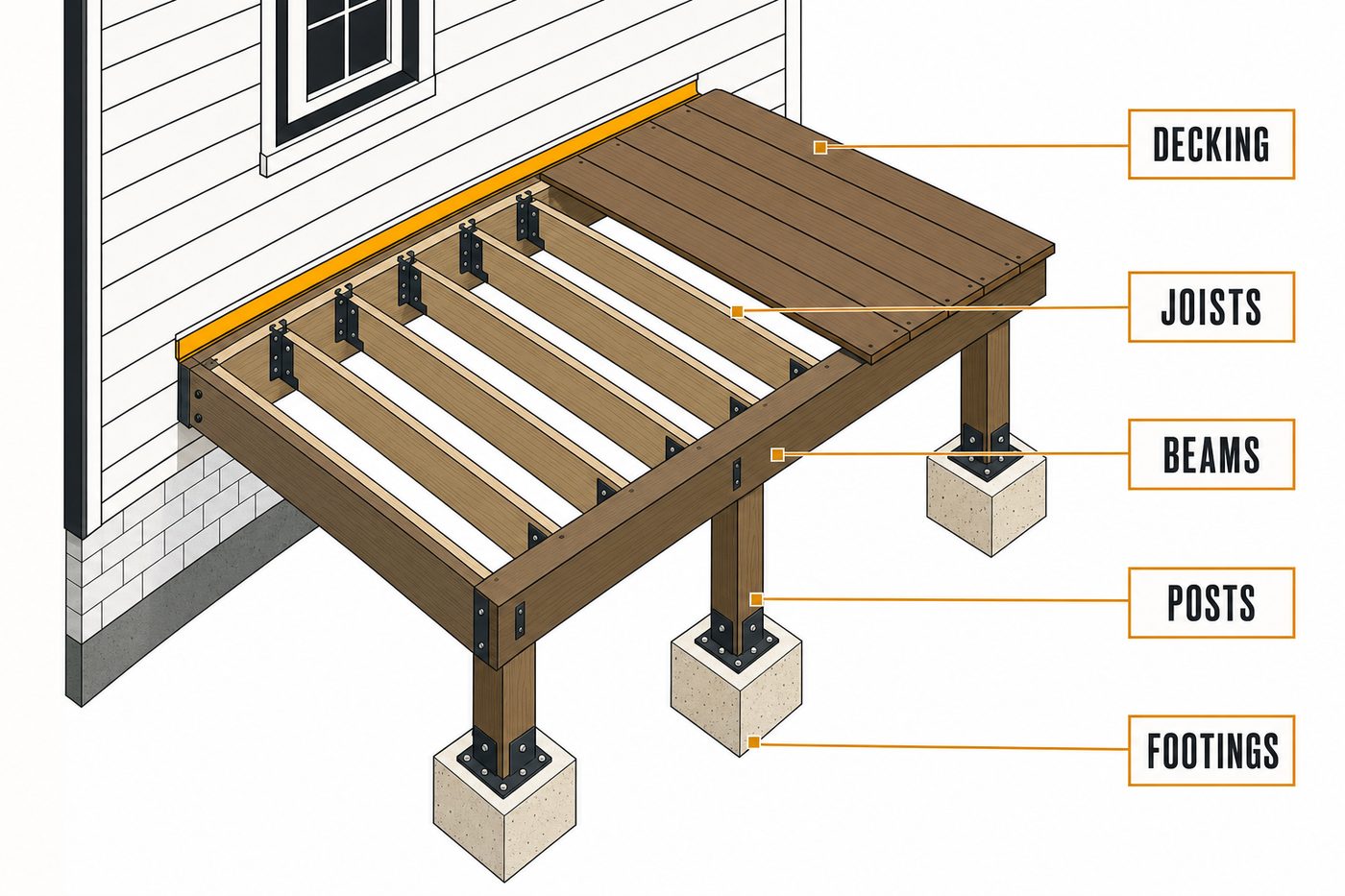
Footings get engineered. Where grade falls away, posts get tall, and tall posts concentrate load. Footings have to reach undisturbed soil below Bonner County's frost depth — shallower, and frost heave jacks a corner of the deck a little more every winter until the railings go out of plumb. On steeper cuts we size and place footings to the actual soil and slope, not to a generic table, and brace tall posts so the structure can't rack under a live crowd or a wind load off the lake.
Snow load is the design number. This end of Bonner County carries more snow than Coeur d'Alene and far more than Spokane. A deck framed to a span table from a milder market is undersized the first winter three feet of settled snowpack sits on it. We frame to the county's ground snow load, which is why our joist spacing and beam sizing can look heavier than a bid drawn up for a milder climate.
Water has to keep moving. A slope sends runoff downhill under and around the deck, and roof meltwater dumps along the house side of it all winter. Grading, gravel, and drainage under the frame keep posts out of standing water. And the ledger — the board bolting the deck to the house — gets flashed like a roof detail, because an unflashed ledger holds meltwater against the rim joist and quietly rots the connection that carries half the deck. Most of the deck failures we're called to look at started right there.
Railings That Don't Erase the View
Nobody builds a deck above Lake Pend Oreille to look at pickets. Railing choice is where structure and view negotiate. Horizontal cable rail keeps sightlines nearly clear, shrugs off weather, and only asks for occasional retensioning. Slender aluminum balusters cost less, need nothing, and read as a thin gray line from a chair. Glass panels give the cleanest view of all — and under fir and ponderosa they collect pollen in June and needle dust all fall, so they belong with owners willing to squeegee. Every option gets built to code height with a graspable handrail on the stairs; on an elevated deck over a slope, the railing is a life-safety system first and a design choice second.
Decking That Can Live Under a Fir Canopy
Most Sagle decks spend their lives in partial shade with needles raining on them, then disappear under snow for a season. That environment argues for capped composite: needle litter that mildews and stains bare wood washes off a capped board, shade that keeps lumber damp doesn't soak a polymer cap, and months under snowpack come off with a plastic shovel and no spring refinishing. On shaded lake-slope lots, composite usually wins the ten-year comparison even though it costs more up front.
Cedar still has a case, and we make it honestly. It's a beautiful, cooler-underfoot, locally traditional board that costs less on day one — and it commits you to washing and recoating on a real schedule, because shaded cedar that skips maintenance goes gray, then slick, then soft. Choose it with open eyes and it's a fine deck.
Either way, the frame underneath is pressure-treated lumber with taped joist tops — a membrane over each joist keeps water out of the fastener holes, where snow-country frames rot first. Board gapping is set for drainage and needle fall-through, not just appearance.
Access, Slope, and the Price of a View
Square footage matters less to a Sagle deck price than what's under and around it. Access is the quiet cost driver: a long forest driveway, material carried downslope by hand, and staging on grade all take crew hours that a flat backyard doesn't. Height and slope drive footing excavation, post length, and bracing. Railing systems spread wide: cable and glass run well above aluminum pickets per foot. Decking choice moves the material line, stairs and landings add framing fast on steep grades, and any engineering the site requires shows up as a line item that buys a deck that passes inspection and holds its snow. We quote a fixed price after standing on the actual site, not from an aerial photo.
The Build in Five Stages
- Site visit and layout. We walk the slope, check drainage paths and the house connection, and chalk out the footprint so you can stand where the deck will be. Free estimate, written up from what the site actually needs.
- Design and spec. Framing plan to Bonner County snow load, footing layout, decking and railing selections, and engineering where the slope calls for it — all on paper before anything is ordered.
- Permit. Bonner County reviews and inspects deck work in Sagle. We submit the plans and slot the inspection points into the schedule.
- Footings and frame. Excavation, concrete below frost depth, posts, beams, joists, ledger flashing, joist tape. Inspections happen at the stages the county requires; we call them in.
- Decking, railing, walkthrough. Boards down, railing tensioned and checked, stairs finished, site cleaned, and a final walk with you, maintenance notes included.
The Calendar of a Deck Year
Footings want to go in before the ground freezes, which makes fall the deadline for a same-year build and spring the smart time to book one. Homeowners who run design and permitting over the winter are first on the schedule when the ground opens up, with the deck done before the good weather instead of during it. Framing and decking can run in cold once footings are in; deep-snow midwinter is the stretch we plan around. Summer slots across Bonner County go early — the same story as every trade up here.
Questions We Hear on Site
Do I have to shovel snow off the deck?
A deck framed to the county's snow load doesn't need rescue shoveling; most owners clear paths for use, not structure. On composite, use a plastic shovel and skip harsh ice-melt products; on cedar, keep the shovel edge off the finish.
How deep do the footings go?
Below Bonner County's required frost depth into undisturbed soil — deeper, or larger, where slope and soils demand it. Depth is inspected before concrete goes in: verified, not promised.
Composite or cedar under all these trees?
Shade and needle litter favor composite for owners who don't want a maintenance schedule. Cedar works if you'll wash and recoat it on a real calendar. We'll give you the ten-year picture of both for your specific exposure.
Can my existing deck be reinforced instead of replaced?
Sometimes. We check the ledger, footings, and frame first — if the ledger was never flashed or the footings are shallow, the problems are structural, and new boards on a failing frame is money spent twice.
Will the county want a permit for this?
Bonner County has jurisdiction over Sagle, and requirements depend on the deck's height and attachment to the house. Sorting that out and filing is our job, not yours.
How long does the build itself take?
Most builds finish in under two weeks on site once footings are in, with slope, size, and railing complexity setting the pace. Custom railing orders can add lead time before we start — another reason winter design pays off.
Can you build close to the water?
Waterfront parcels can carry setback and shoreline rules beyond a standard deck permit. We confirm what applies during permitting and design to the real line before any footing is laid out.
Licensed for the County You're Building In
Domex Construction carries Idaho contractor license RCE-66940, verifiable through the Idaho Contractors Board, along with Washington license DAVYDCI833NC and full insurance. Sagle's unincorporated status means Bonner County reviews the plans and inspects the work — a process we run start to finish. Ask about our workmanship warranty when we're on site. Beyond Sagle, we build decks through Sandpoint, Ponderay, Dover, and down the 95 corridor to Cocolalla, Athol, and Bayview.
Want level ground with a lake under it by summer? Free on-site deck estimates across Sagle. Give us a call or request an estimate online.
More from Domex in Sagle: Siding Installation in Sagle · Window Replacement in Sagle · Custom Home Builder in Sagle · Custom Decks — Spokane hub