
Custom Deck Builders in Palouse, Washington
Custom decks in Palouse, WA sized to historic homes. River-lot footings, snow-ready framing, wood or composite. Free estimates, licensed WA contractor.
$1,000 Off
Your Complete Siding Replacement
Get a Free Estimate
FREE same-day estimates on all exterior projects.








The first thing you notice walking a Palouse block is that every house faces you properly — a front porch, a few steps up, posts and a railing, built in an era when the porch was the household's public room. What visitors don't see is the other half of that arrangement: out back, where the yard runs toward the alley or down toward the river, is where these houses have always wanted a private outdoor room to match. That's the deck's job here. Not a suburban add-on, but the backyard counterpart to a front porch the town has kept for a century.
Domex Construction designs and builds decks across Palouse and rural Whitman County under Washington license DAVYDCI833NC, and on this housing stock the design question and the structural question deserve equal weight.
Matching a Deck to a House That Predates Decks
A 1900s house has strong opinions about scale. Its porch posts have proportion, its railings sit at a height and rhythm the eye has accepted for generations, and a deck that ignores all that — oversized, gray plastic, chunky store-bought balusters — looks bolted on because it was. Getting it right costs design attention more than money.
The moves that work: keep the deck's footprint in proportion to the house rather than maxing out the yard; pick railing profiles that echo the porch's — painted square balusters read beautifully behind a Victorian, slim black metal balusters disappear and suit almost everything; skirt the underside so the frame doesn't show its legs the way the porch never does; and let materials talk to each other, so a house with a painted porch floor gets a deck that doesn't argue with it. Owners restoring the front porch anyway — and in this town, many are — can scope that structural work and the back deck as one project: one crew, one visual language.
Not every Palouse deck needs to be a period piece. It just needs to look designed for this house, and that's decided on paper before any lumber is ordered.
River Ground and Hill Ground Frame Differently
Palouse sits where the Palouse River loops through a gap in the hills, and the dirt behind two houses a block apart can behave completely differently.
Low lots near the river hold water in spring. Soft, seasonally wet ground means footings sized and dug for what the soil actually is, not what a span table assumes — wider bases, full frost depth, and honest compaction. We also keep frames higher off grade on this ground: air moving under a deck is what lets joists dry after snowmelt, and a low frame over damp soil is how pressure-treated lumber ends up punky in fifteen years instead of thirty. Drainage grading under the deck is part of the build, not an extra.
Grid-edge and rural hill lots trade wet soil for slope: uphill cuts, downhill drops, and stepped footings. Taller posts get sized up and braced diagonally, because an unbraced tall frame racks a little more every season until you can feel it under your feet.
On every house, old or new, the ledger is the connection we treat as life-safety: through-bolted to the rim framing, flashed so meltwater cannot sit against the band joist. On century homes the band joist itself gets inspected before we trust it with a bolt — original lumber is usually excellent, but a century of a leaky downspout can change that story.
Snow is the constant across all of it. A Palouse deck carries real load several months a year, so joist spacing, beam sizing, and footing dimensions are calculated for winter, not for the July afternoon when the deck was ordered.
Boards, Rails, and What They Ask of You Later
Cedar suits these houses naturally and costs less up front. Its trade is maintenance: a wash and re-coat every couple of years, more on sun-hammered south exposures, or it grays and checks. Some owners here genuinely like that patina; be sure you're one of them before choosing it.
Composite decking costs more at the start and asks almost nothing after — no coating cycles, no splinters, color that holds. Modern lines have shed the plasticky look, and in muted browns and grays they sit comfortably behind an old house. For owners who'd rather spend Saturdays at the farmers market than with a stain pad, it's usually the better long math.
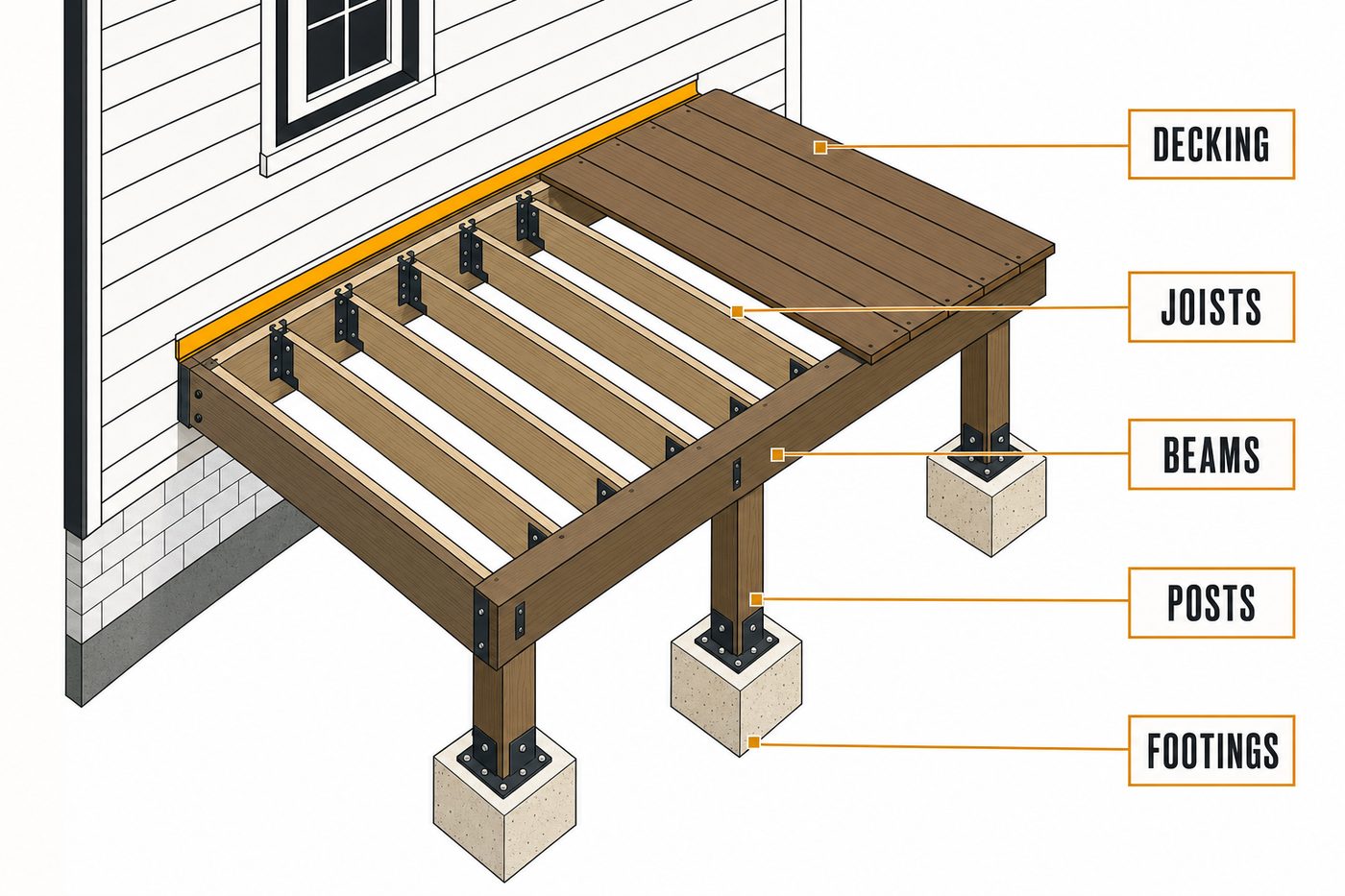
Pressure-treated frame lumber goes underneath either choice; joist tape over the tops of joists and beams is cheap insurance against the freeze-thaw moisture that starts frame rot from above.
Railings carry outsized visual weight on a historic property, so we treat them as a design decision, not a checkbox. Painted wood, metal baluster systems, and composite rail kits each have a house they belong to.
The Line Items That Shape a Deck Bid
Size sets the base, but four things move a Palouse deck number more than square footage: ground conditions (river-lot footings and drainage work cost more than firm level soil), height and slope (tall braced frames carry more lumber and labor), decking and railing selection (the widest price lever you directly control), and features — stairs, benches, skirting, lighting, a covered section. We price fixed after a site visit and a design conversation, with the spec itemized so you can see which choices move the total.
How a Palouse Deck Comes Together
- Site visit. We look at the ground, the grade, the house connection, sun and snow-shed patterns, and how the deck should sit against the architecture.
- Design and fixed quote. Footprint drawn, structure specced, materials and railing chosen from samples you can hold, price itemized in writing.
- Permit. In-town builds are permitted through the City of Palouse; rural Whitman County properties go through the county. We file, and inspections land at the framing stages the permit sets.
- Structure. Footings dug and poured to frost depth, posts, beams, bracing, ledger bolted and flashed, joists taped. Slowest stage, and the one that decides everything.
- Surface, rails, and walkaround. Decking down with consistent gapping, railings set solid, stairs finished, site cleaned, and a full inspection walk with you.
Reserving a Build Slot
Deck season on the calendar is April through October, and mid-summer slots go earliest. Our crews travel from the Spokane area and run Whitman County work in scheduled trip blocks, so your build gets consecutive committed days rather than scattered visits between other jobs. Winter design consultations are the quiet advantage: drawings and permits happen in the slow months, and your build takes one of the first good-weather slots. Footings need workable ground, so the true start of the season depends on when frost leaves the soil.
Straight Answers on Palouse Decks
Can you make a new deck suit a hundred-year-old house? Yes — that's a design problem with known solutions: proportioned footprint, railing profiles that echo the porch, skirting, and colors that defer to the house. It's the first thing we sketch, not an afterthought.
Do you also repair front porches? We take on porch structural work — posts, framing, decking — and it pairs naturally with a backyard deck build. One permit conversation, one crew, one schedule.
Do I need a permit for a deck in Palouse? Nearly all decks of usable size require one — City of Palouse in town, Whitman County outside the limits. We handle it as part of the project.
My yard is soggy every spring. Can I still have a deck? Yes, with the structure designed for it: bigger footings, a taller frame for airflow, and grading underneath so water moves through instead of pooling. It costs somewhat more and lasts decades longer than pretending the water isn't there.
Wood or composite — what do most people pick? Owners who love the ritual of caring for wood pick cedar; owners who want their weekends back pick composite.
How long does a build take? Most single-level decks run about one to two weeks of on-site work once the permit is issued. Height, stairs, and custom railings stretch that; weather and inspection timing set the rest.
Will the crew really come from Spokane for a Palouse job? Yes — Whitman County builds run in dedicated trip blocks, so travel is planned into the schedule, not deducted from your workdays.
What happens under snow load? A deck framed to spec carries Palouse winters without drama — that's what the beam sizing and footing math are for. The decks that sag here were underbuilt on day one, not overloaded later.
Licensed, Insured, and Easy to Verify
Domex Construction builds under Washington contractor license DAVYDCI833NC — check it on the state L&I lookup — with full insurance behind every job. Nine years in business, 32 years of combined experience across the crew, and deck work that sits alongside our siding, window, and remodel trades when a project grows. From Palouse we build in Garfield, Colfax, Pullman, Potlatch over the Idaho line, and across rural Whitman County.
Front porch for the street, deck for yourselves. Free on-site design consultations and estimates in Palouse. Give us a call or request an estimate online.
More from Domex in Palouse: Siding Installation in Palouse · Window Replacement in Palouse · Custom Home Builder in Palouse · Custom Decks — Spokane hub