
Window Replacement in Palouse, Washington
Window replacement in Palouse, WA that respects century-old homes. Period grids, custom sizes, warm winters. Licensed WA contractor. Free estimates.
$1,000 Off
Your Complete Siding Replacement
Get a Free Estimate
FREE same-day estimates on all exterior projects.








A town of about a thousand people holds maybe four hundred houses, and in Palouse you can see most of them in a twenty-minute walk from Main Street. In a streetscape that intact, one wrong window announces itself from half a block away — a squat vinyl slider punched into a facade built for tall double-hungs reads like a typo in an otherwise handsome sentence. Plenty of towns lost enough of their old fabric that nobody notices anymore. This one didn't, which raises the stakes on every replacement.
The good news is that sympathetic replacement isn't exotic or wildly expensive; it's mostly a matter of specifying with care. Domex Construction replaces windows across Palouse and rural Whitman County under Washington license DAVYDCI833NC, and on century homes the spec conversation is where the job is won or lost.
Proportions, Grids, and Why They Carry the Facade
Three decisions determine how a replacement looks from the sidewalk.
Proportion. Windows of the 1890s–1920s are taller than they are wide, and the facade was composed around that vertical rhythm. Keeping the full opening height — rather than downsizing to a stock unit and framing in the difference — preserves it. Openings on these houses are rarely standard sizes anyway, so custom-sized units aren't an upgrade here; they're the default.
Grid pattern. Much of the era's housing wore two-over-one or four-over-one sash — divided upper, single-pane lower. Modern units reproduce this with grids between the glass or, one step up, simulated divided lites with bars bonded to the exterior glass surface that cast real shadows. On a street-facing wall, that shadow line is the difference between a window that passes and one that photographs flat.
Frame and trim. These houses have wide, flat exterior casings and a proper sill horn. A replacement that preserves the casing and matches the frame color to the trim scheme disappears into the house. One that wraps everything in bare white vinyl is the mistake you can spot from the truck.
None of this obligates you to a museum piece. Bedrooms and rear walls can run simpler, cheaper units while the public face of the house gets the full treatment — a split we spec regularly.
What a 1905 Opening Has Inside It
Open up a century-old window and you meet the original technology: single-pane sash hung on cotton ropes over cast-iron weights, riding in wood jambs with a hundred years of paint. Replacing them well means dealing with three things stock installers skip.
The weight pockets — the hollow channels beside each jamb that housed the counterweights — are uninsulated voids connecting your wall cavity to the weather. We strip the weights and pack those pockets with insulation, because leaving them empty installs a brand-new window inside a chimney of cold air.
Settling is the second reality. A hundred years of a house finding its posture leaves openings out of square, sometimes by a little, sometimes visibly. That's why every opening gets measured individually — top, middle, bottom, both diagonals — and why the insert-versus-full-frame call is made opening by opening. An insert preserves interior and exterior trim and suits a square, sound jamb; a full-frame tear-out is the right answer where sills have rotted or the jamb has drifted too far to shim honestly.
Third, paint on pre-1978 sash gets treated as lead-bearing, so removal is contained and the old sash leaves in sealed bags rather than as flaking debris on the flowerbeds.
What Old Glass Costs You Every Winter
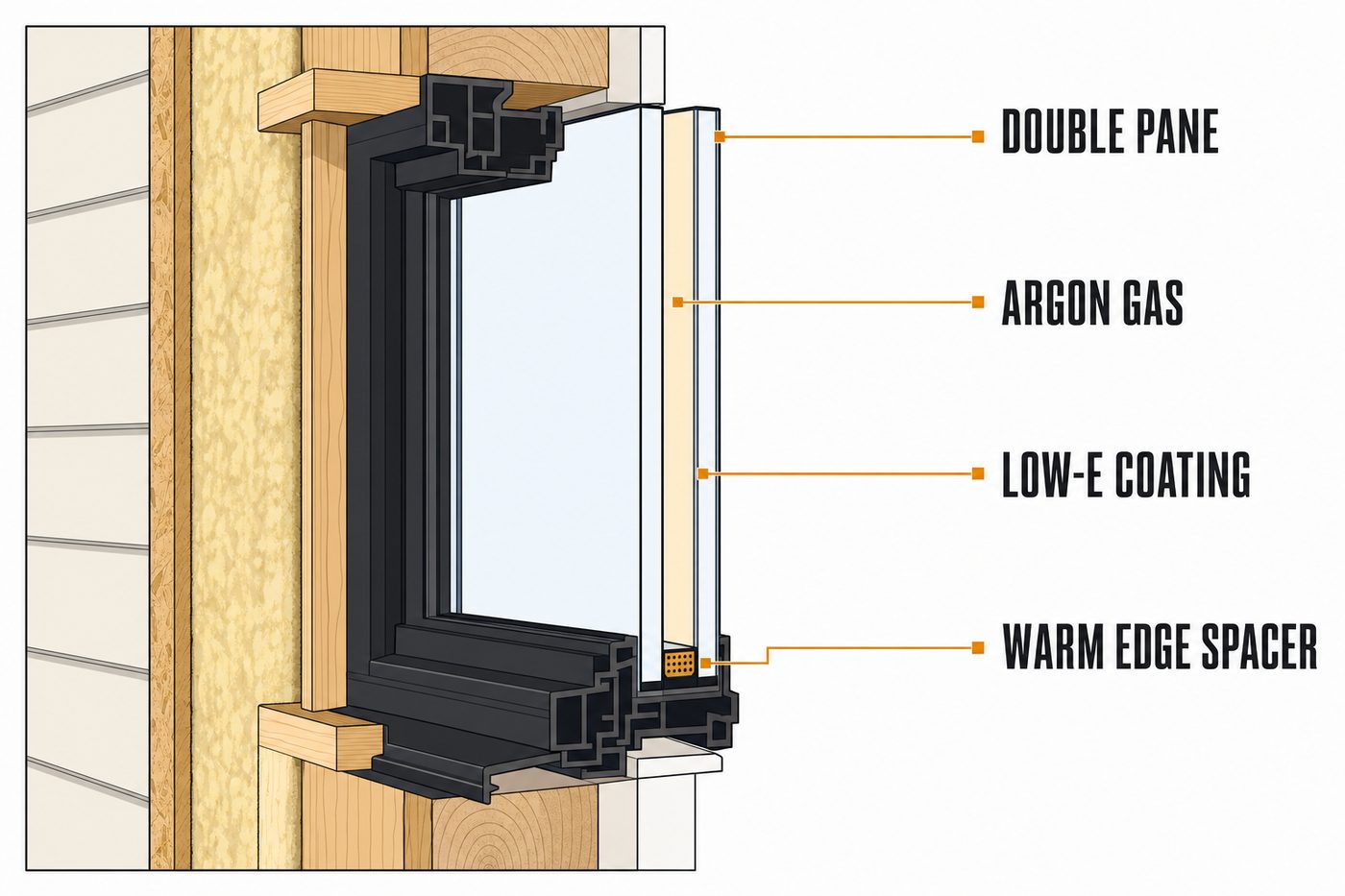
Here is the economics of the project, stated plainly. A single-pane sash with a loose fit is the thermal equivalent of a hole in the insulation plan — the glass itself conducts heat out, and the gaps around hundred-year-old sash leak air every hour the wind blows, which on the open Palouse is most hours from November through March. Storm windows help; they were the era's own retrofit. But a modern double-pane unit with low-E coating and argon fill, air-sealed into an insulated opening, outperforms the sash-plus-storm stack while giving you back windows that actually open in July.
We won't hand you an invented payback number — heating fuel, house size, and how many windows you replace all move it. What we will say from local experience: the comfort change shows up the first cold night, in rooms you can sit in without a draft finding your neck, and the heating system stops fighting a leak it could never win against. On these houses, windows and attic insulation are the two efficiency moves that repay attention first.
The Sequence, Opening by Opening
- Walkthrough and measure. Every opening measured individually; a frank read on which jambs are insert candidates and which need full-frame work.
- Spec and order. Sizes, grid patterns, glass package, frame colors, and interior finish detail on paper. Custom sizing makes the factory order the long pole of the schedule.
- Permitting. Where the scope requires it, in-town permits run through the City of Palouse and rural properties through Whitman County; we handle the filing.
- Install. Typically several openings per day: old sash out under containment, weight pockets insulated, unit set plumb and square, perimeter foamed, exterior flashed and sealed.
- Finish and walkthrough. Interior stops and trim made good, operation and locks checked with you at every window.
What Moves a Window Quote Here
Count is the baseline — but per-window price varies more on old houses than new ones. Custom sizing adds cost over stock dimensions. Simulated divided lites cost more than between-glass grids, which cost more than clear glass. Full-frame openings run meaningfully more than inserts because they include tear-out, sill repair, and exterior trim work. Second-story access, rotted sub-sill framing, and lead containment round out the list. We quote fixed, per-opening, after measuring — not off a window count over the phone.
Ordering Takes Longer Than Installing
The physical install on a whole house is usually two to four days. The wait for custom-sized, custom-gridded units is several weeks from order, and that lead time — not crew availability — sets the project calendar. Our Palouse work runs in scheduled trip blocks alongside other Whitman County jobs, so once your order lands, your install dates are committed, not floating. Cold-season installs are routine: one opening is out of the wall at a time, each hole is open for well under an hour, and winter ordering often means shorter factory queues.
Window Questions We Get in Palouse
Can new windows really match the originals?
Match the proportion, keep the casing, and spec the right grid pattern, and from the sidewalk the answer is yes. We'll show you samples of grid types side by side so you can judge the shadow lines yourself.
Insert or full-frame — which do I need?
It's decided per opening, not per house. Square jamb and sound sill: insert. Rot, racking, or a previous bad replacement: full-frame. Most Palouse houses end up with a mix.
Are my openings standard sizes?
Almost certainly not, and that's fine. Custom sizing is normal on this housing stock and built into how we quote.
Should I keep my storm windows?
Once modern double-pane units go in, exterior storms are redundant and most owners retire them. If you love the look, they can stay — they just stop earning their upkeep.
Is winter a bad time to replace windows?
No. One opening at a time, brief exposure per hole, full air-sealing before we move on. Scheduling can actually be easier in the off season.
What about the wavy old glass?
If original sash matters to you, save a pane or two for a cabinet or transom project — several owners here have. The wall itself deserves glass that holds heat.
Do you handle the permit?
Yes — City of Palouse for in-town work when the scope requires one, Whitman County for rural properties. Filing and inspections are our job, not yours.
Do you replace windows on farmhouses outside town?
All the time. Rural Whitman County properties book into the same trip schedule as in-town work.
The Contractor Behind the Estimate
Domex Construction carries Washington contractor license DAVYDCI833NC — look it up on the state L&I site before you sign anything, with us or anyone — and full insurance. Nine years in business, 32 years of combined field experience, and window work that runs alongside our siding and remodel crews, which matters if your project grows. From Palouse we cover Garfield, Colfax, Pullman, Potlatch across the Idaho line, and the wider Whitman County farm country.
Want windows the house deserves and a warmer January? Free on-site estimates in Palouse. Give us a call or request an estimate online.
More from Domex in Palouse: Siding Installation in Palouse · Custom Decks in Palouse · Custom Home Builder in Palouse · Window Replacement — Spokane hub