
Window Replacement in St. Maries, Idaho
Window replacement in St. Maries, Idaho: settled century-old openings, condensation fixes, efficient glass. Licensed ID crew. Free estimates.
$1,000 Off
Your Complete Siding Replacement
Get a Free Estimate
FREE same-day estimates on all exterior projects.








The houses on the hillside above the confluence have been watching this valley work for a hundred years. Some of them stood through the log-drive era, when the St. Joe carried timber instead of tour boats, and plenty still hold the glass they were built with — single panes in wood sash, wavy if you look at an angle, freezing to the touch by Thanksgiving. Character is the polite word for it. Cold is the accurate one.
Replacing windows in housing this age is a trade of its own, and it's one Domex Construction does across St. Maries and Benewah County under Idaho license RCE-66940. We work on the century-old grid homes, the mid-century stock that filled in around them, and the rural places up the St. Joe, and the approach differs for each. Free estimates, measured on site, priced in writing.
Century-Old Openings Don't Come in Stock Sizes
Order a window from a catalog for a 1912 house and it will fit the catalog, not the house. A century of settling on a hillside means the openings have moved — sills a half-inch out of level, jambs that lean with the slope, rough openings hand-framed to whatever dimension the carpenter had that morning. We measure every opening individually, order custom-sized units, and shim each one plumb and square inside its imperfect hole. The window has to sit true even when the wall around it isn't, or the sash binds and the seals wear unevenly from day one.
The other decision old houses force is insert versus full-frame. An insert window slips inside the existing frame — less cost, less disruption, a fine choice where the old frame is sound. Full-frame replacement strips the opening to the studs, which is the right call where sills have rotted, where gaps need real insulation, or where a hundred winters have left framing problems behind. Most St. Maries houses end up with a mix, decided opening by opening, and we'll show you which is which during the measure.
The Water Running Down Your Glass in November
Two rivers meet here, and the valley air carries their moisture all winter. Add a wood stove, a kettle, and a family breathing indoors, and household humidity finds the coldest surface available — the glass. Hence the streaming condensation, ice in the sash corners, the black mold line along the bottom rail, and eventually the rotted sill.
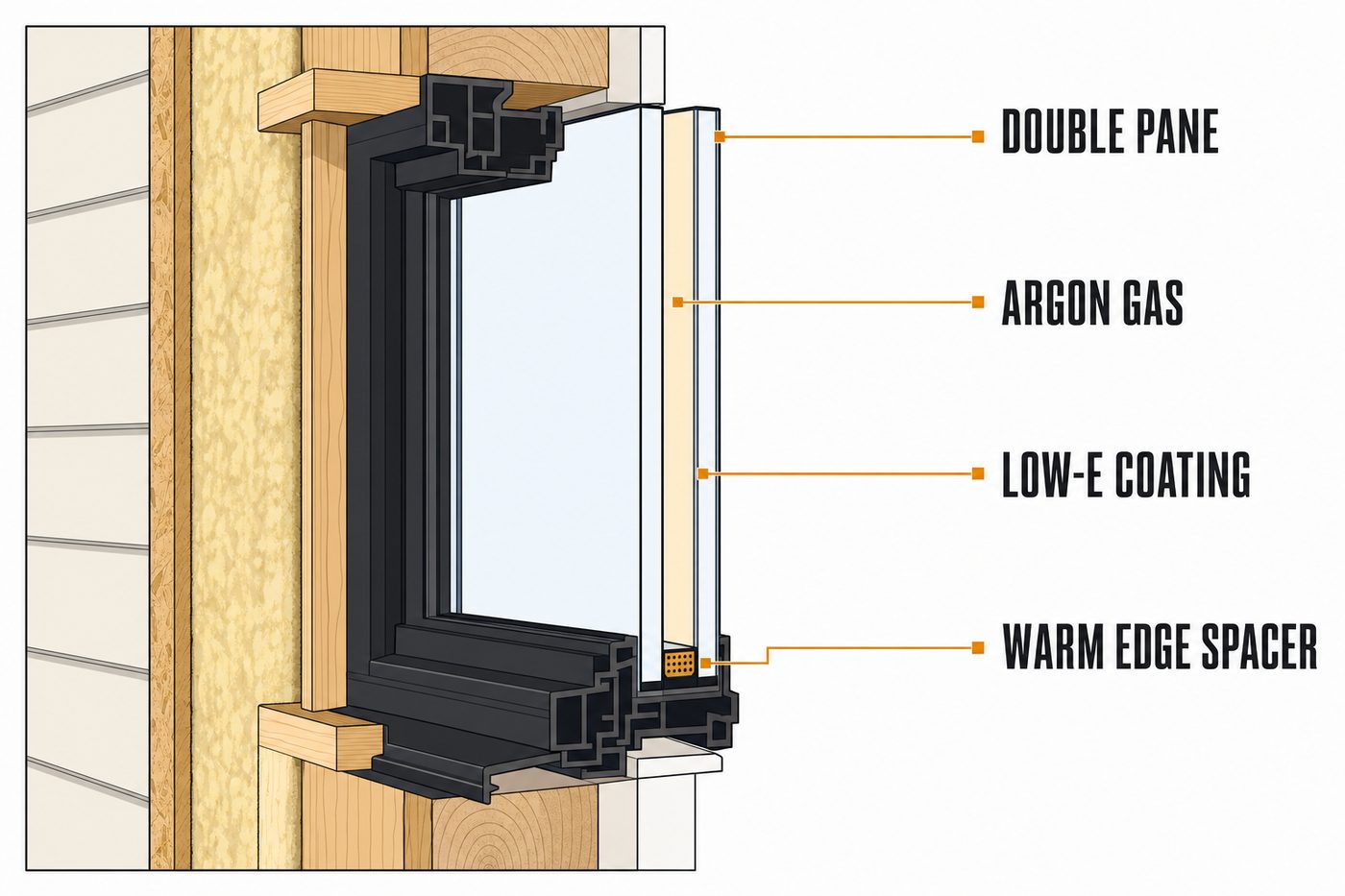
New glass changes the physics. A modern double-pane unit with a low-E coating and argon fill keeps the interior surface of the glass far warmer, so the room's moisture no longer condenses there. Warm-edge spacers do the same for the corners, which is where cheap units still sweat. To be plain about it: windows don't remove humidity, they stop it from destroying the window and the wall under it. A genuinely damp house also needs ventilation habits, and we'll say so rather than let new glass take the blame later.
What Old Glass Costs You Every Winter
Heating season is long in this valley, and a single pane insulates at roughly a quarter the level of a modern double-pane unit — functionally, a hole in your insulation that you happen to see through. Drafty weight pockets and gapped sash make it worse, because moving air beats even bad glass as a heat thief.
We won't invent a payback number, because it depends on your fuel, your house, and how many openings you replace. What we can do is prioritize: the windows losing the most are usually the big north-facing units, anything with visible gaps, and any glass you can feel radiating cold from a step away. Start there and the heating difference shows up the first winter.
Working-Budget Tiers That Actually Make Sense
Not every project needs to be every window at the top spec, and this is a town that respects a budget spent carefully. The way we usually tier it:
- First priority: the worst offenders — failed seals, rot, the coldest rooms — replaced with solid vinyl-frame double-pane units with low-E and argon. This is the workhorse spec, and for most houses here it's the right one.
- Middle path: the same glass package in better frames or with upgraded hardware and screens, phased over two seasons so the checkbook keeps up.
- Full scope: whole-house replacement, full-frame where the openings need it, with fiberglass or wood-clad frames where an owner wants the look to match a century home. Worth it on a house you'll keep for decades.
Orientation gets a vote too: a west-facing wall that bakes in July can justify a stronger solar-control coating, while north glass wants the best insulating package you can afford.
From First Visit to Final Bead
- Measure and assessment. Every opening measured individually; frames and sills probed; insert or full-frame recommended per opening.
- Quote in writing. Unit specs, glass packages, install method, and price — itemized so you can phase the work if you choose.
- Ordering. Custom sizes typically take a few weeks from the manufacturer; we schedule your install date when the order is placed.
- Installation. Old units out, new units shimmed true, gaps foam-insulated, exteriors flashed and sealed, interiors trimmed. Most houses take one to three days.
- Walkthrough. Every sash operated, every lock checked, every bead inspected with you before we leave — and the old windows hauled off.
Where the Money Goes on a Window Job
Unit count sets the base, but the spread between quotes comes from everything else. Custom sizing for settled openings costs more than stock. Full-frame installs run well above inserts because they're small carpentry projects, not swaps. Frame material is a real ladder — vinyl, then fiberglass, then wood-clad. Glass options (low-E types, argon, warm-edge spacers, sound packages) each move the number modestly. Rot repair at sills is the honest wildcard in housing this age, so our quotes state repair terms before the job starts. Permits, where required, run through City of St. Maries permitting in town or Benewah County for rural parcels, and we handle that filing.
Scheduling Around a St. Joe Winter
Window work happens year-round here — each opening is only exposed for an hour or so, and we work one opening at a time so the house never stands open to the weather. Manufacturing lead time, not weather, sets your calendar: measure to install typically spans several weeks depending on the maker and the season. Spring and fall book heaviest; if your glass is failing now, a winter install often comes with a shorter wait.
Answers for St. Maries Homeowners
My house is from the 1910s — can it even take modern windows?
Yes. Custom-sized units are built to your actual openings, and full-frame installation handles the settling and rot a century leaves behind. Old houses are most of our window work in this town.
Will new windows stop the condensation?
On the glass, almost always — warmer interior glass surfaces give moisture nowhere to condense. If the house itself runs damp, we'll tell you, because that part is ventilation, not windows.
Insert or full-frame — which do I need?
Sound frames and square-enough openings: insert. Rotted sills, big air gaps, or failed framing: full-frame. We recommend per opening, not per house, and plenty of homes here get both.
Do I have to do the whole house at once?
No. Worst-first phasing is common in St. Maries and we quote it that way on request; the main cost of phasing is a second mobilization, and we'll show you what that adds.
Is winter installation risky?
No — one opening open at a time, sealed the same day, with cold-weather sealants and foams rated for it. Lead times are often shorter in winter, too.
What about keeping the old-house look?
Grid patterns, exterior trim profiles, and wood-clad or fiberglass frames can keep a century home looking like itself. Bring photos of what you want preserved and we'll spec to it.
Who handles the permit?
We do — City of St. Maries permitting for addresses in town, Benewah County for rural parcels up the river or out toward the prairie towns.
The License Line, and Why It's There
Domex Construction is licensed in Idaho as RCE-66940 — look it up with the Idaho Contractors Board before you sign anything with anyone, including us — and in Washington as DAVYDCI833NC, fully insured, with nine years in business and 32 years of combined field experience. Ask about the workmanship warranty at your estimate. We serve St. Maries, Plummer, Fernwood, Santa, the St. Joe River corridor, and the rest of Benewah County.
Tired of scraping ice off the inside of the glass? Free on-site window estimates in St. Maries and across Benewah County. Give us a call or request an estimate online.
More from Domex in St. Maries: Siding Installation in St. Maries · Custom Decks in St. Maries · Custom Home Builder in St. Maries · Window Replacement — Spokane hub