
Window Replacement in Osburn, Idaho
Window replacement in Osburn, Idaho: honest phasing, glass built for valley cold, licensed Idaho installers. Free in-home estimates.
$1,000 Off
Your Complete Siding Replacement
Get a Free Estimate
FREE same-day estimates on all exterior projects.








Almost every window job we do in Osburn begins with one window that finally quits. A sash that won't stay up without a stick propping it. A crank that spins without moving anything. A pane that's been fogged between the glass since February. The call is about that one window — and then, walking the house together, we count how many of the others are on the same road.
That walk-through count is the most useful twenty minutes of the whole project, because it turns a repair into a plan. Domex Construction installs replacement windows throughout the Silver Valley under Idaho license RCE-66940, and the estimate — including the honest audit of every opening — is free.
Replace One, the Worst Few, or All of Them
Osburn households tend to be long-tenure and budget-careful, so we'll say plainly what some contractors won't: phasing a window project over two or three years is a legitimate strategy, and we price it to make that workable.
The audit sorts your openings into three groups. Failed — fogged units, rotted sashes, windows that no longer open or lock — get replaced now, because they're costing heat and, in the case of a bedroom window that won't open, compromising egress. Failing — drafty but intact — get scheduled. Fine — and older houses often have a few genuinely serviceable windows on the sheltered side — get left alone. You get per-opening pricing so the phasing math is transparent.
The counter-argument for doing the whole house at once is real, and we'll make it when it fits: one mobilization, one lead-time wait, matched frames on every elevation, and better pricing per opening. Neither answer is a default. The right one depends on your count of failed units and your budget, not ours.
Valley Cold and the Condensation Problem
Osburn's winter cold has a particular character. Cold air drains off the hillsides at night and settles on the valley floor where the town sits, so calm, clear nights get seriously cold and stay that way — and window glass is the coldest interior surface in the house.
Condensation is the symptom everyone notices. When indoor air touches glass that's below its dew point, the moisture lets go — first fog, then water pooling on the sill, then frost on the worst mornings. Single-pane windows and the early aluminum-framed double-panes common in mid-century Osburn houses run cold enough to sweat all winter. Years of that is why we find blackened sill corners, paint that won't hold on the sash, and soft wood under the interior stool. The window isn't just uncomfortable; it's slowly feeding water into the wall below it.
New glass fixes this by keeping the interior surface warm enough that the dew point rarely gets reached. That, more than the draft reduction, is what surprises people the first winter after replacement: the sills stay dry.
Glass That Earns Its Price at This Heating Load
The Silver Valley is a heating-dominated climate with a long, cold season, and that fact should drive the glass package more than any brochure feature.
U-factor is the number that pays you back. It measures how fast heat escapes through the whole unit, and at Osburn's heating load, every improvement works for you most of the year. Prioritize it over everything else on the spec sheet.
Solar heat gain matters less here than you'd think. The ridge shade that shortens winter sun on the valley floor means there's less free solar heat to harvest anyway, especially on north elevations. We tune low-E coatings by orientation, but U-factor leads.
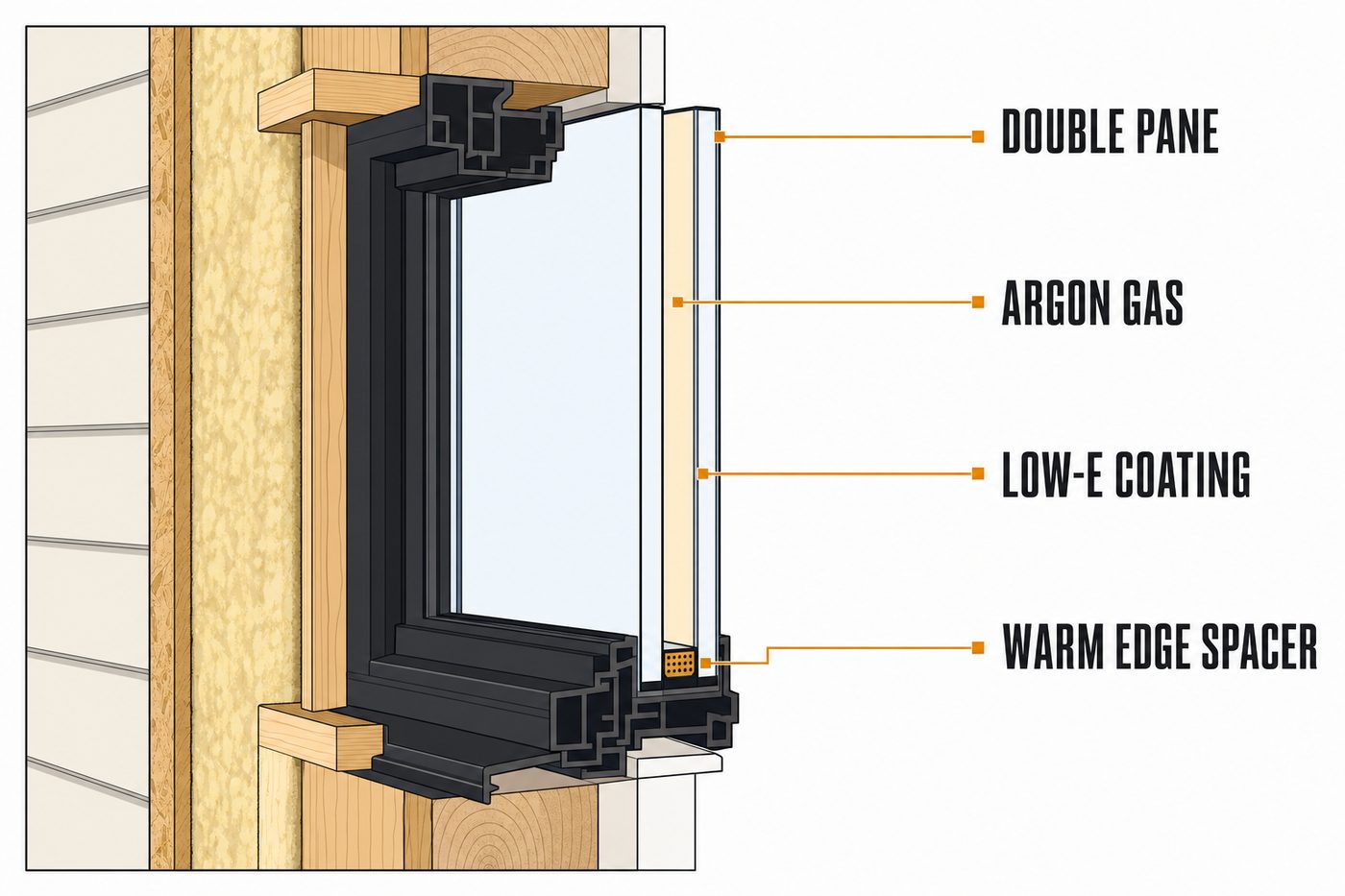
Argon fill and warm-edge spacers are worth having. The gas slows heat transfer across the gap; the spacer keeps the glass edge — where condensation starts — warmer. Cheap spacers are why some newer windows still fog at the corners.
Triple-pane deserves a real look in this valley. In milder markets it's a luxury; at this heating load, on north-facing and bedroom windows, the comfort and condensation improvement is large enough that we'll price it alongside double-pane and let the numbers argue.
For frames, vinyl is the workhorse value and handles cold well; fiberglass moves less with big temperature swings and holds seals longer, at a higher price. Both beat the aluminum they're usually replacing by a wide margin, because aluminum conducts heat almost as well as the glass leaks it.
From Measure to Final Bead
- Audit and measure. Every opening inspected and measured, sorted into now / soon / fine, with notes on any rot or flashing issues at the frames.
- Written quote, per opening. Frame material, glass package, and insert versus full-frame called out window by window, so a phased plan is easy to build.
- Ordering. Replacement windows are made to measure, so there's a manufacturing lead time between deposit and install day. We schedule you before the truck arrives.
- Installation. Insert installs preserve existing interior and exterior trim and go quickly. Full-frame installs — which we recommend where there's rot or failed flashing — take the opening back to the rough framing and rebuild it correctly. Any permits run through the City of Osburn, and we handle them.
- Sealing and walkthrough. Foam, flashing, exterior sealant, interior trim, and an operation check on every unit with you watching.
What Moves a Window Quote
Opening count is the biggest lever, which is why phasing works. After that: size and style (a picture window and an egress-sized slider price differently), frame material, glass package, and — the one people don't expect — the condition of the opening itself. A frame with rot at the sill needs full-frame replacement and some carpentry, not just a new unit slipped in. We flag those during the audit so the quote you sign is the price you pay.
Lead Times and Install Days
Plan for a few weeks between signing and install while your units are manufactured — longer in peak season, shorter in winter. The installation itself moves fast: an experienced crew replaces several openings a day, so most Osburn homes are a one-to-three-day job. Winter installs are routine; we open and close one opening at a time so the house is never standing open to the cold, and swapping a window takes less time than most people expect.
Window Questions From Osburn Homeowners
Can I really replace just two or three windows?
Yes. We price per opening and sequence worst-first. The only caution is appearance — mixing new and old frames on the same street-facing elevation is visible, so we help you phase by elevation when that matters to you.
My windows are double-pane. Why do they still sweat?
Age. Early double-pane units, especially aluminum-framed, run cold at the glass and colder at the edges. Failed seals also let the insulating gas escape, so a 30-year-old double-pane can perform closer to single glass than to a modern unit.
Insert or full-frame — which do I need?
Insert when the existing frame is square, sound, and dry: less cost, less disruption. Full-frame when there's rot, water staining below the window, or flashing that was never right. An insert over a rotten frame just hides the problem while it grows.
Is triple-pane worth it in the Silver Valley?
Here, more than most places. The heating season is long and the cold snaps are real, so the payback and the comfort difference both improve. We'll quote both and show you the gap.
Do you install windows in winter?
Yes, one opening at a time, each sealed the same day it's opened. Winter often means shorter manufacturing lead times as well.
Will new windows fix my cold house by themselves?
They'll fix the coldest surfaces and the worst drafts, and dry sills end the condensation damage. If the house also leaks air at the attic and rim joists, windows are part of the answer, not all of it — we'd rather tell you that up front.
Do I need a permit for window replacement in Osburn?
Requirements depend on the scope — like-for-like inserts and full-frame or size-change work are treated differently. Anything required goes through the City of Osburn, and we manage it.
Should windows wait for a future siding project?
If a re-side is within a couple of years, coordinating them is worth real money — full-frame windows flash best into an open wall. If siding is a someday idea, don't spend winters with failed glass waiting for it.
The Company Doing the Work
Domex Construction carries Idaho license RCE-66940 — verifiable through the Idaho Contractors Board — plus Washington license DAVYDCI833NC, and full insurance. Nine years in business, 32 years of combined crew experience, and window work is a core trade for us alongside siding, not a sideline. Ask about our workmanship warranty when we're at your kitchen table.
Our Silver Valley service area covers Osburn, Kellogg, Wallace, Silverton, and everything along I-90 between them.
Got one window that's finally quit? Start with a free audit of all of them. Give us a call or request an estimate online.
More from Domex in Osburn: Siding Installation in Osburn · Custom Decks in Osburn · Custom Home Builder in Osburn · Window Replacement — Spokane hub