
Deck Builders in Nine Mile Falls, Washington
Deck builders in Nine Mile Falls, WA. River-view decks on sloped ponderosa lots, engineered footings, fire-aware materials. Free estimates.
$1,000 Off
Your Complete Siding Replacement
Get a Free Estimate
FREE same-day estimates on all exterior projects.








Almost every deck project we do in Nine Mile Falls begins the same way: standing at the back of the house with the homeowner, then walking down the slope to figure out where the deck actually wants to sit. The house faces the river or Lake Spokane, the ground falls away toward the water, and somewhere between the back door and the ponderosas is the spot with the view, the evening light, and enough buildable grade. On plenty of lots that flat spot doesn't exist, so the job becomes building it — posts and footings, out over the grade. Finding or making that spot is the real first step, long before anyone talks board colors.
That walk is free. Domex Construction builds custom decks along the river corridor northwest of Spokane, from the older cottages near the water up to the newer view homes toward Suncrest. We're licensed in Washington (DAVYDCI833NC), fully insured, nine years in business with 32 years of combined experience on the crew.
Building on a Grade
The slope that gives you the view is also the problem your deck has to solve.
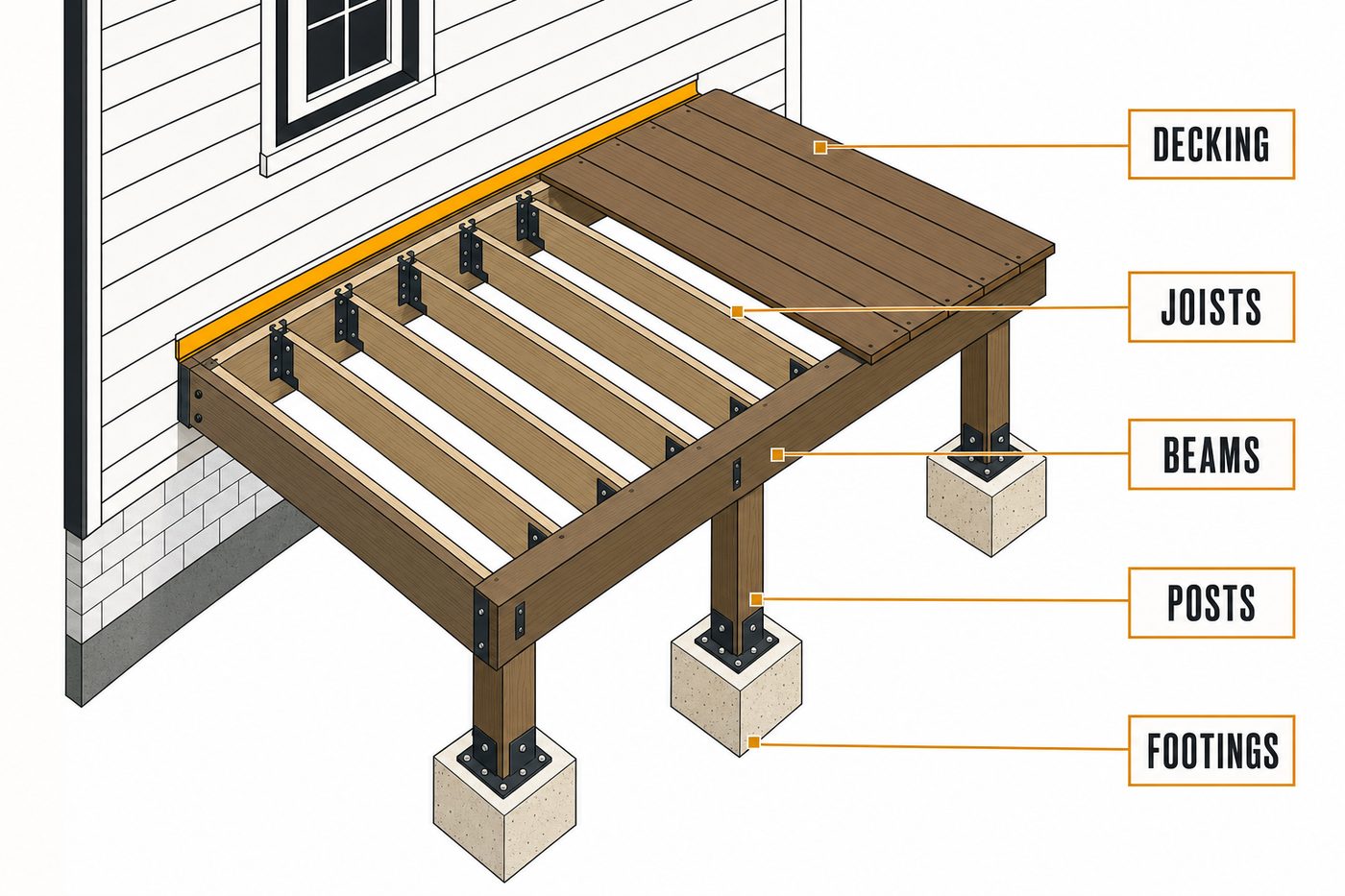
Footings on a Nine Mile Falls hillside rarely line up in tidy equal rows. The downhill posts run tall and carry heavy loads, so their footings go deeper and wider — always below frost depth, sometimes stepped down the slope in tiers, and occasionally redesigned when digging hits rock a foot down — common along this stretch of river. We adjust the footing plan to what the ground gives us. Where the county wants stamped engineering — tall structures, tricky ground — we tell you at the proposal stage, not mid-project.
Above the footings, tall posts need bracing so the structure resists sway, and beams get sized for the snow this side of the county actually collects. The connection back at the house — the ledger — gets through-bolts and flashing that sends water out over the siding, because spring snowmelt moves plenty of water down these lots and the deck-to-wall joint can't be where it sneaks in.
Pointing the Deck at the Water
Orientation is the design decision people underrate. On a river lot, ten degrees of rotation or six feet of shift can change what you see from your chair: water instead of your neighbor's roofline, evening sun instead of glare. We spend real time on layout stakes before committing footings, including where the summer sun lands at six in the evening — a west-facing deck over water gets a double dose of it.
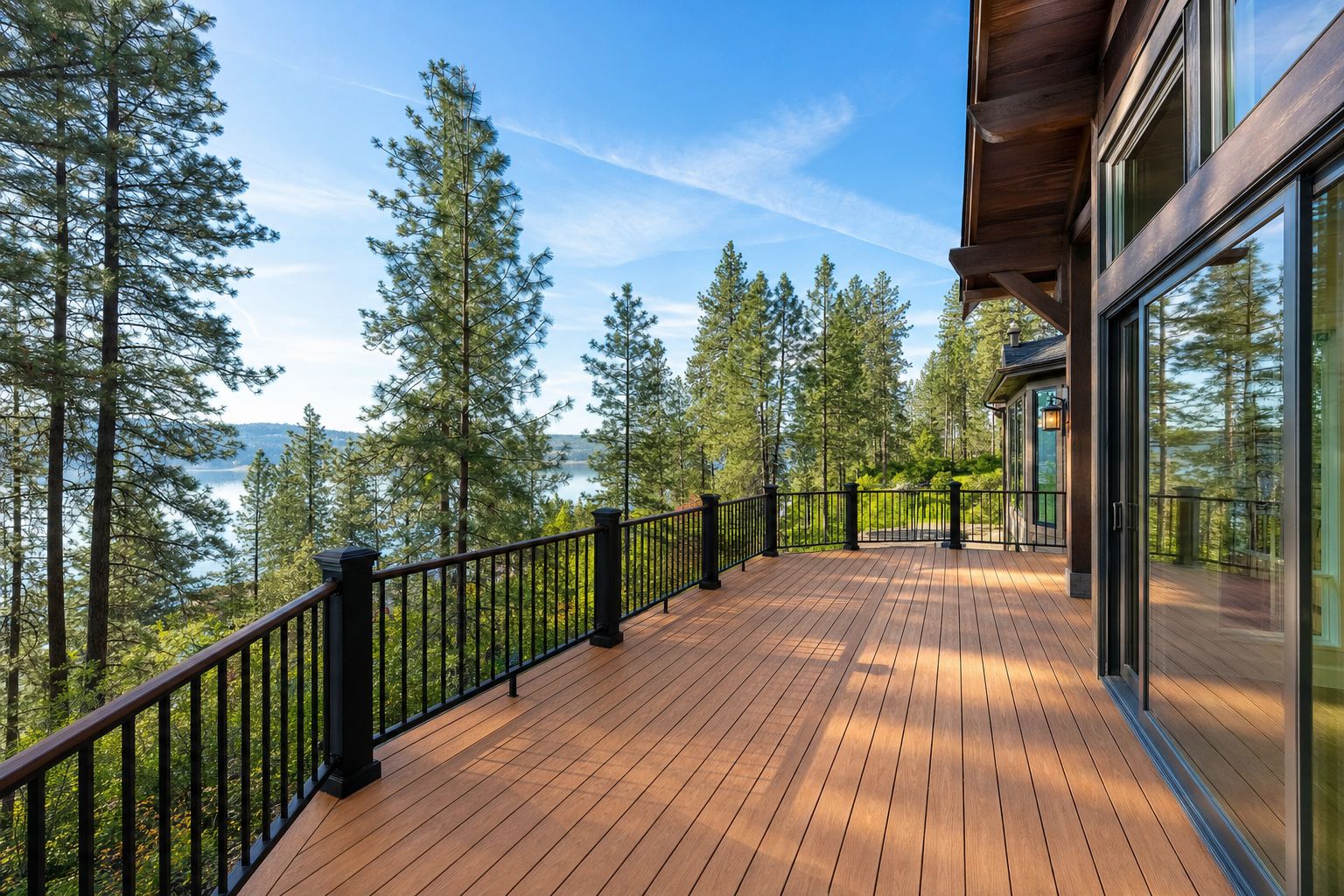
Railings decide the rest. Code sets rail height on any deck more than 30 inches off grade; it doesn't say the rail must block the reason you built the deck. Cable rail and slim metal-picket systems exist precisely for lots like these — from a seated sightline they nearly disappear, where a chunky wood-baluster rail draws a fence across the water. Canyon wind matters too: long cable runs need stiff end posts or they slack and sing, so we frame rail posts for tension.
Boards Under Ponderosa
Nine Mile Falls lots live under ponderosa pine, and the trees set the maintenance terms. Needles drop in volume every fall, collect in board gaps and stair corners, and hold moisture against whatever they land on. Shade from the canopy keeps parts of the deck damp well into spring while the exposed end bakes all summer — one deck, two climates.
Cedar handles this if you handle cedar: annual cleanout of the gaps, wash and re-finish on a short cycle for the shaded sections. It's beautiful and it's a commitment — we say both parts out loud.
Composite is the more common choice here for defensible reasons: no rot under packed needles, no refinishing, sap cleans off, and the shaded and sunny halves of the deck age at the same rate. It still needs its gaps cleared and a spring wash — every deck under pines does. On river cottages we often rebuild old wood decks in composite specifically so a weekend place doesn't come with a refinishing chore attached. Whatever the surface, the framing below is pressure-treated and detailed to drain; boards are replaceable, the frame shouldn't be.
Decks in a Fire-Aware Neighborhood
This is forested country, and a deck is one of the ways embers reach a house — dry boards, needle litter in the gaps, and the sheltered space underneath where debris collects and an ember can sit and work. Material choices push back on that without turning the project into a bunker. Metal railings — the same systems the view already argues for — take the thinnest, most exposed components out of the fuel category. Composite decking varies by product line in how it behaves in fire, and we walk through those differences honestly instead of waving one "fire-safe" label around. Under the deck, noncombustible skirting or a maintained, litter-free zone matters as much as the boards — a winter's worth of needles packed under wood decking is kindling regardless of railing. None of it is county-required; it's judgment from building on these lots all year.
What Drives Cost on a River Lot
Elevation is the honest answer — the same square footage costs meaningfully more ten feet in the air than two feet up on flat ground, because posts, bracing, footings, stairs, and railing length all scale with height. Access is second: materials that can't reach the site by truck get carried down the hill — that's labor. Rock excavation changes footing work. Railing selection swings the number, and view lots usually justify the nicer systems; composite over wood moves it further; tear-off of an old structure adds disposal. Everything shows in the written proposal as line items you can adjust before we start.
From Layout Stakes to Last Board
- Stake the layout. Corners and stairs staked on the actual slope so you can stand where the deck will be and check the view before anything is permanent.
- Lock the design. Final plan, materials, and fixed price on paper; engineering brought in where the structure calls for it.
- Permit through the county. Nine Mile Falls is unincorporated, so permits run through the county — Spokane County for most parcels, Stevens County north of the line. We file and map inspections into the schedule.
- Excavate, pour, frame. Footings dug or adjusted to what the slope allows, posts and beams set and braced, ledger bolted and flashed, county sign-off before cover.
- Surface and finish. Decking, railings, stairs, cleanup, and a walkthrough where you put weight on every rail before we leave.
How Long It Takes
Two clocks run on a Nine Mile Falls deck. The calendar clock — design and county permitting — usually runs longer than the tools-on-site clock: winter conversations put homeowners on their deck by early summer, while May callers often land in late season. The build clock scales with elevation and access: a modest deck near grade goes up in about a week; a tall river-view structure with tiered footings and long stairs can run several weeks. Footings want to go in before the ground freezes; framing and decking carry on through cold weather.
Questions We Hear Along the River
Our lot drops steeply toward the water — can a deck even work?
Almost always, with structure to match the grade. Stepped footings, engineered posts, and bracing are routine for us on this corridor. Steep costs more than flat; it's rarely a dealbreaker.
Which railing keeps the river view open?
Cable rail and slim metal-picket systems are the two we install most on view lots. Both meet code height and both nearly disappear from a seated sightline compared to wood balusters.
Are there deck materials that make sense for wildfire risk?
Yes — metal railings, composite lines chosen with fire behavior in mind, and a clean, skirted or maintained zone under the deck all reduce what an ember can do. We lay out the options without dramatizing them.
Is composite worth it on a weekend place we don't visit often?
That's the strongest case for it — wood decks suffer most from deferred maintenance, and a part-time cottage defers by definition. Composite plus a spring visit with a hose is a workable regimen.
Who handles the county paperwork out here?
We do. Depending on the parcel, the permit runs through Spokane County or Stevens County; we file, schedule, and meet the inspectors.
When should we call to have a deck ready for summer?
Winter. Design and county permitting take weeks before the build starts, and spring build slots fill first. A January conversation is how you get a June deck.
License, Insurance, and Where We Work
Domex Construction is a licensed Washington contractor — DAVYDCI833NC, verifiable through the state L&I lookup — licensed in Idaho as RCE-66940, and fully insured. Ask about our workmanship warranty at the estimate. From Nine Mile Falls we serve the whole corridor: Suncrest, Tumtum, Ford, Seven Mile, Five Mile, and northwest Spokane.
Want to walk your slope with a builder before you commit to anything? Estimates are free anywhere in Nine Mile Falls and Suncrest. Give us a call or request an estimate online.
More from Domex in Nine Mile Falls: Siding Installation in Nine Mile Falls · Window Replacement in Nine Mile Falls · Custom Home Builder in Nine Mile Falls · Custom Decks — Spokane hub