
Window Replacement in Medical Lake, WA
Window replacement in Medical Lake, WA. Full-frame installs for century homes, upgrades for mid-century blocks, wind-tight glass. Free estimates.
$1,000 Off
Your Complete Siding Replacement
Get a Free Estimate
FREE same-day estimates on all exterior projects.








Wind is the resident weather on the West Plains. It crosses miles of open ground before it reaches Medical Lake, and when it hits a house it goes looking for openings — and finds every gap that a century of settling has pried loose. On a January night with a northeast blow, you can hold a hand near an old window sash in this town and feel exactly where your heating dollars leave the building.
Windows are the concentrated version of that problem. A wall leaks air through a thousand small paths; a bad window leaks through one big one, right where you sit. Domex Construction replaces windows across Medical Lake — the 1890s-era frame homes near the lake, the mid-century blocks, the newer streets — under Washington license DAVYDCI833NC, and the work starts with an honest read of what each opening actually needs.
Openings That Are 100 Years Out of Square
Medical Lake's oldest housing goes back to its resort decades, and those homes have been settling on their foundations since before the state paved the highway out here. Their window openings are rarely square anymore. Sills slope, jambs lean, and the original single-pane sashes — some still hanging on weight-and-pulley hardware — have been painted, swollen, and planed into a truce with their frames.
Here is where we differ from the companies that quote everything as a quick insert job. An insert window slides a new unit inside the old frame. That's legitimate when the frame is sound and reasonably true. Put an insert into a racked, rot-softened hundred-year-old frame and you've sealed a new window to a failing structure — you lose glass area, keep the rot, and inherit the air leaks around a frame that was never flashed. On most century homes here, full-frame replacement is the honest recommendation: old frame out to the rough opening, sill and framing repaired, the opening flashed with modern materials for the first time in its existence, then the new unit set plumb and square. It costs more. It's also the version that's still tight in twenty years, and we'll tell you frankly which of your openings need it and which don't.
The Mid-Century Blocks: Easier Wins
The ranches and split-levels that filled in around town from the 1950s through the 1980s are a friendlier story. Their openings are usually square-ish and their frames sound, so inserts often make sense — which keeps cost down and disruption minimal.
What they're carrying is bad glazing. Original aluminum sliders are the classic case: the frame conducts cold straight through, so the interior metal frosts and drips all winter, staining sills and feeding mold in the corners. Early vinyl double-panes from the '80s and '90s have their own tell — fogging between panes as seals fail, one window at a time. If three of your seals have gone, the rest are on the same clock; replacing the set at once costs less per window than picking them off over five years.
Wind, Glass, and What Actually Pays Off
Window shopping tends to fixate on U-factor, but on an open-plains lot the spec sheet line that matters just as much is air infiltration. Wind pressure forces air through sash joints and weatherstripping, and it does it hardest exactly when it's coldest. A well-built window with tight compression seals outperforms a nominally better-insulated unit that leaks under load. We spec for that, because Medical Lake tests it nightly from November through March.
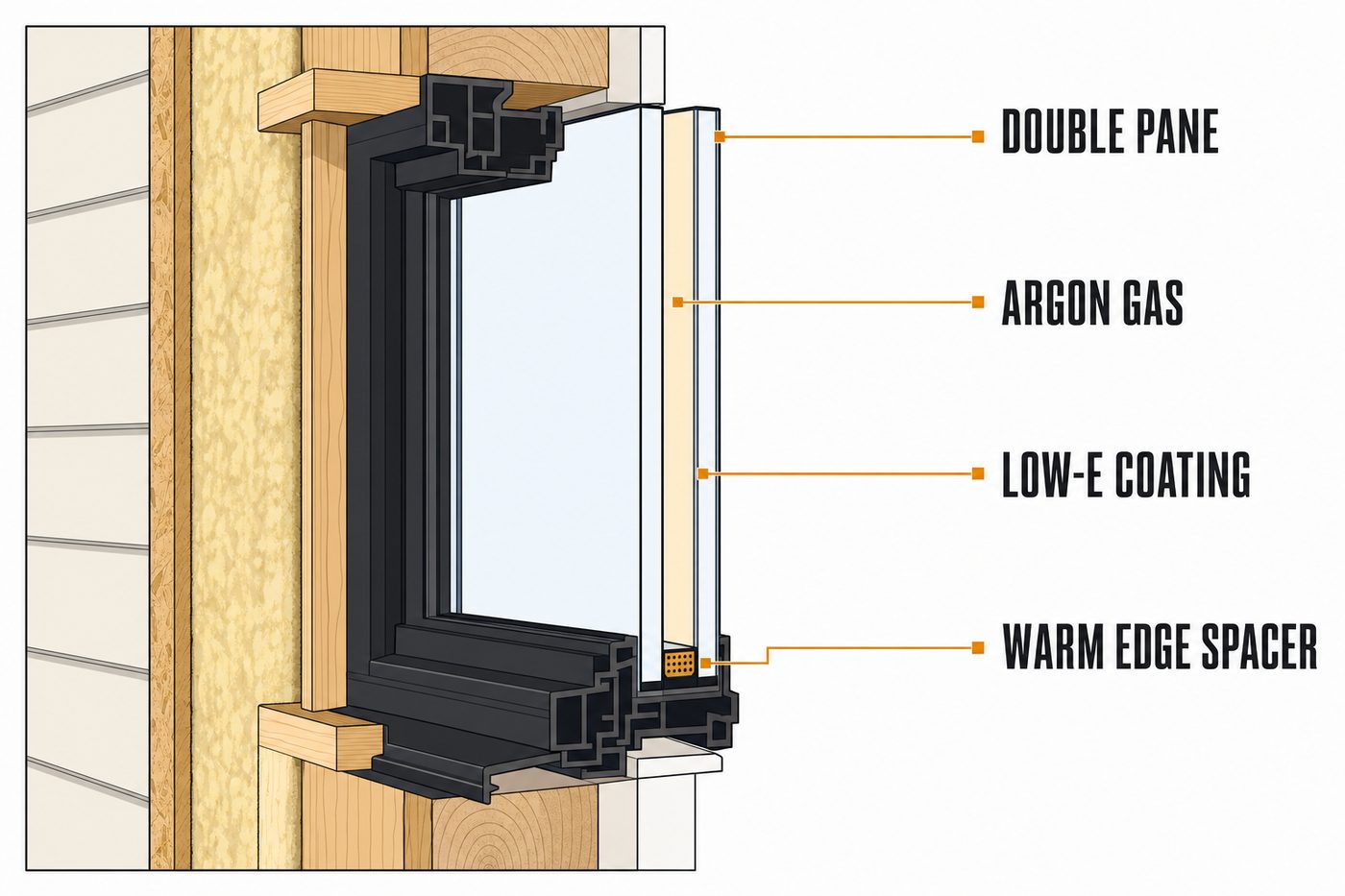
Glass economics here run on orientation. West- and south-facing glass takes this region's strong summer sun — rooms that overheat by 4 p.m. want a lower solar-heat-gain low-E coating. North- and east-facing glass mostly fights winter heat loss, so the priority flips toward insulation value: double-pane low-E with argon fill is the sensible baseline, and warm-edge spacers cut the condensation ring that forms at pane edges on subzero nights. Triple-pane earns its premium on the coldest exposures and near bedrooms facing the prevailing wind, where its sound-damping is a quiet bonus. We spec glass window-by-window rather than selling one package for the whole house, because the west wall and the north wall are living different lives.
How the Work Goes
- Measurement visit. Every opening measured, every frame checked for rot and square. You get a straight verdict per window: insert or full-frame, and why. Free.
- Written proposal. Frame material, glass package by orientation, install method per opening, and trim scope, all on paper.
- Ordering and permitting. Units are built to order. Any required permit runs through City of Medical Lake; we manage it.
- Installation. Old units out, openings repaired and flashed, new units set, insulated, sealed, and trimmed. A typical crew day covers several windows, so most homes finish in one to three days.
- Final check. Every sash operated, every lock engaged, sealant lines inspected, and your questions answered before we leave.
What Moves the Price of a Window Job
Count is the obvious driver, and full-frame openings cost more than inserts because they include carpentry, not just a unit swap. Beyond that: frame material (vinyl at the value end, fiberglass and composite above it, wood-clad at the top), glass upgrades like triple-pane or specialty low-E, large or arched openings, and any rot repair the tear-out reveals — which we handle under contingency terms written into the proposal, not improvised on invoice day. Egress requirements can shape bedroom window choices, and we flag that during measurement rather than after ordering.
Scheduling Around the Seasons
The build time on ordered units — typically several weeks, varying by manufacturer and season — sets your timeline more than the install does. Winter installs are routine for us: openings are done one at a time, so the house is never standing open, and each window is weathered-in the same day. The one thing we won't fight is a high-wind day with large glass; handling a picture window in a prairie gust is a broken-unit risk we schedule around. Book a spring measurement and you're typically enjoying the new windows before the heat arrives; book in fall and you're tight before the cold.
Straight Answers on Windows
Insert or full-frame — how do I know which I need?
You don't have to know; the frame does. Sound, square frames take inserts. Rotted or badly racked frames need full-frame work. We check every opening and give you a per-window answer, not a blanket upsell.
Are my foggy windows failed, or just dirty?
Fog between the panes means the insulated seal has failed and the argon is gone. That window is now insulating far below its rating. Cleaning can't reach it; replacement is the fix.
Why do my aluminum windows drip water all winter?
The metal frame conducts cold indoors, and interior humidity condenses on it. It's the frame material, not a humidity crisis in your house. Modern vinyl, fiberglass, or wood-clad frames end it.
Is triple-pane worth it in Medical Lake?
On north-facing and wind-facing glass, and for bedrooms where wind noise bothers sleep, often yes. On sheltered or small openings, double-pane low-E with argon usually hits the value sweet spot. We'll price both so you can see the gap.
Do I need a permit to replace windows here?
Requirements depend on scope — like-for-like swaps and size changes are treated differently. City of Medical Lake permitting applies in town, and we sort out and handle whatever your project requires.
Can you replace windows in an occupied house in winter?
Yes. One opening open at a time, sealed the same day. Winter is often the season with the shortest wait.
Will new windows change how my old house looks?
Not if we spec them right. Grille patterns, exterior color, and trim profiles can match the original character of a century home — that conversation happens at the proposal stage, not after installation.
Should I do windows and siding together?
If both are within a few years of due, yes — flashing integrates better and you pay for wall access once. We do both, on one schedule.
Who You're Hiring
Domex Construction: 9 years in business, 32 years of combined team experience, licensed in Washington (DAVYDCI833NC, verifiable through the state L&I lookup), and fully insured. Window work is part of a full exterior practice — siding, windows, decks — so the flashing details between trades get done by people who own all of them. Ask about our workmanship warranty at your estimate.
We serve Medical Lake and the rest of the West Plains — Cheney, Airway Heights, and Four Lakes — along with Spokane and surrounding communities.
Feel the draft now, fix it before next winter. Free window estimates in Medical Lake. Give us a call or request an estimate online.
More from Domex in Medical Lake: Siding Installation in Medical Lake · Custom Decks in Medical Lake · Custom Home Builder in Medical Lake · Window Replacement — Spokane hub