
Window Replacement in Kellogg, Idaho
Window replacement in Kellogg, Idaho: company houses, cold valley floors, ski rentals. Licensed, insured, free estimates. Call Domex today.
$1,000 Off
Your Complete Siding Replacement
Get a Free Estimate
FREE same-day estimates on all exterior projects.








Here's something you notice after replacing windows in enough Kellogg company houses: the openings are small on purpose. Mining companies built these houses to be cheap to heat with a coal stove, so they gave each room one modest window and called it good. A hundred years later that stinginess produces the most dramatic before-and-after in our service area — swap a wavy single-pane sash and its storm window for a modern clear-glass unit, and a room dim since 1917 suddenly has real daylight. Same opening. The old glass, thick frames, and storm hardware were eating a startling share of the light.
That's the job in Kellogg: getting the most from openings sized for a different century, in a valley that gets genuinely cold. Domex Construction runs window projects throughout the Silver Valley under Idaho license RCE-66940, an easy I-90 run from our Spokane–Post Falls home base.
Small Openings, Played Right
The temptation with a company house is to cut bigger holes everywhere. Sometimes that's the right call. Often it isn't, and we'd rather tell you which is which before you spend money.
Where enlargement is worth it: bedrooms that don't meet modern egress. Plenty of Kellogg bedrooms have openings too small for code-compliant escape, and if the house is becoming a short-term rental, sleeping-room egress isn't a nice-to-have — it's the line between a listable bedroom and a den. Cutting a sill lower or widening for a proper egress unit is structural work, and we scope the header and framing honestly instead of pretending it's a same-day swap.
Where it usually isn't: everywhere else. Enlarging an opening on a wall that's due for siding anyway is reasonable; cutting into a wall with sound siding adds exterior patching costs that rarely pay back. Modern glass in the existing opening captures most of the light gain at a fraction of the price, and slimmer frames make the same rough opening feel bigger while keeping the house's mining-era face intact.
We give you that math opening by opening. Some Kellogg projects end up as two enlargements and eight straight replacements — usually the version that makes sense.
Glass for a Valley Floor That Holds Cold
Kellogg's valley is narrow, and cold air behaves like water in it — it drains off the slopes at night and pools on the valley floor, where most of town sits. On still winter nights the coldest air in the Silver Valley is at your window sill. That's why single-pane and early aluminum-frame windows here don't just leak heat, they run wet: interior condensation forms on the cold glass and frame, drips onto sills and drywall, and feeds the black staining and soft sill wood we find in house after house.
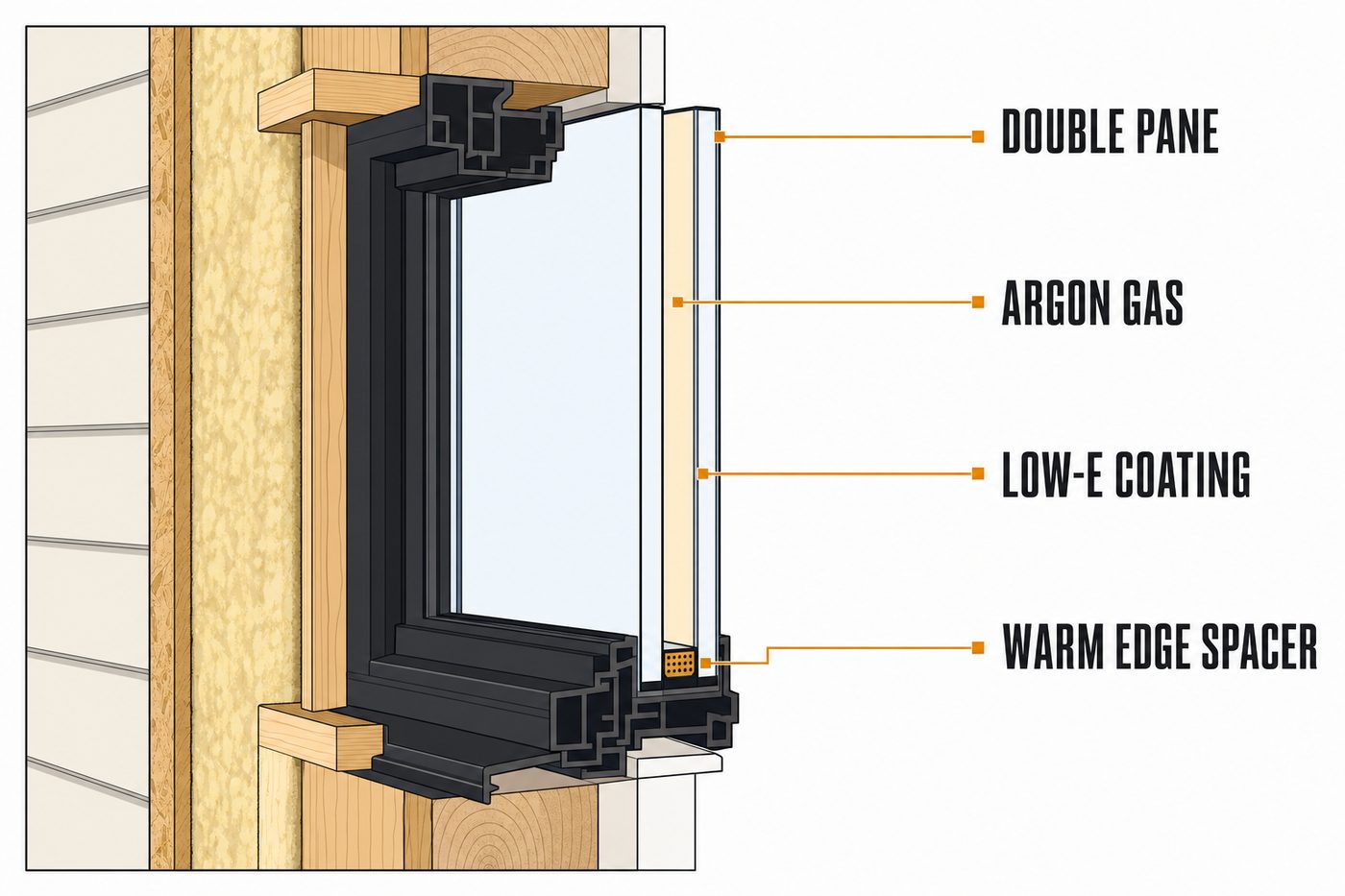
The fix is a glass package and frame built for the exposure. Double-pane low-E glass with argon fill keeps the interior surface warm enough that room moisture stays in the air instead of condensing; warm-edge spacers cut the cold ring at the glass perimeter where fogging starts; and non-conductive frames — vinyl or fiberglass — break the thermal path that made old aluminum frames sweat. North-facing rooms in terrain shade get the stronger low-E coatings; south walls that catch valley sun get a balance of heat retention and useful winter solar gain. Frost on the inside of your glass in January is the clearest sign your windows are done — not drafty yet, maybe, but done.
Hardware That Survives a Rental Calendar
A window in an owner-occupied house gets operated a few hundred times a year by people who own it. A window in a gondola-district rental gets operated by a different family every weekend, in ski gloves, usually harder than necessary. Rental owners should spec for it: metal-reinforced locks rather than light-duty plastic, tilt-in sashes so turnover cleaning doesn't involve a ladder, limiters on upper-floor units where kids sleep, and screens that pop back in without a service call. None of this costs much at order time. All of it costs real money and blocked bookings when a guest snaps a flimsy latch in February. We'll flag the handful of upgrades that matter and skip the ones that don't.
How We Run a Kellogg Window Job
- Measure and assess. Every opening measured, every sill probed, egress checked in every sleeping room. You get a straight report on which openings need structural work and which don't.
- Spec on paper. Frame material, glass package, hardware level, insert versus full-frame per opening, and exactly how exteriors get trimmed and flashed. Free estimate, itemized.
- Permitting. In-town work runs through City of Kellogg permitting; we file it and fold inspections into the schedule.
- Install. Openings are opened, corrected, and closed the same day — nobody in Kellogg leaves a hole in a wall overnight in January. Full-frame installs get new flashing tied into the weather barrier; inserts get sealed and insulated at the perimeter, not just foamed and forgotten.
- Final operation check. Every sash cycled, every lock thrown, every screen seated, with you watching.
What Moves the Price
Opening count sets the baseline, but the spread between quotes comes from four places. Insert versus full-frame: inserts preserve sound existing frames and cost less; full-frame replacement is the honest answer where sills are rotted or frames are out of square — common in settled company houses. Structural changes: egress enlargements carry framing, header, and exterior-patch costs that simple swaps don't. Glass and frame tier: fiberglass frames and upgraded low-E packages cost more than builder-grade vinyl and earn it on the cold north exposures. And condition surprises: a century of paint, settling, and moisture means some openings fight back. We price the known scope fixed and state contingency terms in writing.
Timing It
Window replacement is close to a year-round trade for us — installs are one opening at a time, so your house is never opened up the way a re-side leaves it. Winter jobs are routine here and often quicker to schedule. Rental owners book shoulder seasons — April–May or October dead weeks — so no earning weekend is lost. Lead time is mostly manufacturing: standard sizes turn fastest, while custom sizes for odd company-house openings — there are always a few — add weeks, which is why measuring early beats panicking before ski season.
Answers for Kellogg Window Shoppers
Can I keep the original look of my company house with new windows?
Yes. Trim profiles and grille patterns can echo the original sash layout while the working parts go fully modern — one of our most common Kellogg requests.
Do my bedroom windows have to meet egress if I'm converting to a short-term rental?
Sleeping rooms need code-compliant egress, and inspectors and insurers both look for it. We check every bedroom at the estimate and tell you which openings pass and which need enlargement.
Why do my windows drip water on the inside every winter?
Interior condensation — indoor moisture hitting glass chilled by valley-floor cold. It's the top reason Kellogg homeowners call us; modern low-E units keep the surface warm enough to stop it at normal household humidity.
Insert or full-frame — which do I need?
Insert if your existing frames are square, sound, and dry; full-frame if there's sill rot, racking, or you want the maximum glass area from a small opening. Most Kellogg houses end up with a mix, and we spec it opening by opening.
Can windows really be installed in a Silver Valley winter?
Yes — one opening at a time, weather watched, interior protected. Cold-weather sealants and same-day close-in are standard practice for us.
Will new windows cut my heating bill?
Replacing single-pane or aluminum-frame units makes a real difference — those are the worst offenders in a cold-pooling valley. We won't promise a percentage, but the comfort change at the glass is immediate.
Do you handle the permit with the city?
Yes. City of Kellogg permitting is part of the job scope, filings and inspections included.
How far do you actually travel for a window job?
Kellogg is inside our normal I-90 rotation from the Spokane–Post Falls base, and we batch Silver Valley work so travel never bumps your schedule.
The Paperwork That Protects You
Domex Construction is licensed in Idaho (RCE-66940, look it up through the Idaho Contractors Board), licensed in Washington, and fully insured, with nine years in business and 32 years of combined team experience behind every install. Ask about our workmanship warranty on top of the manufacturer coverage on your units.
Our window crews cover Kellogg, Wardner, Smelterville, Pinehurst, Osburn, and the rest of the Silver Valley along I-90.
Ready to see what your openings can actually do? Free on-site estimates. Give us a call or request an estimate online.
More from Domex in Kellogg: Siding Installation in Kellogg · Custom Decks in Kellogg · Custom Home Builder in Kellogg · Window Replacement — Spokane hub