
Custom Deck Builders in Kellogg, Idaho
Custom deck builders in Kellogg, Idaho. Sun-smart placement, snow-rated framing, compact-lot design. Licensed & insured. Free estimates.
$1,000 Off
Your Complete Siding Replacement
Get a Free Estimate
FREE same-day estimates on all exterior projects.








Kellogg runs east to west along the floor of a valley tight enough that sunlight is a scheduled event. The south wall of mountains throws shade across whole neighborhoods for part of the day — longer in winter, when the sun barely clears the ridge — and the gondola climbing out of town is a daily reminder of how steep the terrain is on every side. Build a deck without thinking about that geometry and you get a beautiful platform sitting in shadow exactly when you'd want to be on it.
So deck design in Kellogg starts with a question most towns never ask: when does the sun actually reach this spot? Domex Construction builds custom decks across the Silver Valley — for longtime locals, company-house renovators, and short-term-rental owners who know outdoor space is worth real money in a listing photo. Idaho license RCE-66940, fully insured, and an hour up I-90 from our Spokane–Post Falls base.
Reading the Sun Before Pouring a Footing
Two houses a block apart in Kellogg can have completely different solar situations depending on which side of the valley they sit and what the ridge does behind them. North-side houses face south and collect the best light in town; houses tucked against the north-facing slopes trade sun for shelter and hold snow far longer. Before drawing anything, we stand in your yard and work out where light lands in July and in October — a deck that only works in high summer is a short season.
Placement follows the light, and elevation is often the tool that finds it. Lifting a deck to second-story height — off a kitchen or main living floor — can pull it out of fence-line and neighbor-roof shade into hours of sun the yard never gets, and open a view up the valley you didn't know you had. On steep lots climbing toward Wardner, an elevated or stepped deck is often the only usable flat outdoor space on the property. Wraparound sections earn their cost too: a deck that turns a corner follows the sun from morning to evening instead of getting one good hour.
Framing for Silver Valley Snow
Kellogg gets real mountain snow, and a deck is a horizontal surface that catches all of it. Our framing here is engineered to the snow-load requirements the permit demands, not to lowland span tables — tighter joist spacing, beefier beams, footings below frost depth so heaving winters don't rack the structure. It's the least photogenic money in the project and the most important.
The detail homeowners never think about is the shed zone. A metal roof — and Kellogg has plenty — releases its snow in concentrated slides, and a deck built in that drop line takes a dynamic load far beyond what falls from the sky. During design we either keep the deck out of the shed path, add snow retention above it, or frame that zone to take the hit. We also detail ledger flashing like the siding contractors we are — the ledger is where deck failures start, and meltwater against the house all winter is exactly the exposure Kellogg provides.
Big Ideas on Small Lots
Company houses came with company lots — compact, rectangular, close to the neighbors. Building a generous deck on one is a design problem we enjoy. Sometimes the answer is elevation. Sometimes it's built-in benches and planters that replace furniture, keeping the walking surface clear. Sometimes it's a deck running the full narrow side of the house rather than squaring off the back, catching a sun angle the backyard never sees. Privacy screening matters more in town than on acreage, and a louvered panel doubles as a windbreak when evening cold air drains down the valley. On rentals we design for the listing photo and the group of six: zones for the grill, the hot tub, the table — outdoor space is a booking filter people search by.
Decking, Rails, and What Holds Up Here
Composite decking is what most Kellogg clients land on, and for rental owners it's nearly automatic. Months under snowpack, shovel blades every storm, and zero appetite for annual staining all point the same direction. Capped composites shrug off moisture, don't splinter, and hold color through snow-glare UV.
Cedar and treated wood still make sense on tighter budgets — lower cost up front, honest good looks, and repairable with a screw gun. The trade is maintenance: in this snow, wood wants refinishing on a real schedule, and shaded north-side decks grow slick algae film if neglected.
Railings get more thought here than in mild climates. Metal balusters or cable rail outlast wood pickets under freeze-thaw, and thinner profiles keep the valley in sight from a chair. Where a deck doubles as winter access, stair treads and landings get built with traction and shoveling in mind.
What the Price Depends On
Size and height drive the baseline — elevated decks carry more structure, more footings, and more railing than ground-huggers. Site work is next: steep-lot footings and limited machine access on tight in-town lots add labor. Decking and railing selections swing the materials line more than anything else, with capped composite and metal rail at the top and treated wood at the bottom. Extras like built-ins, screening, lighting, and hot-tub-rated framing are priced as listed options so you see what each adds. Every quote is fixed, written, and itemized after a free site visit.
How a Deck Comes Together
- Site visit and sun read. We walk the lot, track the light, check soil and slope, and talk through how you'll actually use the space.
- Design and fixed quote. A drawn plan with dimensions, materials, railing, and options priced individually.
- Permit and engineering. Deck permits in town go through City of Kellogg permitting, with framing documented to the required snow loads. We handle all of it.
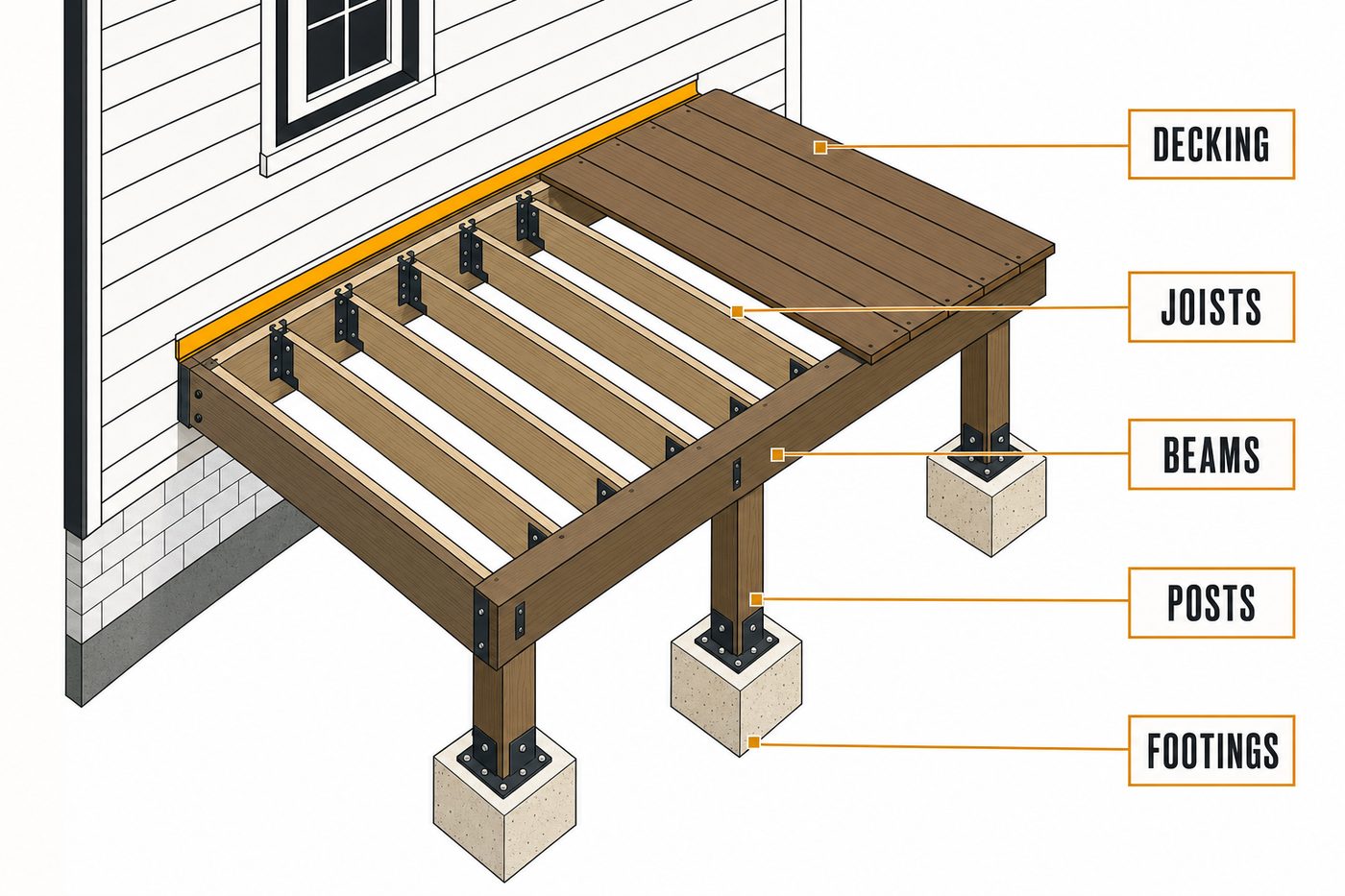
- Footings and frame. Excavation below frost line, concrete, hardware-connected framing, and ledger flashing done to siding-contractor standards.
- Decking, rails, and walkthrough. Surface and railings installed, site cleaned, and a board-by-board review with you before we leave.
Booking a Build
Deck season concentrates into May through October, and the calendar fills from the front. Spring estimates get summer builds; mid-summer callers sometimes land in September — honestly a fine month to build here. Fall builds are underrated: a deck finished in October cures over winter, is ready for spring's first warm weekend, and photographs for winter hot-tub listings in the meantime. Most builds run one to two weeks on site once permits and materials are in hand; steep-lot footings and custom railing orders are the usual stretchers.
Deck Questions We Hear in Kellogg
How much snow load does a deck here need to handle?
Whatever City of Kellogg permitting requires for your site — Silver Valley numbers run far above mild-climate assumptions. We design to the permitted spec and put the engineering in your documents.
Should I shovel my deck in winter?
A properly engineered deck carries its design snow load, but shoveling the paths you use is smart. A plastic-edged shovel won't mark composite or wood.
Can you build on my steep lot?
Steep lots are normal work for us in Kellogg and Wardner. Elevated framing on engineered footings is usually the answer, and the view often makes it the best deck on the block.
Is composite worth the extra cost for a rental?
Almost always. No refinishing, no splinters for barefoot guests, no maintenance visits eating booking weekends. Wood's lower up-front price rarely survives contact with a rental maintenance calendar.
Will a hot tub need special framing?
Yes — a filled tub is a concentrated load on top of snow load, and the frame under it gets designed for it. Retrofitting later costs more than planning now.
Do you build decks outside Kellogg itself?
All over the valley — Osburn, Pinehurst, Smelterville, Wardner, and the rest of the Silver Valley corridor. I-90 from our Spokane–Post Falls base makes the whole valley routine range.
How long will a composite deck actually last here?
The frame, built to spec and flashed properly, is a multi-decade structure. Capped composite surfaces carry long manufacturer coverage and realistically outlast the will to replace them. Ask about our workmanship warranty on the build itself.
Who You're Hiring
Domex Construction — nine years in business, 32 years of combined crew experience, Idaho license RCE-66940 (verify it through the Idaho Contractors Board), Washington-licensed as well, and fully insured. We build decks the way we build exteriors: flashing first, structure to spec, finishes chosen for the climate they'll actually live in.
Want a deck that catches the sun this valley allows? Free on-site design estimates across Kellogg and the Silver Valley. Give us a call or request an estimate online.
More from Domex in Kellogg: Siding Installation in Kellogg · Window Replacement in Kellogg · Custom Home Builder in Kellogg · Custom Decks — Spokane hub