
Window Replacement in Deer Park, Washington
Window replacement in Deer Park, WA sized for cold-pocket winters. Full-frame and insert installs, honest advice, free estimates. Call today.
$1,000 Off
Your Complete Siding Replacement
Get a Free Estimate
FREE same-day estimates on all exterior projects.








Deer Park freezes harder than Spokane. The town sits in a known cold pocket, and on a clear, still night the temperature here drops several degrees past what the Spokane forecast promised — earlier frosts in fall, deeper lows in winter, more nights below zero. You feel that difference standing next to a window before you ever see it on a utility bill. Cold glass pulls heat off your skin from across the room, and the oldest windows in town announce themselves every January.
Domex Construction replaces windows throughout Deer Park and the surrounding acreage, licensed in Washington under DAVYDCI833NC. Two facts shape our advice here more than anywhere else we work: the cold pocket rewards better glass faster, and the town's oldest houses punish shortcuts around the frame.
Reading the Frost on Your Glass
Condensation on a window is a thermometer you can see. Indoor air always carries moisture — cooking, showers, people breathing — and that moisture condenses on any surface cold enough to bring it to its dew point. The colder the interior face of your glass, the more mornings it happens, and Deer Park's nights make interior glass colder than the same window would be in Spokane.
Where the water shows up tells you what's failing. Fog or ice at the bottom corners of the glass points to a cold edge — old aluminum spacers conducting the outdoor temperature straight through. A milky haze between the panes means the insulated glass seal has failed and the unit is done, no matter how good the frame is. Frost on the frame itself is common on older aluminum windows, which conduct cold so well the metal becomes the coldest surface in the room. And water pooling on the sill every cold morning isn't cosmetic — it runs into the joinery, and year after year it's what rots sills from the inside.
What Better Glass Buys You in a Cold Pocket
U-factor measures how fast heat escapes through a window — lower is better. Here's why the number matters more in Deer Park than twenty miles south: savings from a lower U-factor scale with the temperature difference between inside and outside, and this town spends more hours at bigger differences than Spokane does. The same upgrade pays back faster here.
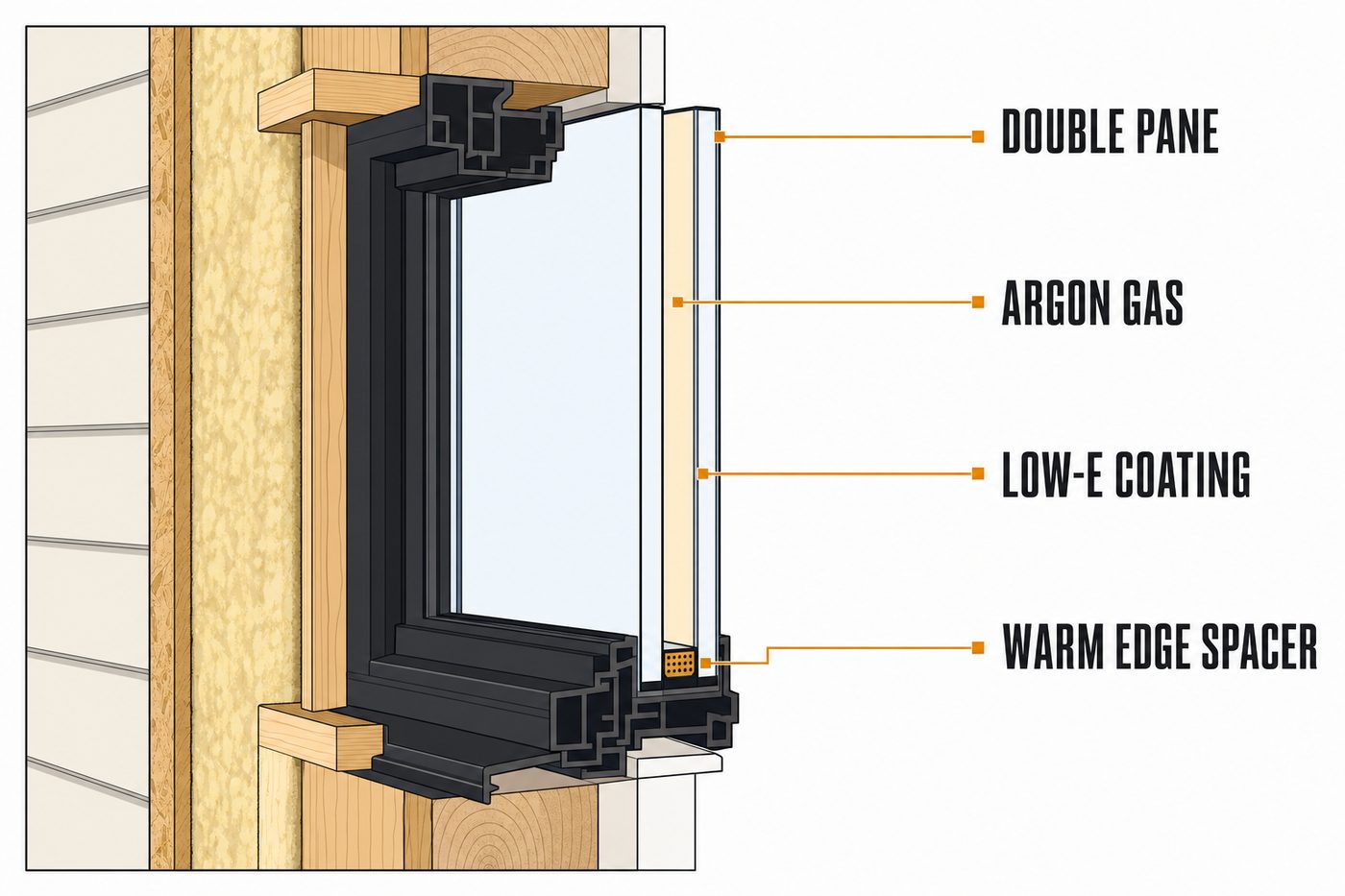
Washington's energy code effectively requires U-0.30 or better on replacement windows, and we treat that as the floor, not the target. Double-pane units with low-e coatings, argon fill, and warm-edge spacers meet it comfortably; triple-pane drops the number further and is worth a real conversation in this climate: a warmer interior pane also means fewer condensation mornings and a warmer seat by the window. Orientation belongs in the decision too. South and west walls on open parcels take strong sun and summer heat, so glass coatings can be tuned wall by wall: let winter sun in where it helps, knock down summer gain where it doesn't.
Farmhouse Openings Are Rarely Square
The pre-war frame houses in the old core of town have settled for a century, and their window openings have settled with them. Sills slope, jambs lean, and the original single-pane units were often the only thing bridging the gap.
This is where we're direct with homeowners about insert versus full-frame replacement. An insert window slides into the existing frame — faster, cheaper, less disruption. But an insert inherits everything about that frame: its rot, its air leaks, its out-of-square geometry, and the uninsulated weight pockets beside old sash windows — hollow channels of winter air inside your wall. Putting new glass into a compromised frame buys the look of a new window without most of the performance. Full-frame replacement takes the opening back to the rough framing, lets us square it, insulate the cavities, and flash it correctly, and on most of Deer Park's older housing it's the version of the job we can stand behind. When an existing frame is genuinely sound, we'll say so and quote the insert — the walkthrough is where that gets decided, not the sales pitch.
Builder Units in the New Subdivisions
The subdivisions built during Spokane's northward growth spurt came with builder-grade vinyl windows, and those units are now reaching the age where seals let go. The pattern is familiar: one window fogs between the panes, then two more the next winter, because the whole house's units share the same manufacture date and the same duty cycle. On these homes the frames and openings are usually fine, so the fix can be proportionate — sometimes glass-unit replacement, sometimes inserts, occasionally a whole-house package if enough seals have failed to make piecemeal work false economy. We'll count the failed units and price the options side by side rather than defaulting to the biggest job.
The Way an Install Goes
- Measure and assess. Every opening measured, every frame checked for rot and square. This visit decides insert versus full-frame, honestly, opening by opening.
- Spec and order. Glass package, frame material, grid style, and coating choices by orientation — in writing. Manufacturing lead time starts here.
- Permits. We confirm what the City of Deer Park requires for window replacement — or Spokane County for addresses outside the line — and file whatever applies.
- Installation. Openings are opened one at a time and closed the same day, so the house is never left uncovered overnight. Full-frame openings get squared, insulated, and flashed before the unit sets.
- Seal, trim, and demonstrate. Interior and exterior sealing, trim restored or upgraded, and every sash operated with you before we sign off.
What Sets the Cost
Window count is the baseline, but it's not a simple multiplication. Full-frame openings cost more than inserts because they involve carpentry, insulation, and flashing rather than just a unit swap. Frame material moves the number — vinyl, fiberglass, and wood-clad occupy different tiers. Glass packages stack: triple-pane, upgraded coatings, and specialty glass each add cost this climate can justify; your budget decides. Rot repair discovered at tear-out adds carpentry, which is why we assess frames up front rather than pricing blind. Large or custom shapes on older houses cost more than standard sizes.
Timing the Project
Manufacturing lead time — typically a few weeks from order — sets the schedule more than the season does. Installation itself is a year-round trade here: because each opening is closed the same day it's opened, a winter install costs the house a few hours of one room's heat, not a night of exposure. Most whole-house jobs run one to three days on site. If you want new windows working for you by the coldest stretch of winter, ordering in early fall is the practical deadline.
Questions From Deer Park Homeowners
Why do my windows frost over here when my relatives in Spokane don't see it?
Colder nights make colder glass, and colder glass condenses moisture sooner. Same humidity, same windows — Deer Park's lows push more mornings past the dew point.
Is triple-pane worth the money in this climate?
It's one of the few local climates where the honest answer is often yes. More hours at deep cold means the extra pane earns its cost faster, and the comfort difference sitting near the glass is immediate.
Can I just replace the foggy glass instead of the whole window?
If the frame and hardware are sound, often yes — glass-unit replacement is a legitimate fix, common on the newer subdivision homes. It stops making sense when several units are failing or the frames themselves leak air.
Do replacement windows need a permit in Deer Park?
Requirements differ between the City of Deer Park and Spokane County, and by scope. We confirm and file whatever your address needs as part of the job.
Will new windows stop the condensation completely?
They raise the interior glass temperature, which eliminates it on all but the most extreme mornings at normal indoor humidity. If the house runs very humid, we'll say so — ventilation is part of that fix.
What about windows in a shop or outbuilding?
We handle those too — common on the acreage properties, and worth doing while a crew is already on site.
Licensed, Insured, Local Enough to Show Up
Domex Construction carries Washington license DAVYDCI833NC (verifiable through Labor & Industries) and full insurance, with 9 years in business and 32 years of combined team experience. Ask about our workmanship warranty on top of the manufacturer coverage. Our window crews serve Deer Park, Chattaroy, Clayton, Loon Lake, Colbert, and the rest of north Spokane County.
Cold glass this winter, or warm glass? Free in-home estimates. Give us a call or request an estimate online.
More from Domex in Deer Park: Siding Installation in Deer Park · Custom Decks in Deer Park · Custom Home Builder in Deer Park · Window Replacement — Spokane hub