
Custom Deck Builders in Clarkston, Washington
Custom deck builders in Clarkston, WA. Shade-smart designs for the LC Valley's nine-month outdoor season. Licensed in WA. Free estimates.
$1,000 Off
Your Complete Siding Replacement
Get a Free Estimate
FREE same-day estimates on all exterior projects.








Two rivers meet at the bottom of this valley, and the low elevation that puts Clarkston at the confluence also hands it the longest outdoor season anywhere we build. Spring arrives here while Spokane is still scraping frost; October evenings are still dinner-outside weather. A deck in Sandpoint earns its keep maybe five months a year. A deck in Clarkston works nine — which changes what a deck is worth and how it should be designed.
Domex Construction builds custom decks across Clarkston and the LC Valley under Washington license DAVYDCI833NC. The valley's design problem isn't stretching the season — the climate already did that. The problem is the middle of it: July and August sun fierce enough to chase you off your own deck. The builds that succeed here are the ones designed around shade and surface temperature from the first sketch.
Designing for a Nine-Month Season
An uncovered deck in this valley is a spring-and-fall deck. To own the whole season, shade has to be part of the structure, not an afterthought umbrella. Options run from a solid roof over part of the deck — a true outdoor room for the valley's mild winters — to louvered or fixed pergolas oriented against the western evening sun. Most self-designed decks miss that detail: in high summer the brutal hours come late, when the sun sits low in the west and overhead shade alone doesn't finish the job. A pergola positioned to block the low angle, or a screening wall on the west edge, is what keeps the deck usable at six in the evening.
Surface temperature is the second design input. Decking in full valley sun gets dramatically hotter than the air — dark boards can be genuinely unwalkable barefoot on a 100°F afternoon. Lighter boards run cooler, and shading a section of deck does more for its surface temperature than any product claim. Because the season runs long and the evenings stay warm, outdoor-living additions that don't pencil out up north earn their cost here: ceiling fans under covered sections, lighting for long fall nights, gas lines for outdoor kitchens. This is retiree-friendly, river-recreation country; many of our valley builds are the household's main living room from April through October, and we design them to that standard.
Building on the Benches
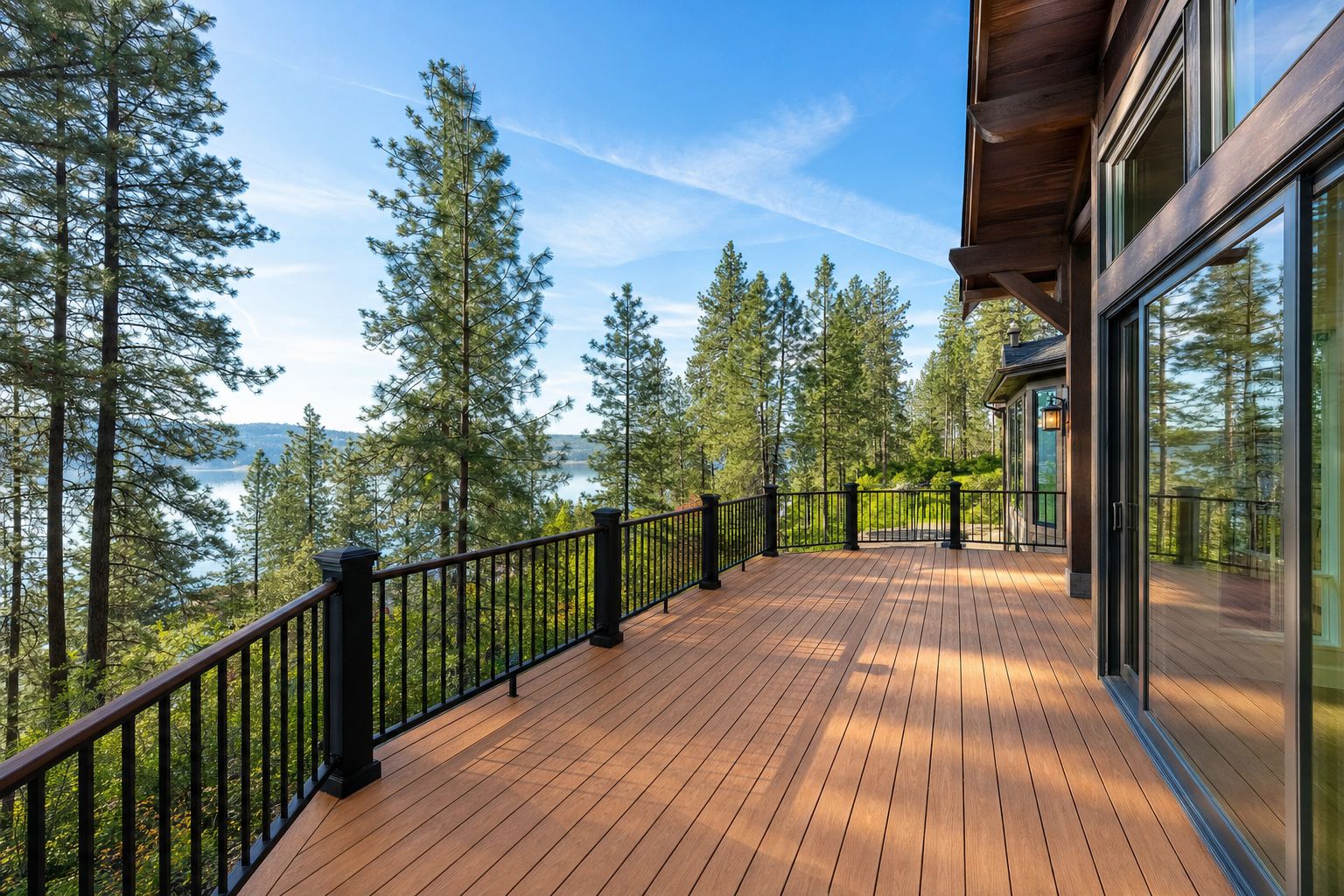
Clarkston's newer growth climbs the benches above town, and those hillside lots produce the valley's best decks and its most demanding structural work. An elevated deck hanging off a bench lot is a view platform over the confluence — and a structure whose footings bear on sloped, sometimes fill-and-cut ground. We size and set footings for the actual soil and slope, not a flat-lot template, and taller support posts get the bracing that wind coming up the valley demands. On view lots we spec railing to protect the reason you bought the lot: cable or glass-panel systems keep the sightline to the river instead of striping it with pickets.
Down on the flats, the mid-century blocks are simpler ground — low decks off the back of single-story ranches, often replacing a cracked concrete patio or a sagging deck from decades back. Grade-level builds here still need honest drainage planning and ground clearance; low airflow under boards shortens their life in any climate. And mild winters don't relax the framing — a deck full of guests weighs the same in Clarkston as in the mountains.
Decking That Survives Valley Sun
UV is the material test here, the way snow is up north. Wood feels it fastest: cedar in full Clarkston sun dries hard, checks, and grays quickly, and keeping a stained finish alive on a sun-blasted surface is a recoat-every-couple-of-years commitment. Wood remains the budget-friendly build and a fine choice under a roof or on a shaded exposure — on an open southern or western deck, you're signing up for maintenance.
Composite and PVC decking is where most of our valley builds land. Capped composites carry fade and stain warranties from their manufacturers and shrug off the UV that eats stain finishes — but they're not all equal in the heat. Darker composite boards absorb and hold serious heat in direct sun, so we steer valley clients toward lighter colorways and toward the product lines engineered to run cooler underfoot. Expansion gapping matters more here too: composite moves with temperature, and a deck gapped for the swing between a winter night and a July afternoon stays flat and quiet through all of it. Fasteners, hidden clips, and railing hardware get the same heat-rated attention. Hardware is cheap; redoing a surface isn't.
Cost Drivers on a Clarkston Deck
Size and height set the base — an elevated bench-lot deck carries engineering, footing, and railing costs a grade-level ranch deck doesn't. Shade structure is the next big line: a solid roof costs more than a pergola, which costs more than open framing, and it's the line we least recommend cutting in this valley. Decking material moves the number in the familiar way, wood below composite below premium PVC, with the maintenance trade-offs described above. Railing choice swings wider than most clients expect — cable and glass systems cost real money over standard pickets, and earn it only where there's a view. Site access on steep bench lots adds labor. We quote a fixed price from a written design and tell you which line items your lot actually needs.
From Sketch to Final Screw
- Site visit and design talk. We look at the lot, the slope, the sun path, and how you actually want to use the space — then sketch options against your budget. Free.
- Design and written proposal. Framing plan, decking and railing spec, shade structure, and a fixed price on paper.
- Permit and engineering. Deck permits run through the City of Clarkston in town or Asotin County for rural parcels; elevated builds may carry engineering requirements. We manage all of it.
- Footings and framing. The structural phase, inspected at the stages the permit requires. On bench lots this is where the money you can't see goes — and why the deck doesn't move for the next thirty years.
- Decking, railing, and walkthrough. Surface laid with heat-correct gapping, railing set, shade structure finished, and a full review with you before sign-off.
When We Can Build
The valley's building calendar is the longest we work with. Footings and framing proceed through mild winters that would stall a mountain build, so the season here runs close to year-round. Spring is the crunch — everyone wants a deck by June — so homeowners who call in fall or winter get first pick of build windows and walk onto a finished deck in March. Valley projects run as scheduled multi-day trips from our Spokane base: consecutive committed days on site, with inspection holds worked into the plan rather than discovered mid-build. Most builds run from several days for a simple grade-level deck to a few weeks for an elevated build with a roof structure.
Deck Questions from the Valley
What decking color should I pick for this much sun?
Lighter than your first instinct. Dark boards get painfully hot in direct valley sun and fade shows on them sooner. If your heart is set on a dark tone, put it under shade.
Is composite worth the extra cost here?
For open sun exposure, usually yes — the UV that forces constant refinishing on stained wood is exactly what capped composite is built to ignore. Under a solid roof, wood competes much better.
Do I really need a shade structure?
You need shade from somewhere — structure, screening, or orientation. An open deck facing west in Clarkston will sit empty on July evenings, which are exactly the hours you built it for.
What permits does a deck need in Clarkston?
In town, the City of Clarkston permits deck construction; rural Asotin County parcels go through the county. Height and attachment details affect requirements, and we handle the determination and filing.
My lot slopes hard toward the river. Can it hold a deck?
Sloped bench lots are some of the best deck sites in the valley — they just need footings and engineering matched to the ground. That's structural work we plan for, not a reason to settle for a patio.
How long will a composite deck last in this heat?
Installed with correct gapping and ventilation, capped composite is a decades-class surface even under valley UV; manufacturers back the fade performance in writing. The early failures we see are installation shortcuts — tight gapping, bad clips — not the material.
License, Insurance, Service Area
Domex Construction is licensed in Washington (DAVYDCI833NC, verifiable through the Washington L&I contractor lookup) and Idaho (RCE-66940), and fully insured. Nine years in business with thirty-two years of combined crew experience — and ask about our workmanship warranty when we visit.
We build decks throughout the LC Valley: Clarkston and Asotin on the Washington side, rural Asotin County up the benches and river canyons, and Lewiston, Idaho across the Snake under our Idaho license.
Nine months of deck weather starts in March. Free design estimates across Clarkston and the LC Valley. Give us a call or request an estimate online.
More from Domex in Clarkston: Siding Installation in Clarkston · Window Replacement in Clarkston · Custom Home Builder in Clarkston · Custom Decks — Spokane hub