
Window Replacement in Bonners Ferry, Idaho
Window replacement in Bonners Ferry, ID: cold-climate glass packages for Boundary County homes. Licensed, insured, free on-site estimates.
$1,000 Off
Your Complete Siding Replacement
Get a Free Estimate
FREE same-day estimates on all exterior projects.








The window calls we get from Boundary County have changed over the last few years. More of them now start with a recent purchase: a couple who bought a farmhouse out in the Kootenai Valley, or a family that took on one of the older houses on the hill above downtown, drawn north by land and quiet. Then their first winter arrives, and the 1970s aluminum sliders that photographed so charmingly in the listing start explaining themselves — frost feathering across the inside of the glass, a wood stove that can't keep up after dark, and a heating bill that reads like a second mortgage payment.
Domex Construction replaces windows across Bonners Ferry and the surrounding valley under Idaho license RCE-66940. Nine years in business, 32 years of combined team experience, and a habit of treating a window order for this town differently than one for Coeur d'Alene — because the climate demands it.
Why Glass Costs More to Ignore Here
Start with the arithmetic. Heat leaves a house in proportion to three things: how big the cold surface is, how poorly it insulates, and how many hours the outside stays cold. A single-pane window insulates at roughly R-1; the wall around it might be R-19 or better. Every square foot of old glass is effectively a hole in your insulation nearly twenty times leakier than the wall it sits in.
Now apply Bonners Ferry's third variable. This is the coldest, longest winter on our entire service map — hard freezes settle in early and hold, and cold air pooling in the valley keeps nighttime temperatures down even when afternoons soften. The same leaky window bleeds more heat here than it would in Spokane or Sandpoint simply because winter runs deeper and longer. Which is the honest case for replacement this far north: upgraded glass pays its keep faster where the heating season is bigger, and nowhere on our map is it bigger than Boundary County.
What the Older Openings Tell Us
The hill houses and the valley farmhouses each bring their own version of an opening.
In the older neighborhoods on the bench, we still find weight-and-pulley double-hungs, single-pane glass, and frames that a century of settling has pulled out of square. The weight pockets beside those old sashes are uninsulated voids running the full height of the window — a chimney for heat even when the glass itself is intact. Openings like these usually argue for full-frame replacement: pull everything back to the rough opening, insulate the voids, square the frame, and flash it properly.
Valley farmhouses are less uniform. Windows got added, moved, and resized as the house grew, so one wall might hold three different eras of unit. Sills take the worst of it — wind-driven rain and snowmelt off open fields work into the joint below the frame, and soft sills are the most common rot we find. Newer homes from the recent growth wave typically need less carpentry but arrived with builder-grade double-pane units whose seals and hardware are already aging.
Specifying Glass and Frames for Hard Freeze
U-factor is the number to care about — it measures how fast heat crosses the whole window assembly, and lower is better. Standard double-pane low-E units commonly land around 0.30; good triple-pane packages push into the low 0.20s. In most of our service area, triple pane is a judgment call. In Bonners Ferry it's the default recommendation: the extra pane earns its cost back through the longest heating season we serve, and it changes how rooms feel — you can sit next to a triple-pane window in January without feeling the cold pour off it.
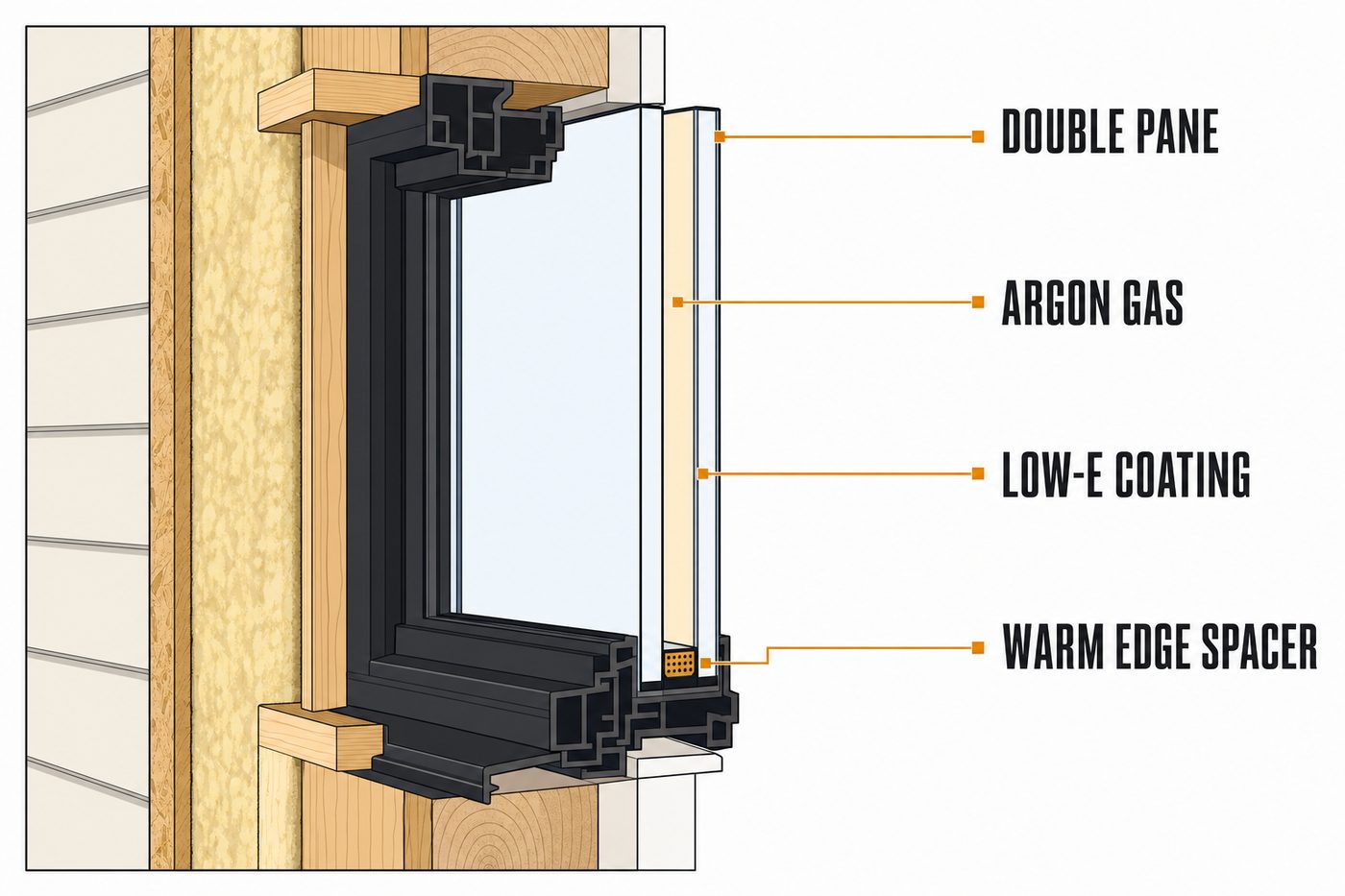
Condensation is the other cold-climate spec. When interior humidity touches glass that's below the dew point, water films and freezes on the pane — the frost older Boundary County homes wear all winter. Warmer inner glass is the cure: triple glazing, argon fill, and warm-edge spacers keep the interior surface above the dew point on far more mornings. We check each unit's condensation resistance rating, not just its U-factor.
Frames matter as much as glass at this latitude. Multi-chamber vinyl performs well and prices sensibly. Fiberglass expands and contracts at nearly the same rate as glass, so seals stay seated through 100-degree annual temperature swings — a real advantage here. Wood-clad units suit the historic houses on the hill where the interior look matters. Aluminum without a thermal break has no business this far north, and we'll say so if that's what your bids are showing.
How a Window Job Runs
- Measure and assess. We check every opening for square, probe sills for rot, and decide unit by unit between insert replacement (new window inside a sound existing frame) and full-frame (everything out, back to the rough opening). Older Bonners Ferry homes usually justify full-frame; we'll show you why or why not on your house.
- Order. Windows are manufactured to your measurements, which sets the lead time — typically several weeks, longer for custom shapes and triple-pane packages.
- Permits. In-town projects run through the City of Bonners Ferry; rural parcels file with Boundary County. We manage whichever applies.
- Installation. One opening at a time, opened and closed the same day — your house is never left open overnight, which matters in a place where a clear October night can land well below freezing. Each unit gets shimmed square, foamed, flashed, and sealed.
- Finish and walkthrough. Interior trim, exterior sealant in its temperature window, and an operation check on every sash and lock with you present.
What Moves a Window Quote
Count of openings first, then the split between insert and full-frame — the carpentry in a full-frame job is real work and priced as such. Glass package comes next: triple pane costs more than double, and we'll show the trade-off rather than defaulting you into either. Size and shape matter (custom geometry and egress-sized bedroom units cost more than stock), and so does exterior integration — tying new flashing into old siding cleanly takes time on layered walls. We quote fixed numbers after measuring, and the estimate is free.
Booking the North Run
Bonners Ferry sits at the far north end of our range, so window projects here are scheduled as committed multi-day crew blocks rather than scattered single days — one mobilization, one crew, your whole house. That takes planning around season and around manufacturing lead times: measure in late winter and your install can land in the pleasant part of spring; call in September and we'll tell you honestly whether the work happens before deep cold or sequences into a winter-safe, one-opening-at-a-time install. Both are doable. We'd rather set the expectation now than surprise you later.
Window Questions From Bonners Ferry Homeowners
Is triple pane worth it this far north?
Usually, yes — and this is the one part of our service area where we say that without hedging. The longest heating season on our map is exactly where the third pane earns its cost.
Will new windows end the frost on my glass?
Mostly. Modern units keep the interior surface warm enough that frost becomes rare instead of nightly. Heavy indoor humidity — woodstove kettles, unvented dryers — can still fog edges on the coldest mornings.
Insert or full-frame — how do you decide?
By the condition of what's there. Sound, square frames take inserts; rot, racked openings, or old weight-pocket double-hungs call for full-frame. On older Boundary County housing, full-frame is the more common answer.
Can windows be replaced in winter?
Yes. We work one opening at a time so no room stands open long, and exterior sealants get applied in their temperature windows. Winter slots often book faster than people expect.
Do I need a permit?
Depends on the parcel: City of Bonners Ferry inside town, Boundary County for rural properties. We handle the filing either way.
Should I do the whole house or phase it?
Whole-house costs less per opening because mobilization this far north happens once. If phasing fits the budget better, start with north- and east-facing rooms — they lose the most.
My house is older — will new windows look wrong on it?
Not if they're chosen for it. Wood-clad and well-proportioned vinyl units with correct grille patterns keep the character of the hill neighborhoods. We'll bring samples to the estimate.
Do you handle bedroom egress requirements?
Yes. Older homes often have bedroom windows smaller than modern egress code allows, and replacement is the moment to correct that. We flag it during measuring, not after.
Who You're Hiring
Domex Construction is licensed in Idaho (RCE-66940 — look us up through the Idaho Contractors Board) and Washington (DAVYDCI833NC), and fully insured. Ask about our workmanship warranty at the estimate. Our window crews serve Bonners Ferry, Moyie Springs, Naples, the farm and rural properties throughout the Kootenai Valley, and the corridor south to Sandpoint.
Tired of heating the outdoors? Free on-site window estimates anywhere in Boundary County. Give us a call or request an estimate online.
More from Domex in Bonners Ferry: Siding Installation in Bonners Ferry · Custom Decks in Bonners Ferry · Custom Home Builder in Bonners Ferry · Window Replacement — Spokane hub