
Custom Deck Builders in Bonners Ferry, Idaho
Custom deck builders serving Bonners Ferry, ID. Snow-load-rated framing and freeze-proof materials for Boundary County. Free estimates.
$1,000 Off
Your Complete Siding Replacement
Get a Free Estimate
FREE same-day estimates on all exterior projects.








Every deck we design carries a snow number, and Bonners Ferry's is the biggest one in our book. Boundary County catches more snow, keeps it longer, and freezes it harder than any other place Domex builds — which means the decks we frame up here get the heaviest structural spec we produce anywhere. A deck that would sail through engineering review in Post Falls gets its beams upsized, its posts multiplied, and its footings deepened before we'd put our name on it north of Naples.
That's the starting point for this page, because it's the starting point for every deck conversation we have in this town. The view, the decking color, the railing style — all of it matters, and all of it comes after the structure question is settled. Domex Construction builds custom decks throughout Bonners Ferry and the Kootenai Valley under Idaho license RCE-66940, fully insured, estimates free.
Framing to the Heaviest Spec We Build
Snow is a dead load pretending to be temporary. A winter's accumulation on a Bonners Ferry deck — compacted, iced, sometimes rained on and refrozen — is weight the structure carries for months, not days. So the frame gets designed to the design snow loads Boundary County requires, and then we build in margin, because the county's number is a floor, not a target.
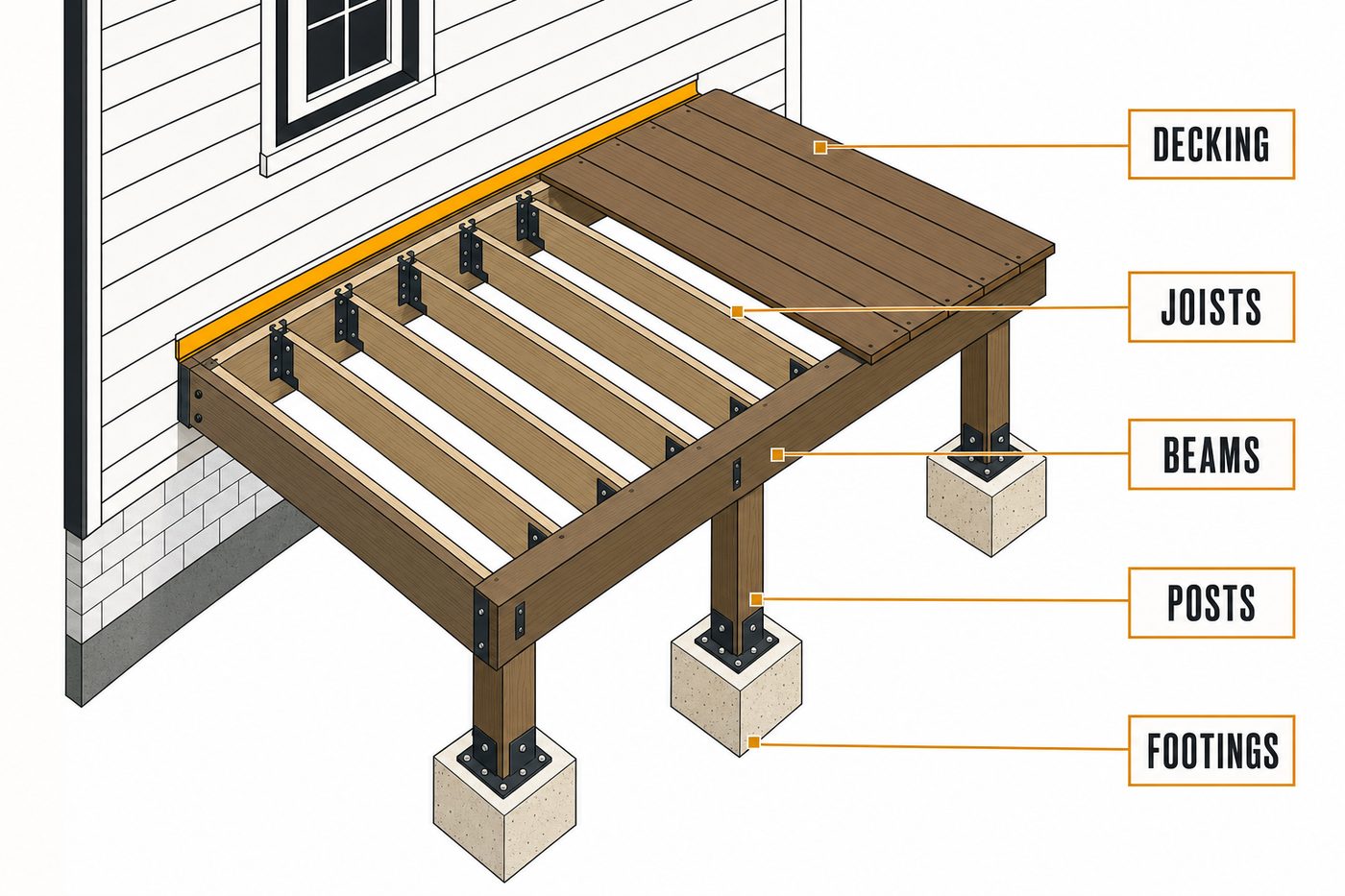
In practice that means footings dug below frost depth — and frost drives deeper here than anywhere else we excavate — with diameters sized to spread real loads into the soil, which itself differs between the bench and the valley bottom. It means beams a size up from what a milder climate would call for, joists on tighter spacing, and hardware that's hot-dip galvanized or stainless throughout, because a connector that corrodes is a connector that fails under exactly the load you built for.
One Bonners Ferry factor deserves its own paragraph: roof shed. Steel roofs are everywhere in this county, and a steep steel roof doesn't just drop snow — it launches it, in consolidated slabs, onto whatever sits under the eave line. A deck in a shed zone takes the roof's whole winter in concentrated piles. When a deck has to live under an eave, we either reposition it in design, add posts and beam capacity directly under the impact zone, or both. Ledger connections get through-bolted and flashed so meltwater running down the wall never reaches the house framing — a rotted ledger is the failure mode behind most deck collapses, and it's entirely preventable.
Facing the Valley
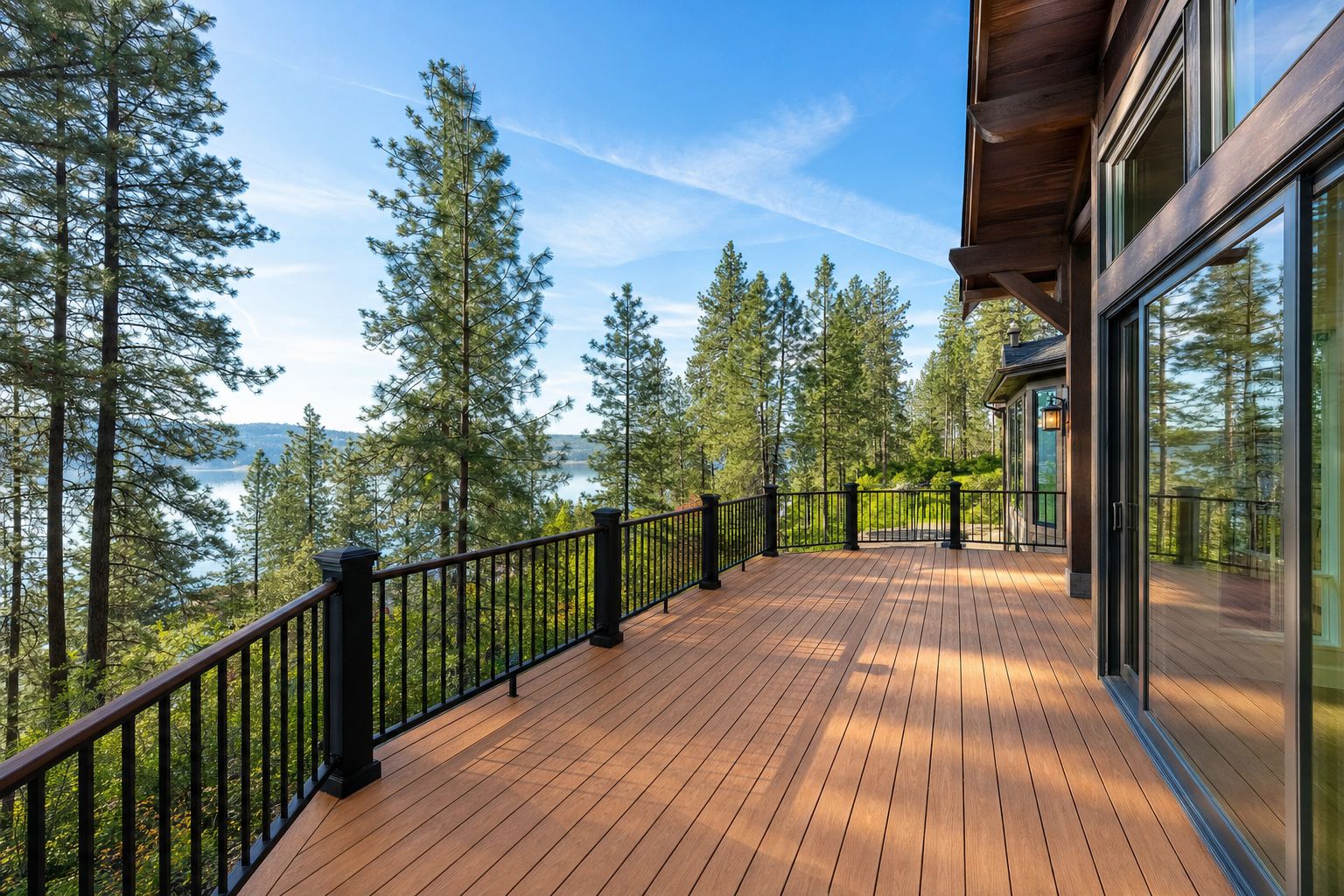
Most Bonners Ferry decks want to point the same direction: out over the drop, toward the river and the patchwork of Kootenai Valley farmland, with the Selkirks stacked behind it. It's one of the better standing views in Idaho and the deck should be built to serve it.
Orientation has consequences, though. A valley-facing deck on the bench edge is often a tall deck, which raises the stakes on post sizing, bracing, and railing engineering. It also tends to catch wind coming up the valley, which influences furniture, railing solidity, and whether a windbreak wall earns its cost. Railing choice is where view and safety negotiate: slender-profile systems preserve the panorama better than chunky pickets, and we'll walk through the options with the actual sightline from your chair height in mind. Sun matters too — west-facing decks take the full afternoon load in summer, which pushes decking color and material choices toward heat-tolerant options, while shaded or north-facing decks hold snow and ice weeks longer and favor textured, grippy surfaces.
Decking That Survives the Freeze-Thaw Grind
Boundary County's freeze-thaw cycle is the roughest test we ask a walking surface to pass. Wood that absorbs fall rain and then freezes gets checked and split from the inside; fasteners loosen as boards cycle; finishes fail early.
Capped composite is our usual recommendation up here. The polymer shell takes on essentially no water, so there's nothing inside the board for ice to pry apart, and it never needs the staining schedule that a wood deck at this latitude actually requires (annually or close to it, honestly done). The discipline composite demands is movement: boards grow and shrink lengthwise across big temperature swings, so end gapping and fastening follow the manufacturer's cold-climate tables, not habit.
Pressure-treated and cedar still have their place — budget builds, ranch outbuilding decks, homeowners who like the maintenance ritual. We build them with ground-contact-rated framing lumber, sealed end cuts, and hidden or plugged fasteners where the budget allows, and we're plain about the upkeep schedule you're signing up for.
Under either surface, the framing details are the same: joist tape over every horizontal wood surface, standoff post bases so lumber never sits in snowmelt, and drainage slope built in rather than hoped for.
Where Deck Budgets Go
Square footage is the obvious driver, but on Bonners Ferry decks the structural line items carry unusual weight: footing count and depth, beam and post sizing to snow load, and height off grade on bench-edge lots. Railing is the next biggest swing — a slender view-preserving system costs meaningfully more than standard pickets. Stairs, benches, and multi-level layouts add carpentry. Decking material sets the final spread: composite costs more up front than treated lumber and gives most of it back in skipped maintenance. We put fixed numbers on all of it after a site visit, never over the phone.
How We Build It
- Design and load spec. Site visit, view study, soil and slope check, and a structural design worked out to the county's snow-load requirements with margin on top.
- Permit. Decks here need one — through the City of Bonners Ferry in town, through Boundary County for rural parcels. We draw the plans and file.
- Footings. Excavated below frost depth, inspected at the stage the permit requires, poured, and cured before a stick of framing goes up.
- Frame. Beams, joists, ledger or freestanding structure, flashing, joist tape, and hardware — the part of the deck you'll never see and the part that matters most.
- Surface, railing, walkthrough. Decking gapped to spec, railing set and load-tested, stairs finished, and a full review with you on the finished deck.
A Short Season, Booked Early
Straight talk about the calendar. The ground up here holds frost well into spring, and footings can't be dug until it lets go — so the practical building season is compressed at both ends, and it's shorter than anywhere else we work. Add the fact that Bonners Ferry jobs run as committed multi-day crew blocks — one mobilization, a crew that stays on your build start to finish — and the math is simple: the homeowners who get summer decks are the ones who designed and permitted in winter. Call us in January or February, and the estimate, engineering, and permit can all be done while the ground is still white. Call in July, and we'll be honest that you may be looking at fall — or at next season.
Deck Questions We Hear North of Sandpoint
Do I have to shovel snow off my deck?
A deck we've built to spec carries its design snow load without help. Shoveling before big storms stack up is still cheap insurance — use a plastic shovel and work parallel to the boards.
Composite or wood for this climate?
Composite, for most people. It ignores the freeze-thaw cycle that eats wood surfaces here and skips a staining schedule that this climate makes genuinely demanding. Wood wins on up-front cost, and we build both well.
How deep do the footings go?
Below local frost depth — deeper than the rest of our service area — and verified at inspection. Shallow footings heave with the frost, and a heaved footing means a racked frame.
Can you build under my metal roof's eave?
Carefully. Either the deck moves out of the shed zone in design, or the framing under that zone gets reinforced for concentrated impact loads. Ignoring roof shed is how decks up here get crushed.
When should I book to get a deck this summer?
Winter. Design and permitting happen while the ground is frozen, and your build takes one of the first thaw-season slots.
Do I need a permit for a deck?
Yes in nearly every case — City of Bonners Ferry inside town limits, Boundary County for rural properties. We handle plans, filing, and inspections.
Can you beef up my existing deck instead of replacing it?
Sometimes. If the footings and ledger are sound, we can sister joists, add beams, and re-surface. If the foundation of the structure is undersized for the snow here, honest advice is usually to rebuild.
The Company Behind the Deck
Domex Construction carries Idaho license RCE-66940 — verify it through the Idaho Contractors Board — along with Washington license DAVYDCI833NC, and full insurance. Ask about our workmanship warranty when we visit. Deck crews cover Bonners Ferry, Moyie Springs, Naples, rural properties across the Kootenai Valley, and south to Sandpoint.
Want to be standing on it by July? Free deck estimates across Boundary County — winter is the right time to call..
More from Domex in Bonners Ferry: Siding Installation in Bonners Ferry · Window Replacement in Bonners Ferry · Custom Home Builder in Bonners Ferry · Custom Decks — Spokane hub