
Window Replacement in Spirit Lake, Idaho
Window replacement in Spirit Lake, Idaho: century homes, converted cabins, and newer builds. Cold-climate glass, insert or full-frame. Free estimates.
$1,000 Off
Your Complete Siding Replacement
Get a Free Estimate
FREE same-day estimates on all exterior projects.








Spirit Lake's street grid was platted for mill families in the first decade of the 1900s, which puts its original housing about fifty years ahead of insulated glass. Those homes were built with single-pane double-hungs riding on ropes and iron weights, and a surprising number of them still have some. Even where glass has been swapped once already — usually in the eighties or nineties — the surrounding frame, the hidden weight pockets, and the settled openings are still doing 1910 things inside a 2026 heating season.
Domex Construction replaces windows across every era Spirit Lake has built in: the townsite's century homes, the converted cabins near the water, and the builder houses filling the prairie edge. Idaho registration RCE-66940, fully insured, free on-site estimates — and a measuring habit that treats every opening in an old house as its own project, because in this town it is.
Century Homes: The Opening Is the Job
On the townsite grid, the glass is the easy part. The openings are what demand experience. A hundred-plus years of settling means few of them are square anymore — we routinely measure a half inch of difference between diagonals — and the houses were framed before standard window sizes existed, so nearly everything is a custom order. That's not a problem, just a fact to plan around: custom sizing adds manufacturing lead time, not drama.
Then there are the weight pockets. Every old double-hung has a hollow channel beside each jamb where the iron counterweights travel, and those channels are uninsulated chases running from sill toward header. Replace only the sash and you've upgraded the glass while leaving two air-filled gaps in the wall on either side of it. Done right, a townsite window job opens those pockets, insulates them, and squares the new unit into an opening that hasn't been square since Taft was president.
Converted Cabins by the Water
The lake just west of town holds another Spirit Lake specialty: summer cabins that became year-round houses one improvement at a time. Their windows are often the last original thing left — single panes in thin frames, or first-generation aluminum sliders that frost over from the inside every January. Interior condensation and ice on the glass are the usual complaints that start these calls.
Cabin walls bring their own wrinkles. Framing can be minimal, wall depths shallow, and opening sizes whatever the original builder had on hand. We treat these as full re-framing conversations more often than not, because the opening frequently needs as much correction as the window. The payoff is large: going from a single pane to a modern insulated unit is the biggest single comfort jump we can make in any house we touch.
What Cold-Climate Glass Actually Buys
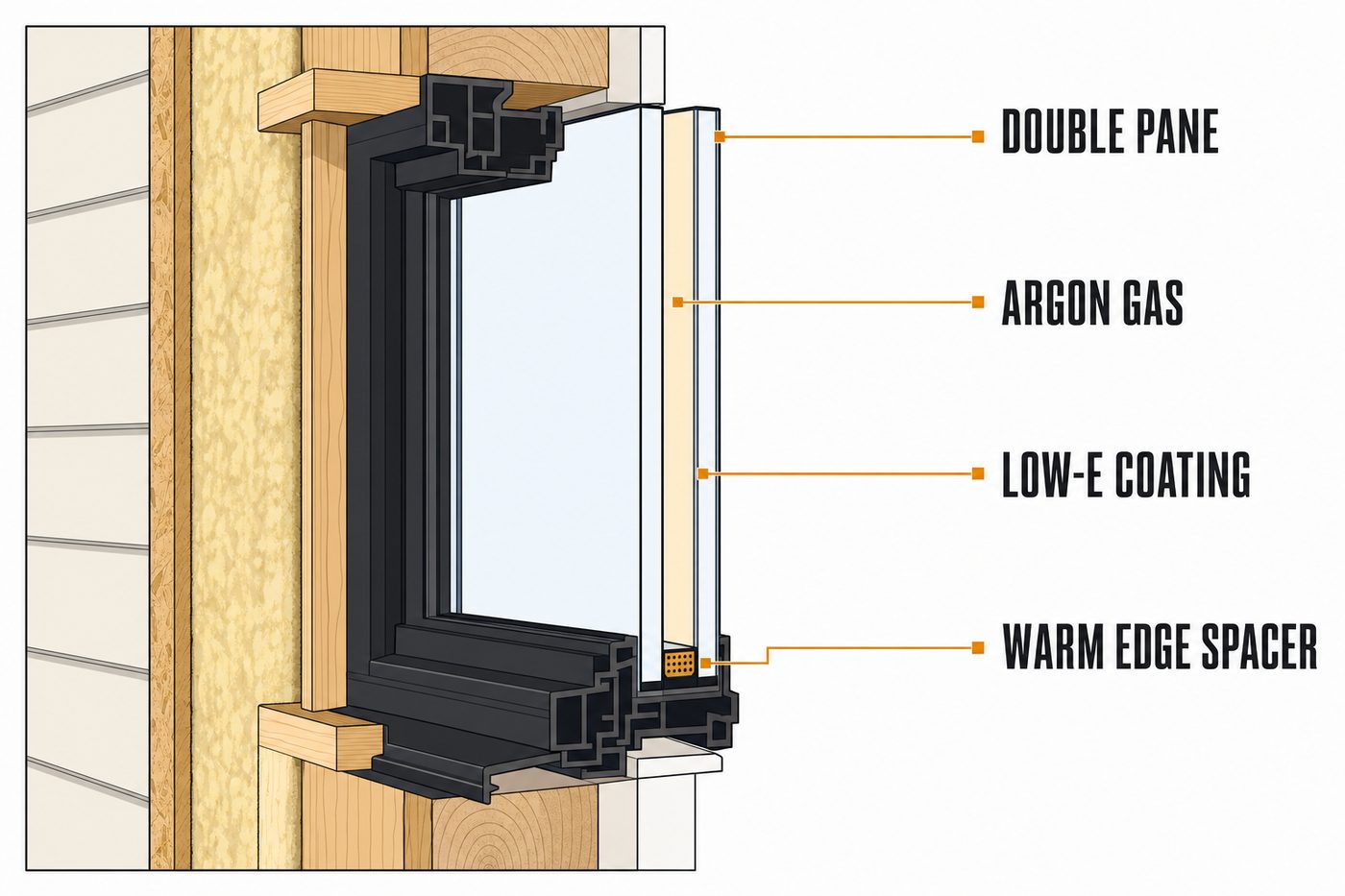
Window shopping gets simpler once you know which numbers matter here. Spirit Lake is a heating town — snowier and colder than Post Falls or Coeur d'Alene down the prairie — so U-factor, the measure of heat loss, outranks everything else on the label. Low-E coatings tuned for northern climates, argon fill between panes, and warm-edge spacers all push that number down; the spacer detail also decides whether the glass edge sweats and ices in January.
Solar gain deserves nuance rather than a blanket rule. South-facing glass collects free heat through a long winter, so we don't automatically spec the most aggressive heat-blocking coating on every wall. Triple-pane is worth an honest conversation at this snow line: the energy payback is slow, but the comfort near the glass and the near-elimination of condensation are immediate, and on a north wall or a bedroom it can be the right call.
Insert or Full-Frame: The House's Age Decides
An insert slips a new unit into the existing frame; a full-frame replacement strips the opening to the rough framing and rebuilds it. Which one you need mostly tracks the decade your walls went up.
On 1910s townsite homes, full-frame is usually the honest answer — it's the only way to reach the weight pockets, correct out-of-square openings, and replace sills that have been drinking meltwater for generations. On prairie-edge houses from the 2000s onward, sound square frames make inserts a clean, budget-friendly option, though if a re-side is in your future, a full-frame swap timed with the siding gets flashing integration no caulk bead can match. Cabins near the water are almost always full-frame. We'll tell you which side your house lands on window by window, because plenty of homes need both.
How a Window Job Runs
- Measure and assess. Every opening individually — diagonals, sill condition, wall depth, and what's living in the weight pockets.
- Spec and order. Frame material, glass package, and insert-versus-full-frame decisions in writing; custom sizes go to manufacturing.
- Permitting. Where the scope requires it, the paperwork runs through the City of Spirit Lake and we handle it.
- Installation, one opening at a time. Each window comes out and its replacement goes in, insulated, flashed, and sealed the same day — no house sits open overnight, in any season.
- Finish and walkthrough. Interior trim made right, every sash operated with you watching, stickers off, glass cleaned.
What Moves the Quote
Opening count sets the base, but the spread between two Spirit Lake bids usually comes from four places: custom sizing (near-universal on the grid, rare on the prairie edge), full-frame work versus inserts, frame material — vinyl at the value end, fiberglass and wood-clad above it — and the glass package itself. Old-house interiors add a real line item too: plaster walls and hundred-year-old casings take patience that drywall and clamshell trim don't. We quote fixed numbers after measuring, never off a window count over the phone.
Lead Times and Install Weather
Custom-size manufacturing is the long pole — figure weeks from order to delivery, longer in the spring rush. Installation itself moves fast: a typical house is one to three days on site. And winter is a fine time to do this work; because each opening is closed up the same day, the season mostly affects sealant choices, not the calendar. Booking measurement in fall or winter often means new glass before the worst cold.
Spirit Lake Window Questions
None of my windows are standard sizes. Is that a big cost problem?
It's normal for this town and priced accordingly — custom sizing mostly adds lead time. What you should avoid is a contractor forcing stock sizes into old openings with oversized filler strips.
My windows fog between the panes. Can just the glass be fixed?
Fog between panes means the insulated unit's seal has failed. Sometimes the glass unit alone can be swapped in a sound frame, but on units old enough to fail, the frame is often near the end too. We'll price both honestly.
Is triple-pane worth it in Spirit Lake?
For pure payback, slowly. For comfort near the glass, quiet, and condensation control in a town this cold, often yes — especially on north walls and bedrooms. It's a wall-by-wall decision, not all-or-nothing.
Can windows go in during winter here?
Yes. One opening at a time, opened and sealed the same day. Crews work in the cold routinely; your furnace barely notices.
Do replacement windows need a permit in town?
Depends on scope — like-for-like swaps and structural changes are treated differently. Jobs inside city limits run through the City of Spirit Lake, and we sort the requirement and file it for you.
My old bedroom windows are small. Anything to know before replacing them?
Yes — modern egress rules for sleeping rooms. Many century-home bedroom openings are smaller than today's code wants, and replacement is the natural moment to enlarge one. We'll flag it during measurement.
Is there lead paint risk on my original frames?
On pre-1978 housing, assume yes until tested. We follow the lead-safe work practices federal rules require for homes that age — containment, clean removal, proper disposal.
Will new windows stop the ice that forms on my cabin glass?
Almost certainly. Interior ice is single-pane physics: warm moist air meeting freezing glass. An insulated unit with a warm-edge spacer keeps the interior surface above the frost point in all but extreme conditions.
The Company Behind the Caulk Line
Domex Construction carries Idaho registration RCE-66940 — check it yourself with the Idaho Contractors Board — along with Washington license DAVYDCI833NC and full insurance. Nine years in business, 32 years of combined field experience, and a workmanship warranty worth asking about at your estimate.
Window crews working Spirit Lake also cover Rathdrum, Twin Lakes, Athol, and Blanchard.
Drafty sashes or iced-over glass? Free window assessments across Spirit Lake. Give us a call or request an estimate online.
More from Domex in Spirit Lake: Siding Installation in Spirit Lake · Custom Decks in Spirit Lake · Custom Home Builder in Spirit Lake · Window Replacement — Spokane hub