
Custom Deck Builders in Spirit Lake, Idaho
Custom deck builders in Spirit Lake, Idaho. Porch rebuilds, snow-rated frames, lakeside decks. Licensed, insured, free estimates: call today.
$1,000 Off
Your Complete Siding Replacement
Get a Free Estimate
FREE same-day estimates on all exterior projects.








A lot of our Spirit Lake deck work starts as a phone call about a porch. Someone on the old grid notices the front porch has dropped an inch at one corner — the posts are sitting on stacked stone or a buried chunk of concrete, the way porches were built in 1912 — and asks us to fix it. Halfway through that conversation comes the realization that the house, in a century of existence, has never once had a real place to sit outside in July. The porch gets rebuilt on proper footings, and a deck the house never had goes on the back.
Domex Construction builds decks and rebuilds porches across Spirit Lake under Idaho registration RCE-66940. Design, engineering-minded framing, City of Spirit Lake permits, and the finish carpentry — one contract, free estimate first.
Old-Town Porches and the Decks Behind Them
Porch work on the grid is half restoration, half structure. The visible job is columns, railings, and tongue-and-groove decking that suit a 1910s frame house; the invisible job is getting real footings under a structure that never had them and re-tying it to a rim board that may be rough-cut lumber. When a back deck joins the project, the ledger connection deserves the most attention of anything on the plan. Bolting a ledger through old board sheathing into century-old framing takes blocking, through-bolts, and careful flashing — and on some houses the smarter engineering answer is a freestanding frame that doesn't ask the old structure to carry anything new at all.
Prairie-edge houses are the mirror image. Builders there typically left a small concrete stoop or a bare patio door a step above the yard, so those projects begin as blank slates: full-width composite decks, built-in benches, room for the grill and the kiddie pool, laid out around the two things the prairie edge has plenty of — wind and open sun.
Framed for the Snow That Actually Falls Here
Spirit Lake catches more snow than the towns down the prairie, and a deck here spends the winter holding whatever the sky and the roofline give it — including the drift line where a roof sheds onto the frame. Design has to start from that number, not from a generic span table. We size footings, beams, and joist spacing to the ground snow load the City of Spirit Lake enforces, confirm the current figure at permit time, and go heavier where a roof dumps onto the deck or a hot tub is in the plans.
Depth matters as much as load. Footings have to bear below local frost depth, or the first winter will lift and rack the frame no matter how well it was screwed together. Frost heave is the failure behind most of the leaning DIY decks we're asked to rescue, and it's designed out at the hole-digging stage or never.
Decks on the West Shore
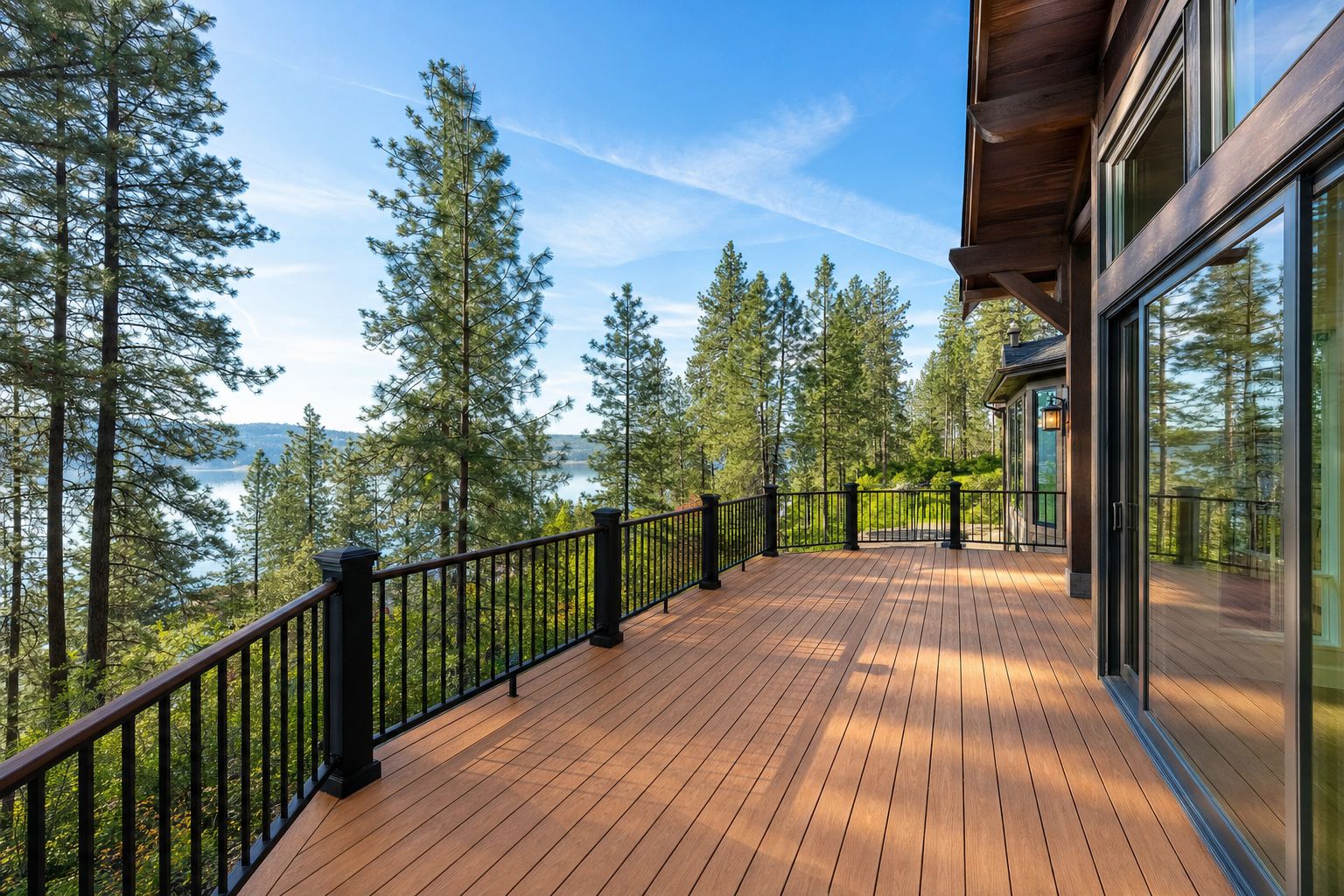
The lake sits just west of town, and its shoreline cabins — most of them converted to year-round homes — bring the most interesting deck work we do here. Lots slope toward the water, which means elevated frames, taller posts with real bracing, and footing layouts adjusted pier by pier as the grade drops. Guardrails become the design question: code sets the height, but nobody buys a lake view to stare at pickets, so cable infill and slim-profile railings do heavy duty on these projects.
Shade and lake moisture shape material choice on this shore, too. A deck under conifers that sees limited sun holds dampness the way an open prairie deck never will, which pushes the spec toward capped composite, generous board gapping, and a frame protected with joist tape.
Cedar, Pressure-Treated, or Composite
Every frame we build is pressure-treated structural lumber — that debate ended long ago. The surface is where the choice lives. Cedar walks barefoot-cool, smells right, and costs less on day one, but under five months of snowpack it demands honest refinishing on a schedule most owners abandon by year four. Capped composite costs more up front, shrugs off the freeze-and-melt cycle, and asks for nothing but a wash — though on a full-sun prairie lot, darker boards run hot in an Idaho August, so color selection is a practical decision, not just a visual one. Hidden fasteners, joist tape over every framing member, and stainless hardware near the water round out a spec built for this climate.
What a Spirit Lake Deck Costs Depends On
We put fixed numbers on paper after a site visit, and these are the levers that move them: square footage and height off grade, footing count and depth, slope (a lakeside drop adds structure a flat prairie yard doesn't need), railing selection — cable and aluminum sit well above wood pickets — stairs, surface material, and any demolition of a failing porch or stoop ahead of the build. Hot tub reinforcement is its own line.
Five Steps From Sketch to Final Screw
- Site visit and design talk. Grade, sun, roof shed lines, how you actually want to use the space — then a layout and a fixed quote.
- Plans and paperwork. Framing plan reflecting local snow load and frost depth, submitted to the City of Spirit Lake; we run the permit.
- Footings and inspection. Holes dug below frost depth, inspected, poured — the stage that decides whether the deck is still level in 2046.
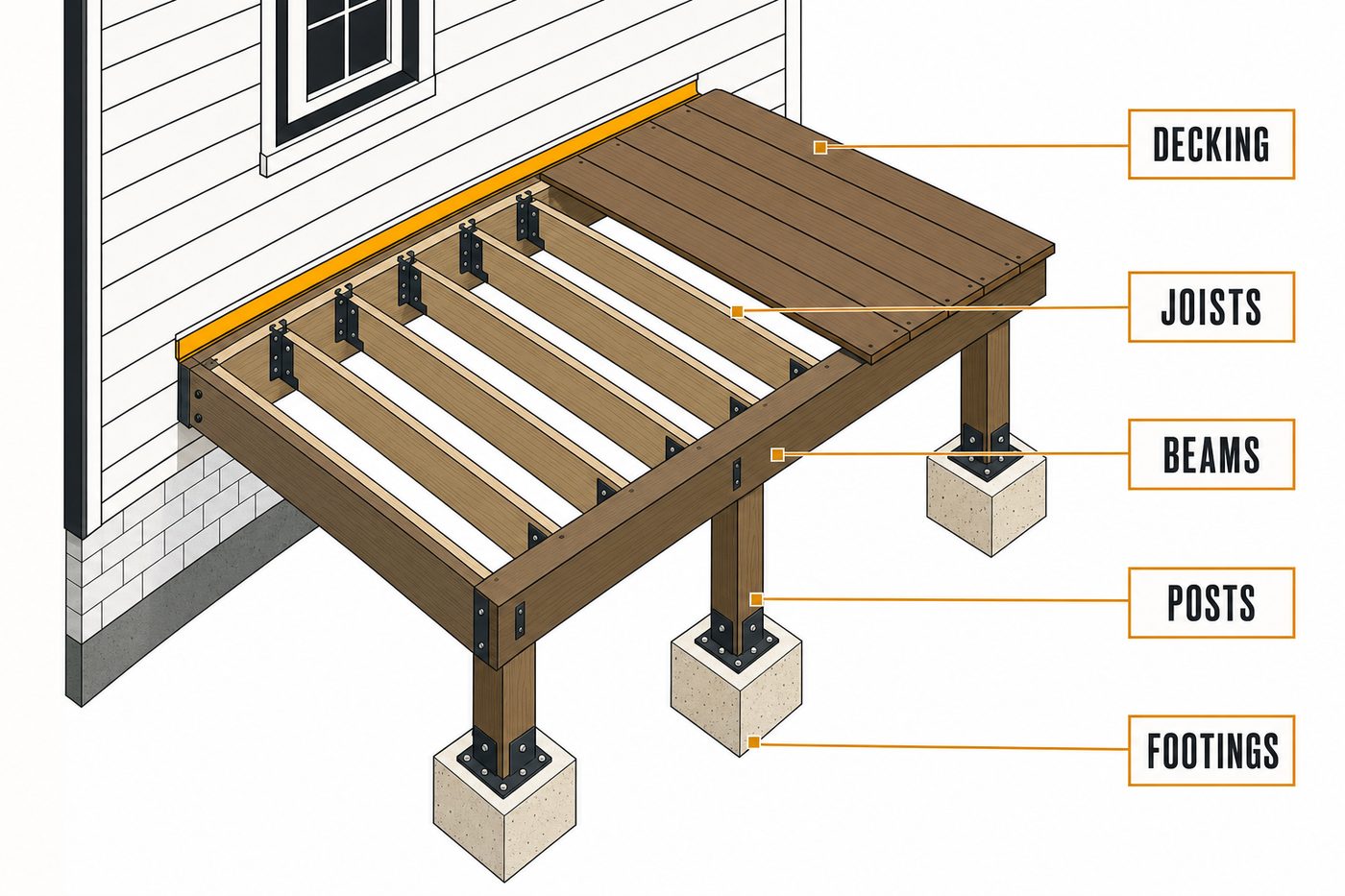
- Framing. Beams, joists, ledger or freestanding structure, hardware, and joist tape before a single deck board goes down.
- Surface, railing, walkthrough. Decking, stairs, guardrails, cleanup, and a final inspection alongside yours.
When to Book and How Long It Takes
The build itself is the short part — most decks run several days to two weeks on site depending on size, height, and railing complexity. The calendar is the long part: after a Spirit Lake winter, spring fills the schedule fast, and frozen ground complicates footing work from roughly December into March. The efficient move is booking design and permitting through winter so your footings go in as soon as the ground gives, and the deck is yours by the first hot weekend instead of by Labor Day.
Deck Questions, Answered
Do I need a permit to rebuild a porch on its existing footprint?
Usually yes once structure is involved — posts, footings, guardrails. City-limits projects go through the City of Spirit Lake, and we handle the application and inspections either way.
Should a new deck attach to my century-old house or stand on its own?
It depends on what the rim and sheathing look like when we open things up. Old framing can absolutely take a properly bolted ledger, but where it can't, a freestanding frame inches away is stronger than a compromised connection. We decide from evidence, not habit.
Do I have to shovel my deck all winter?
No — we frame to the local ground snow load so the structure carries the season. Shovel for access if you like (plastic shovel on composite), but the deck shouldn't need rescuing.
How deep do the footings go?
Below local frost depth, verified at the city's footing inspection. Exact depth follows the current code figure, and we don't pour until it's inspected.
Can the deck carry a hot tub?
Yes, when it's designed for one from the start — a filled tub concentrates thousands of pounds on a few square feet, which changes beam sizing and footing layout. Retrofitting that strength later costs more than planning it now.
Is composite slippery under snow and ice?
Modern capped boards are comparable to sealed wood — fine underfoot with ordinary winter caution. Texture varies by line, and we'll show you samples worth standing on.
My lakeside lot drops steeply toward the water. Buildable?
Almost always — slope means engineered footings, taller braced posts, and stepped framing rather than a bigger budget than you feared.
Can you build in winter?
Framing and decking, often yes. Footings are the constraint in frozen ground, which is exactly why winter is the season for design and permits rather than digging.
Check Our License, Then Check Our Work
Domex Construction is registered in Idaho as RCE-66940 — the Idaho Contractors Board will confirm it in about a minute — licensed in Washington as DAVYDCI833NC, and fully insured. Nine years in business, 32 years of combined experience on the crews, and a workmanship warranty we'll walk you through at the estimate.
Deck and porch crews serving Spirit Lake also build in Rathdrum, Athol, Blanchard, and Twin Lakes.
Got a porch that's sinking or a backyard that's still bare? Free deck estimates across Spirit Lake. Give us a call or request an estimate online.
More from Domex in Spirit Lake: Siding Installation in Spirit Lake · Window Replacement in Spirit Lake · Custom Home Builder in Spirit Lake · Custom Decks — Spokane hub