
Window Replacement in Ritzville, Washington
Window replacement in Ritzville, WA: low-SHGC glass for hot summers, tight frames for cold open winters. Licensed WA contractor. Free estimates.
$1,000 Off
Your Complete Siding Replacement
Get a Free Estimate
FREE same-day estimates on all exterior projects.








The call usually starts with dinnertime. It's late July, it's been over 95 all afternoon, and the west side of the house — the kitchen, the dining room, wherever the family actually sits at six o'clock — is unlivable because the low sun is pouring straight through the glass. The air conditioner runs flat out and loses. Three feet from the glass, you feel it on your face like an open oven door.
That's the honest starting point for window replacement in Ritzville — different from Spokane or Coeur d'Alene, where drafts and condensation lead the conversation. Out here at the I-90/US-395 junction, in the hottest and driest part of the territory Domex covers, the first job of a window is keeping solar heat out. Domex Construction installs replacement windows across Adams County under Washington license DAVYDCI833NC, fully insured, with free in-home estimates.
Start With the Number Nobody Talks About
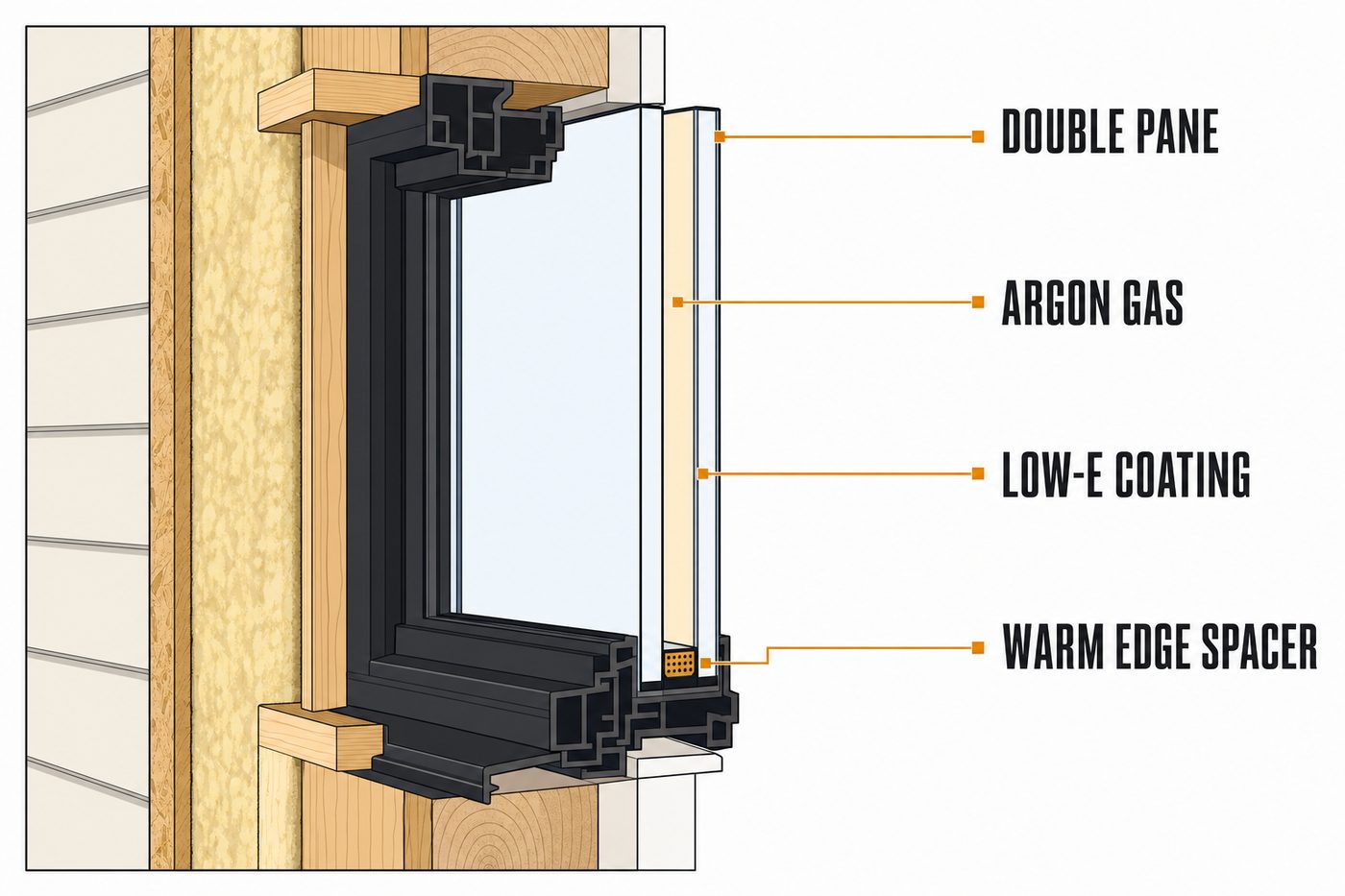
Window shopping trains people to look at U-factor — the insulation number. For Ritzville's summers, the number that changes your July is SHGC: solar heat gain coefficient, the fraction of the sun's heat that makes it through the glass. Old single panes and early dual panes let most of it through. A modern low-E glass package can cut that to a third or less, using microscopically thin metallic coatings that reflect infrared heat while passing visible light. The room stays bright; the heat stays outside.
Orientation decides where this matters. West glass is the worst offender in town, because the evening sun comes in low and level — no roof overhang can block it. South glass is strong but higher-angle, so overhangs and porches help. East glass gives you the same problem at breakfast, milder. North glass barely participates. A good window package for a Ritzville house isn't one glass spec multiplied by every opening — it's aggressive low-SHGC coatings on the west and south, and money saved where the sun never lands. We spec window-by-window — the difference between a measured quote and a catalog order.
The Cold Half of the Year Still Votes
Solar gain leads, but it doesn't get the only vote. Ritzville winters are cold and open — clear high-desert nights with wind moving across country that has nothing to stop it between here and the Palouse. Single-pane and worn-out aluminum-frame windows lose heat two ways on those nights: conduction straight through the glass and frame, and infiltration through sash gaps widened by decades of dry-climate wood shrinkage.
This is where U-factor and airtightness earn their place in the spec. Dual-pane low-E with argon fill handles most homes here well; the same low-E coatings that reflect summer sun also reflect your furnace heat back inside. The dry air does you one favor — interior condensation is a smaller problem than it is in wetter towns — but a leaky frame in a Ritzville wind is a leaky frame, and you feel it from the couch. Frame material matters for the temperature swings too: vinyl frames work fine in light colors, while dark vinyl on a west face absorbs enough summer heat to distort over time, and fiberglass shrugs off the swing altogether.
Openings That Are Older Than the Glass Codes
The houses around Ritzville's National Register downtown were framed when this was a wheat-shipping boomtown, and their window openings show it. Weight-and-pulley pockets beside the sash, dimensions that predate any standard size, trim profiles worth keeping, and sills that a century of this sun has baked until the glazing putty crumbles at a touch. Sun-checked sills and failed putty are the classic failure on these blocks — rot, the wet-climate villain, is a rarer find here.
There are two paths. An insert replacement keeps the original frame and trim and sets the new unit inside it — less cost, less disruption, and the right call when the old frame is sound. A full-frame replacement takes the opening back to the studs, which is what a sun-destroyed sill or an out-of-square 1908 opening actually needs, and it's the only way to insulate the old weight pockets — hollow channels of outside air beside every sash. We check each opening and recommend per window; plenty of houses in the core end up with a mix.
A Sensible Way to Tier the Order
Ritzville owners are practical, so we structure the decision instead of upselling everything:
- Spend where the sun is. The best glass package goes on west and south openings. This is where the comfort difference lives.
- Standard where it's shaded. North-side and porch-shaded windows can take a simpler spec with no felt difference.
- Fix the worst openings fully. Full-frame the failed sills and out-of-square units; insert the sound ones.
- Phase if the budget says so. Doing the west wall this year and the rest next year is a legitimate plan, and we'll quote it that way without attitude.
Triple-pane deserves one honest sentence: it helps most on those cold clear nights and against road noise near the highway and the rail line, but for many Ritzville homes a well-chosen dual-pane package hits the value target.
From Estimate to Last Bead of Sealant
- In-home measure and walkthrough. We check every opening, note orientation and condition, and talk through where the money should go. Free.
- Written window-by-window spec. Glass package, frame material, insert vs. full-frame, per opening — on paper, so bids compare honestly.
- Permitting. City of Ritzville handles in-town work; rural parcels go through Adams County. We file whichever applies.
- Installation. One opening at a time, weather out by evening, foam-sealed and flashed to spec — flashing discipline matters even in a dry climate, because the rain that does come here arrives sideways on the wind.
- Final walkthrough. Every sash operated, every lock checked, labels off, sealant lines inspected with you before we leave town.
What Moves the Quote
Opening count sets the base. Glass package and frame material move it next — low-SHGC coatings and fiberglass frames cost more than builder-grade and are usually worth it on the exposures we flagged. Insert vs. full-frame is the biggest per-window swing, since full-frame adds trim, insulation, and flashing labor. Non-standard century openings add fitting time. Shape and size outliers — picture windows, anything arched — price individually. We quote fixed numbers after measuring, never ranges off a phone call.
Scheduling Around the Seasons
Most Ritzville window jobs run one to three days once product arrives; manufacturing lead time, not labor, is the long pole; custom sizes for older openings take longer than stock. We install year-round — each opening is exposed only briefly, so winter swaps are routine, and summer installs just mean early starts on the worst heat days. Ordering in late winter positions you to have new glass in before the July sun arrives to test it.
Questions Ritzville Homeowners Ask
Will new windows really lower my summer cooling bills?
On a house with older glass and big west or south exposure, yes — cutting solar gain by two-thirds on those openings is a load your AC no longer fights. Exact savings depend on the house, so we won't invent a percentage.
What is SHGC and what should I look for?
Solar heat gain coefficient — the share of solar heat that passes through. Lower blocks more. For unshaded west and south glass here, we spec aggressively low; shaded openings can run higher with no felt difference.
Do low-E coatings make rooms dark?
No. They target infrared heat, not visible light. Rooms stay bright and fabrics fade slower because UV drops too.
Insert or full-frame for my older house?
Sound frame and square opening: insert. Baked-out sill, crumbling putty, or a badly out-of-square opening: full-frame. Most century homes near downtown end up with some of each.
Are dark window frames a problem here?
Dark vinyl on a hot west exposure can distort over years of heat cycling. For dark frames on that side, fiberglass is the safer material.
Is triple-pane worth it in Ritzville?
Sometimes — cold clear winter nights and highway or rail noise are the two arguments for it. For many homes, a good dual-pane low-E package is the better value. We'll give you a straight recommendation per house.
Do I need a permit to replace windows?
Depends on scope and jurisdiction — City of Ritzville in town, Adams County outside it. We handle the determination and the filing either way.
Do you travel to Sprague, Lind, and Washtucna?
Yes. We batch Adams County installs into scheduled runs down I-90 and US-395, so outlying towns get the same committed dates Ritzville does.
The Company Behind the Install
Domex Construction has spent 9 years replacing windows and siding across eastern Washington, with 32 years of combined experience on the crew. Washington license DAVYDCI833NC, verifiable through L&I, fully insured — and ask about our workmanship warranty when we're out for the measure.
Featured Nearby Project
Service area from this page: Ritzville, Sprague, Lind, Washtucna, greater Adams County, and the I-90 corridor toward Spokane.
Tired of surrendering the west side of the house every July? Free in-home window estimates in Ritzville and across Adams County. Give us a call or request an estimate online.
More from Domex in Ritzville: Siding Installation in Ritzville · Custom Decks in Ritzville · Custom Home Builder in Ritzville · Window Replacement — Spokane hub