
Custom Deck Builders in Ritzville, Washington
Custom deck builders in Ritzville, WA. Shade-first designs built for sun, wind, and dry-country summers. Licensed and insured. Free estimates.
$1,000 Off
Your Complete Siding Replacement
Get a Free Estimate
FREE same-day estimates on all exterior projects.








Almost every deck project we build in Ritzville begins with the same wish, told in slightly different words: the owners want to sit outside on a summer evening without cooking. They've got the long light, the open horizon, the quiet after the trucks thin out on I-90 — and a back patio that's been soaking up sun since noon and radiates like a griddle until well past dark. The deck isn't really the product. The usable evening is.
So in this town, shade is the design brief, and everything else follows from it. Domex Construction designs and builds custom decks and covered outdoor structures across Adams County — Washington license DAVYDCI833NC, fully insured, free design estimates on site.
Designing for Shade Before Anything Else
A drawing that makes a fine deck in Spokane can be unusable here, and the difference gets worked out before a footing is dug.
Cover something. The single best investment on a Ritzville deck is a roofed section, either tied into the house or freestanding over part of the deck. A solid roof beats a pergola in this climate: pergola slats cast stripes, not shade, and by five o'clock the low western sun comes in under almost any overhead structure anyway.
Respect the west. Evening sun arrives low and level, straight under roof edges. If the seating area faces west, the design needs a vertical answer — a privacy wall, a screen panel, a roofline pulled low on that edge — or the space fails at exactly the hour you built it for. Sometimes the smartest move is placing the main seating zone on the east or north side of the house and letting the building itself be the shade. We walk the yard at design time and think in hours, not just square feet.
Be honest about surface temperature. Composite decking is a strong material for this climate, but color choice is not cosmetic. Dark composite boards in full Ritzville sun get genuinely too hot for bare feet — hot enough that dogs avoid them — while lighter tones run markedly cooler, and wood runs cooler than dark composite. Board color is a decision to make by touch on a hot day, not from a catalog.
Wind Is a Structural Line Item Here
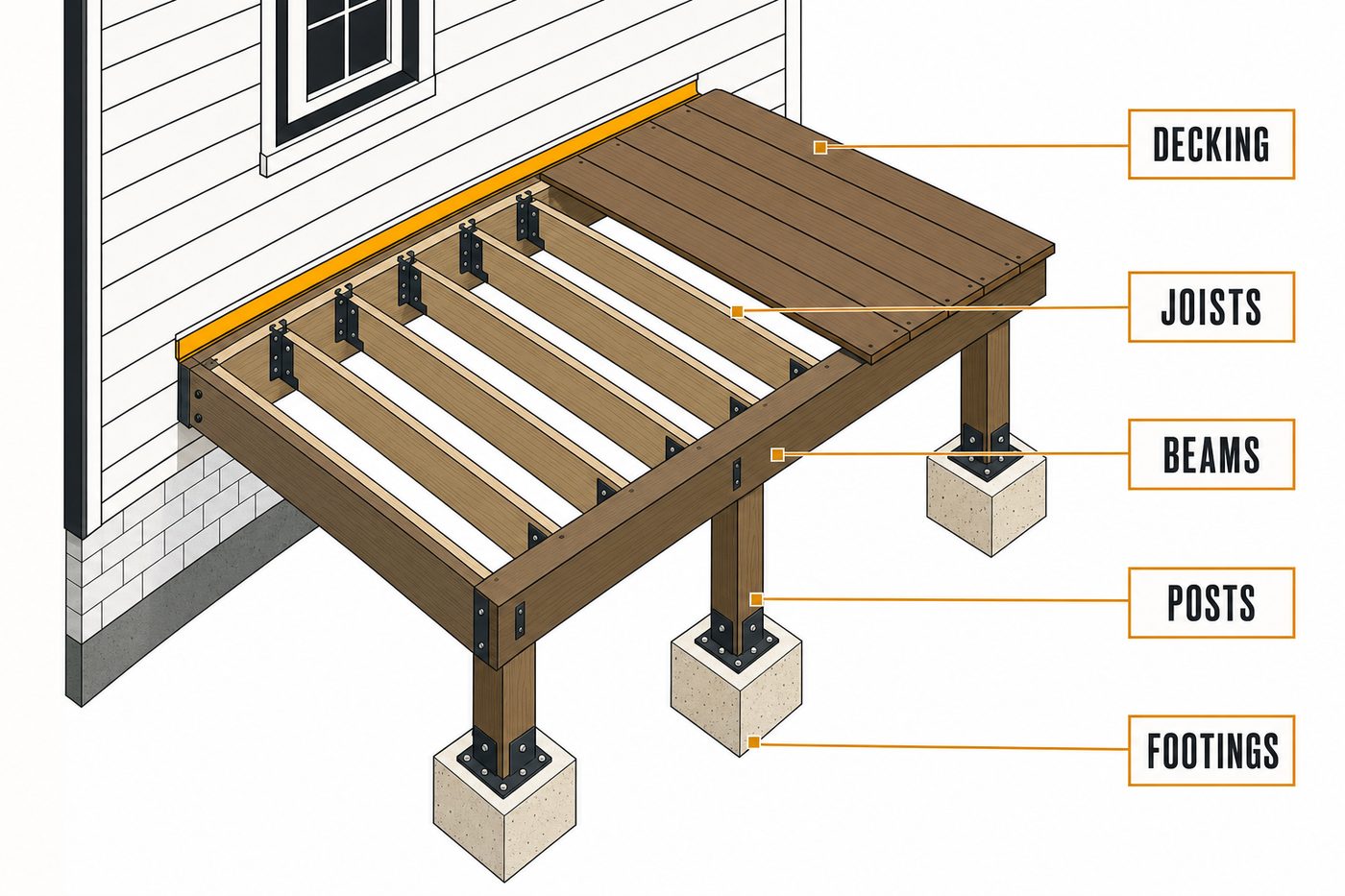
The wind that moves dust across the scablands also loads a deck, and a covered one especially. A roof over a deck is a sail: gusts that just rattle a patio umbrella apply real uplift to a solid cover, so the load path has to run from roof framing through posts into footings with rated hardware at every connection — not toenails and hope. Railings take the same seriousness. Code treats a railing as something someone will fall against, so we block and through-bolt railing posts rather than relying on fasteners into a single rim board.
Underneath, footings are dug below frost depth — Ritzville winters are cold and open, and frost heave doesn't care how dry the summer was. Snow here is lighter than Spokane's, but a covered structure still gets designed to carry the real regional load — the one heavy February in ten years is the one that counts. Wind also drives small details: board gapping that lets dust blow through instead of drifting, and skirting that doesn't turn the under-deck into a dust trap.
What Dry Country Does to Decking
Rot, the great deck killer of wet climates, is a minor player in Adams County — which changes the material conversation.
Cedar is the cautionary tale. Structurally it can last a long time here precisely because it stays dry, but cosmetically the sun is merciless: unfinished cedar grays within a couple of seasons, and the rapid swing between hot days and cool nights opens checks — long surface splits — faster than milder climates do. Cedar in Ritzville is a commitment to a regular sealing schedule with UV-blocking finish, on a shorter cycle than the can suggests. Owners who love the ritual do fine. Owners who wanted a build-it-and-forget-it deck end up unhappy by year three.
Quality composite flips the trade. Its capped surface is engineered against UV fade, never needs sealing, and won't check — the maintenance burden drops to washing. The trade-offs are up-front price and surface heat, which color selection manages. Pressure-treated framing is standard either way, and dry air is kind to it. Seasonal movement backs fasteners out of wood decks faster than owners expect, so we spec hidden fasteners or cycling-rated screws, never nails in the walking surface.
Where the Budget Actually Goes
Size sets the base, but on Ritzville decks the roof structure is usually the biggest single line — it's framing, roofing, and engineering, and it's also the part that makes the deck usable, so we'd rather shrink the footprint than delete the cover when budgets tighten. Decking material is the next lever: composite costs more than cedar up front and takes the maintenance line to nearly zero. Railing style swings cost more than people expect; steel or cable rail preserves the horizon view this country offers but prices above wood. Height and site slope drive footing and framing costs. Electrical — lights, a fan under the cover, an outlet where the smoker goes — is cheapest to run during framing, so we ask early. Fixed written quote after the site visit.
From Sketch to First Evening Out
- Site visit and design talk. We watch where the sun and wind actually come from, take measurements, and sketch options with you — including the phased version if that fits better.
- Written proposal. Dimensioned drawing, materials, railing spec, cover structure, and price on paper.
- Permit and engineering. Deck and covered-structure permits run through City of Ritzville in town or Adams County for rural parcels; covered structures may need engineered drawings, which we arrange.
- Foundation and framing. Footings below frost line, hardware-connected framing, roof structure tied for uplift. Inspections happen at the stages the permit requires.
- Decking, railing, and walkthrough. Surface down with rated fasteners, railing set to code, wiring finished, site cleaned, and a final walk with you — ideally at the hour of evening you plan to use it.
When to Start Talking to Us
Design, permitting, and any engineering usually take a few weeks before a shovel moves, and the build itself runs from about a week for a straightforward platform to several weeks for a large covered project. The scheduling truth is seasonal: everyone calls in May wanting a deck by July. Owners who start the conversation in fall or winter get built in spring and own the whole summer. Cold-season construction is workable — concrete and framing both have cold-weather methods — so a winter build slot is a real option.
Deck Questions From Around Adams County
Solid roof or pergola?
For genuine heat relief here, solid roof. A pergola is shade-flavored decoration — pleasant in May, insufficient in August. If you want the open look, we can mix: solid cover over the seating zone, open frame over the rest.
Which composite colors stay coolest?
Lighter tones, by a wide margin. On a hot day the difference is obvious to the touch — we bring sample boards so your own hand can decide.
Is cedar a bad choice in Ritzville?
Not bad — demanding. It needs UV-protective sealing on a short cycle or it grays and checks quickly. If you won't enjoy that maintenance, composite will make you happier.
Do I need a permit for a deck?
Almost always, and a covered structure raises the bar — possibly to engineered drawings. City of Ritzville in town, Adams County outside it; we handle the paperwork in both.
Can a cover be added to my existing deck?
Sometimes. The existing footings and framing have to carry the new roof and wind loads, so it's an inspection question first. If the bones can't take it, we'll show you why rather than bolting a sail to a deck that wasn't built for one.
How deep do footings go here?
Below local frost depth, per the permit jurisdiction's requirement. Open cold winters make this real; shallow footings are how decks start leaning.
Will wind be a problem for a deck roof?
Not if it's engineered for uplift — rated hardware from roof to footing. That connection path is the difference between a covered deck and a future insurance claim.
Do you build outside Ritzville itself?
Yes — Sprague, Lind, Washtucna, and rural Adams County parcels are all in range. We schedule outlying builds as consecutive crew blocks so the project doesn't dribble out over weeks.
Building It Once, Properly
Domex Construction brings 9 years in business and 32 years of combined crew experience to outdoor projects across eastern Washington. Licensed in Washington (DAVYDCI833NC, verifiable through L&I) and fully insured — and ask about our workmanship warranty when we come out to look at the yard.
Featured Nearby Project
From Ritzville we build across Adams County — Sprague, Lind, Washtucna — and along the I-90 corridor toward Spokane.
Want a place to sit outside in August without cooking? Free on-site design estimates in Ritzville and across Adams County. Give us a call or request an estimate online.
More from Domex in Ritzville: Siding Installation in Ritzville · Window Replacement in Ritzville · Custom Home Builder in Ritzville · Custom Decks — Spokane hub