
Custom Deck Builders in Pinehurst, Idaho
Custom deck builders in Pinehurst, Idaho. Family-sized decks engineered for creek-valley ground and real snow loads. Free design estimates.
$1,000 Off
Your Complete Siding Replacement
Get a Free Estimate
FREE same-day estimates on all exterior projects.








The first thing you notice standing behind a Pinehurst house is the yard. Up-valley in the mining towns, "backyard" often means a strip of gravel between the house and the hillside; here at the west end, where the valley floor spreads out toward Cataldo, houses sit on genuine lots with grass, trees, and room to walk around. Kids' trampolines. Gardens. Space that most of the Silver Valley simply doesn't have.
Which is why deck projects in Pinehurst are a different conversation than anywhere else in the valley. We're not squeezing a landing between a back door and a slope — we're deciding how a family actually wants to use a real yard, then building the structure to survive creek-bottom ground and a legitimate mountain winter. Domex Construction designs and builds decks here under Idaho license RCE-66940.
Room to Design, Not Just Room to Stand
A Pinehurst lot gives you choices that tight-valley lots never offer, and the design phase should use them. A low platform deck can step down into the lawn instead of dead-ending at a railing. Grill zones can sit away from the door traffic. A shade structure can go where the afternoon sun actually lands rather than where the only free corner happens to be. Families here ask for room for a table of eight, a covered corner for rainy shoulder seasons, stairs wide enough for kid traffic — wish lists that finally fit the property.
Our advice at the design stage is usually about restraint in the right places: build the deck for how you'll live on it in July and how you'll shovel it in January. Big open rectangles clear easily; clever multi-level cutouts collect snow and leaves. On a lot this size, simple and generous beats intricate and fussy almost every time.
The Ground Under the Deck
Here's what the pretty green yards don't advertise: a lot of Pinehurst sits on valley-bottom ground near Pine Creek and the river, and that ground holds water. Spring in a creek valley means saturated soil, and shaded lots — most of them, with the ridgelines and the trees — stay damp well into summer.
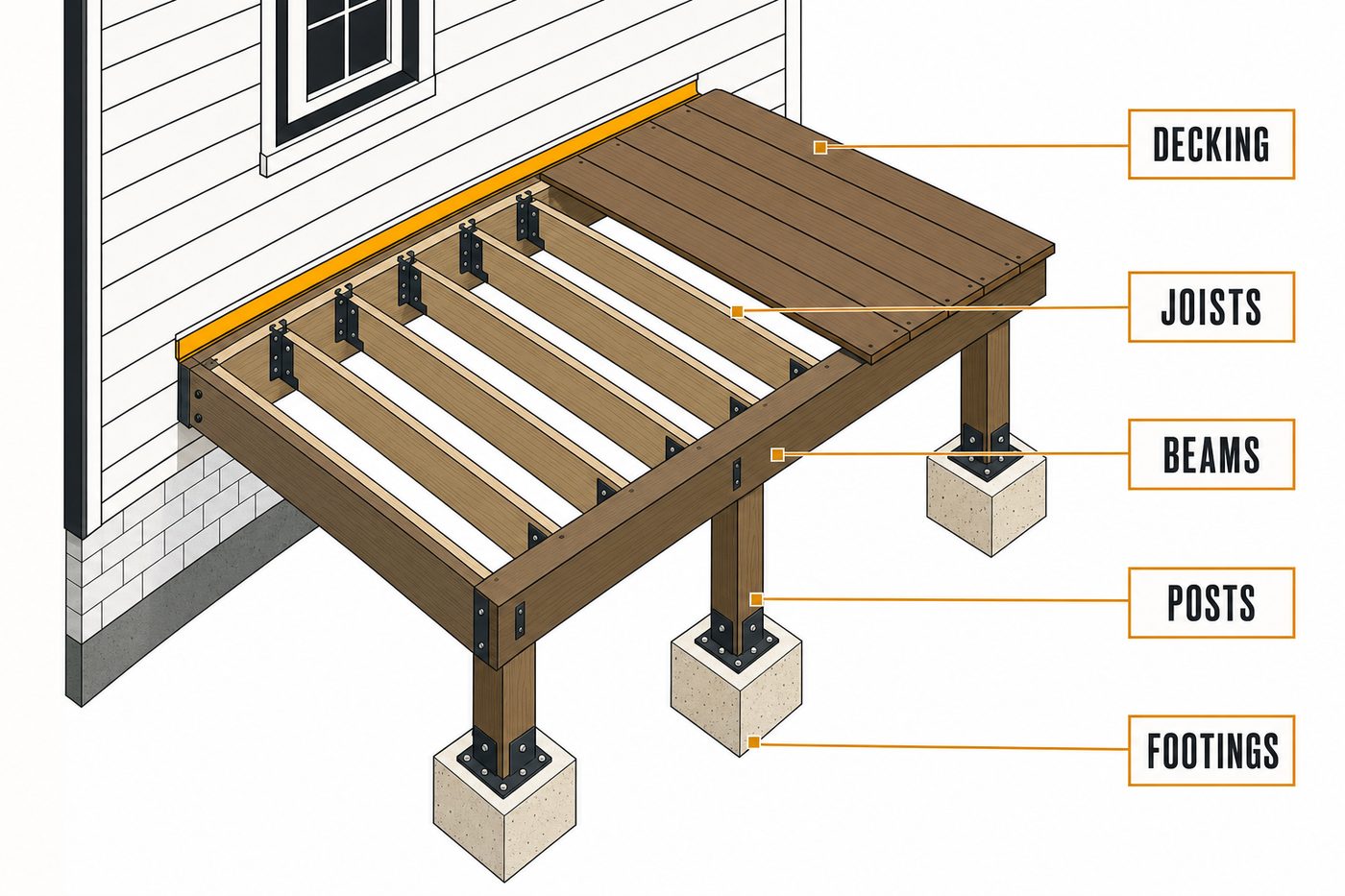
Footings are where that matters. A post set on a shallow pad in soft, wet soil will move, and a moved footing telegraphs through the whole frame: sloping boards, racked railings, doors on the deck-side wall that stick. We dig to proper frost depth, pour concrete footings sized for the actual loads, and keep every wood post up out of ground contact on standoff bases so the post bottom can dry. On the wettest lots we'll talk drainage honestly — sometimes a few yards of grading or gravel under the deck footprint saves the structure a decade of trouble. Ledger attachment gets the same respect: flashed and bolted to solid rim framing, never lagged through old siding into questionable wood, because a ledger failure is the one deck failure that's genuinely dangerous.
Framed for the Snow That Actually Falls
Pinehurst gets real snow — mountain-valley accumulation, not Spokane dustings — and a deck carries it all winter whether anyone shovels or not. Wet spring snow is the heavy kind, and a deck built to a sunny-climate span table will sag here in a few seasons.
So the structure gets sized for the load: joists on tighter spacing than the minimum, beams sized with margin, hardware-connected framing rather than nail-only connections, and railings framed to take a snowblower bump and a decade of kids without loosening. None of this shows once the boards are down, which is exactly why it's the part to ask every bidder about. A snow-country frame costs modestly more in lumber and takes the same time to build correctly — it's the cheapest insurance in the whole project.
Boards: Wood or Composite in a Damp Valley
Shade and damp push the material choice harder here than in dry towns.
Pressure-treated decking is the budget workhorse — structurally fine and honest money. Its costs come later: annual cleaning and periodic re-staining, and in Pinehurst's shade it will grow a slick algae film every spring that needs washing before it's safe in slippers.
Cedar looks and smells the part and stays cooler underfoot, but in a damp, shaded yard it demands the most maintenance of the three to keep from graying and softening.
Composite costs the most up front and earns it back fastest in exactly this climate: no staining, no rot at the cut ends, and modern textured lines hold traction reasonably well even when the shade keeps them damp. For a family deck someone has to maintain between work, school, and everything else, composite over a pressure-treated frame is our most common Pinehurst recommendation — but a well-kept wood deck is a fine choice for a hands-on owner, and we build plenty of them.
Railings run the same logic: wood for budget, aluminum or composite systems where nobody wants to repaint balusters every few summers.
What Changes the Price
Square footage and height set the base — a low platform over grade is a very different build than an elevated deck with long stairs. From there: footing count and any drainage work the ground demands, decking and railing material tier, covered or shade-structure elements, and extras like built-in benches or privacy screens. Old-deck demolition, where there's a failing deck to remove first, is its own line. Everything lands in a fixed written quote after we've seen the yard, measured, and checked what the ledger will attach to.
Our Process
- Yard walk and design talk. We look at the ground, the sun, the door heights, and how you want to use the space — then sketch options with straight prices. Free.
- Written proposal. Dimensions, framing spec, footing plan, materials, and railing system on paper.
- Permit. Decks in town go through City of Pinehurst permitting; outlying properties toward Kingston or up Pine Creek go through Shoshone County. We file it and meet the inspectors.
- Footings and frame. Dug to frost depth, poured, and framed with the hardware and spacing the snow demands — inspected before anything gets covered.
- Decking, rails, and walkthrough. Boards down, railings set, stairs finished, site cleaned, and a full walkaround with you before we leave.
When to Build
Most decks here go in between late spring and fall, and summer slots fill first — talk to us in winter or early spring for the best scheduling. Build time on site typically runs from under a week for a straightforward platform to a few weeks for large or covered projects. Footings are the season-sensitive stage; once concrete is in, framing and decking proceed in most weather. Fall builds are underrated: the deck is ready the moment spring arrives.
Deck Questions We Hear in Pinehurst
How big should a family deck be?
Big enough that the table, the grill, and a walking path around seated people all fit — for most families that's more than they first sketch. Your lot can take it; the design conversation is about matching size to real use, not maximizing lumber.
Will a deck work on my soggy backyard?
Almost always, with the right footings and sometimes modest drainage work under the footprint. Wet ground is a foundation problem to engineer around, not a reason to skip the project.
What's the snow protocol — do I have to shovel it?
A properly framed deck carries a Pinehurst winter without shoveling. Clearing near the door for daily use is about convenience and door clearance, not structural rescue.
Is composite slippery in the shade?
Less than algae-filmed wood, which is the real-world alternative in a shaded yard. Textured composite lines plus an annual rinse keep traction in good shape.
Can you replace just the boards on my existing deck?
If the frame and footings check out, yes — a re-deck saves real money. We inspect the structure first, because new boards on a moving frame is money wasted, and we'll tell you plainly which situation you have.
Do I need a permit for a deck here?
In town, yes — through the City of Pinehurst; outside city limits, through Shoshone County. It's included in our scope, along with the inspections.
Attached to the house or freestanding?
Attached is typical and fine when the ledger detail is done right. Where the wall construction argues against it — some manufactured homes, some additions — a freestanding frame inches away is the cleaner solution, and it's one we use regularly.
How long before we can use it?
Immediately. Wood decks wait a few weeks to dry before their first stain; composite has no waiting period at all.
Built by a Licensed Valley Contractor
Domex Construction holds Idaho license RCE-66940 (verify it through the Idaho Contractors Board) and Washington DAVYDCI833NC, with full insurance. Nine years in business, 32 years of combined experience on the crew, and a workmanship warranty we'll walk you through at the estimate.
Deck projects run from Pinehurst across the Silver Valley's west end — Kellogg, Smelterville, Kingston, Cataldo, and the rural lots up Pine Creek.
Got the yard — want the deck? Free design estimates anywhere in Pinehurst and the west valley. Give us a call or request an estimate online.
More from Domex in Pinehurst: Siding Installation in Pinehurst · Window Replacement in Pinehurst · Custom Home Builder in Pinehurst · Custom Decks — Spokane hub