
Window Replacement in Newport, Washington
Window replacement in Newport, WA: warmer glass for cold river-valley nights from a contractor licensed in WA and ID. Free estimates.
$1,000 Off
Your Complete Siding Replacement
Get a Free Estimate
FREE same-day estimates on all exterior projects.








Cold air behaves like water: it flows downhill and collects in the low spots. Newport is a low spot. On a clear January night, the cold that forms on the surrounding ridges slides down into the Pend Oreille River valley and settles over town, which is why Newport regularly wakes up colder than Spokane and stays socked in fog long after the sun is up. A single-pane window — and plenty survive in this town's older houses — does nothing to argue with that. Glass is a poor insulator on its own, so a single pane simply takes the outdoor temperature and broadcasts it into the room. Stand next to one in January and you can feel the cold falling off the glass like a draft, even with the sash locked tight.
Replacing that glass is one of the most measurable upgrades a Newport house can get, and it's a job we run on both sides of the state line — Washington license DAVYDCI833NC for Newport and the county, Idaho RCE-66940 for the Oldtown addresses that are literally across the street.
Valley Cold, Interior Glass, and the Numbers That Matter
Two things tell you how a window will behave in a Newport winter: its U-factor and what happens on the inside face of the glass at 10 below.
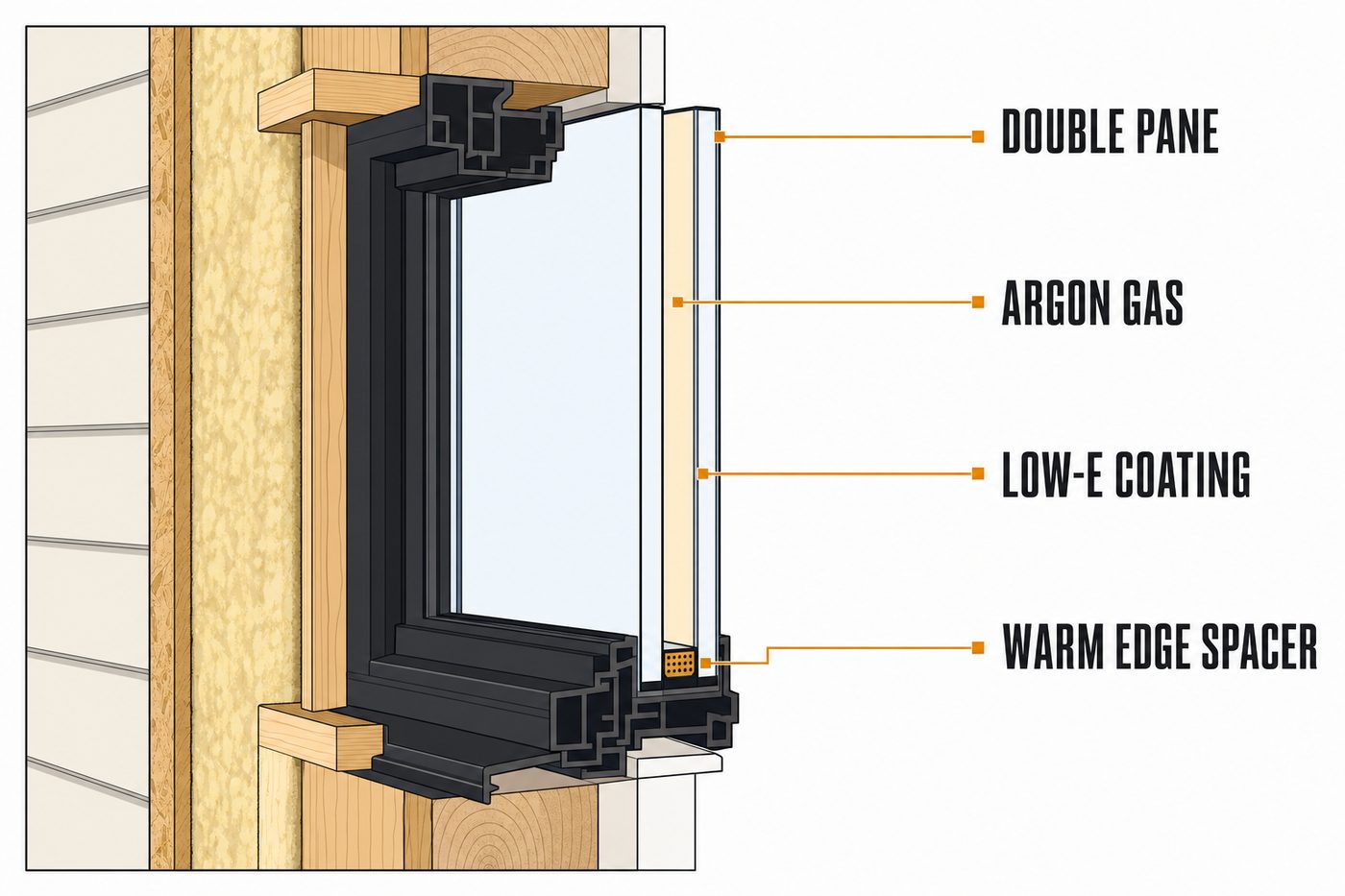
U-factor measures how fast heat escapes through the whole window assembly — lower is better. Old single-pane units and early aluminum sliders sit at the bad end of the scale, and the difference between those and a modern double-pane with low-E coating and argon fill is not subtle; it's the difference between a furnace that cycles all night and one that rests.
Condensation is the symptom homeowners actually see. When warm indoor air touches glass that the valley cold has chilled below the dew point, water films the pane, runs to the sill, and soaks into paint, drywall, and eventually framing. Aluminum frames make it worse — the metal conducts cold straight through and sweats along with the glass. Weeks of valley fog keep indoor humidity higher than people expect, so Newport windows condense earlier in the season and dry out later than the same windows would in a drier town. A warm-edge spacer, an insulated frame, and low-E glass raise the interior surface temperature enough that most mornings the pane stays dry. That protects the sill and the wall below it, not just the view.
Century Openings in Town, Cabin Openings at the Lakes
The window work splits the same way Newport's housing does. On the early-1900s homes around the courthouse district, the openings are the project: true-dimension framing, decades of paint layers, sash weights hiding in the jamb cavities, and sills that a hundred winters of condensation have been feeding water. Some of those openings take an insert replacement cleanly. Others need full-frame work — pulling the unit back to the rough opening so we can repair the sill, insulate the weight cavities that have been moving cold air through the wall for a century, and flash the opening the way the original builders never did.
Mid-century houses bring a different pattern: bigger panes, aluminum sliders, and hardboard-era walls where the flashing under the window is often the reason the siding below it failed.
Out at Diamond Lake and Sacheen Lake, the calls are about cabins that grew into houses. Summer-place windows were bought for price, not performance — builder-grade aluminum or early vinyl, sized for view walls facing the water. Those big lakeside openings lose heat all winter and cook the room all July, so glass selection there is a two-season decision: low U-factor for the heating months, and a solar heat gain coefficient chosen for how much afternoon sun that wall actually takes off the water.
Spec'ing Glass Without Overbuying
We tier window recommendations to the house and the plans you have for it, and we'll say plainly when the cheaper tier is enough.
- Solid double-pane vinyl with low-E and argon covers most Newport homes well. It cures the single-pane problem, calms condensation, and doesn't ask luxury money.
- Upgraded packages — triple-pane, or double-pane with better spacers and tuned coatings — earn their cost on north-facing walls, bedrooms where glass area is large, and the lake places that live with wind straight off open water.
- Frame upgrades (fiberglass, composite, or wood-clad) make sense on view walls with big spans, on street-facing elevations of the older homes where profile matters, and anywhere aluminum is being retired.
Orientation gets a room-by-room look during the estimate. The right glass for a fog-shaded north bedroom and the right glass for a west wall staring at Sacheen Lake all afternoon are not the same product, even in the same house.
How Replacement Day Goes
- Measure and assessment. Every opening measured, every sill probed, insert-vs-full-frame decided window by window, and orientation noted for glass selection.
- Written proposal. Line-itemed per window with frame material, glass package, and install method — so you can phase the project if you want to.
- Ordering and permits. Windows are built to order. Permitting runs through the City of Newport, Pend Oreille County, or Idaho depending on the address; we file it either way.
- Installation. Most whole-house jobs finish in one to three days. Openings are opened, corrected, insulated, flashed, and sealed one at a time — no house full of missing windows overnight.
- Final pass. Operation checked on every sash and lock, interior trim finished, sealant lines inspected, and a walkthrough with you before the crew leaves.
Pricing Factors, Plainly
Window count drives the total, but the per-window number moves with: install method (full-frame costs more than an insert because it fixes more), frame material, glass package, size — the big lake view units are their own category — and the condition of what we uncover. A rotted sill on a 1910 opening is a repair, not a landfill verdict for the whole project, and our proposals state how that repair work is handled before you sign. We give fixed written pricing after measuring, never a phone guess.
From Measure to Install
Custom-built windows typically take a few weeks from order to delivery, with the exact lead time depending on manufacturer and season. Installation itself is short — days, not weeks. The practical advice for Newport: measure in late summer or fall if you want new glass in before the valley cold arrives, because the fall calendar fills with people who waited for the first frost to decide.
Newport Window Questions
Why do my windows sweat so much here?
Valley cold chills the glass below the dew point of your indoor air, and fog season keeps that indoor air more humid than you'd guess. Old glass and aluminum frames make the combination worse. Modern low-E units with warm-edge spacers keep the interior surface warm enough to stay dry most days.
Insert or full-frame — how do you decide?
By the condition of the opening. Sound sills and square frames take inserts; rot, out-of-square century framing, or missing flashing call for full-frame. We decide per window, not per house.
Is triple-pane worth it in Newport?
On north walls, big glass areas, and exposed lake places, often yes. On a sheltered south-facing wall, a good double-pane usually gets you most of the benefit for less. We'll show the comparison per opening.
Can you replace windows in an Oldtown house?
Yes — Oldtown is Idaho, and we hold Idaho license RCE-66940 alongside our Washington license, so the state line down the middle of town doesn't limit which houses we can take.
Do lake cabins need different windows than town houses?
Usually different glass, yes. Open-water exposure means more wind pressure and more solar gain off the water, so we tune the solar heat gain coefficient and sometimes step up the frame on the view wall.
Will new windows fix a cold room by themselves?
They fix the glass losses and the frame drafts, which in older Newport homes is often the biggest single piece. If the wall or attic insulation is also thin, we'll tell you that during the assessment rather than let a window sale carry expectations it can't meet.
How disruptive is the install?
One opening at a time, weather-tight the same day, most homes done in one to three days. Furniture near windows gets moved and covered; that's about the extent of it.
A Crew Both Building Departments Recognize
Domex Construction has 9 years in business and 32 years of combined team experience across siding, windows, and decks. We're licensed in Washington (DAVYDCI833NC, verifiable through L&I) and Idaho (RCE-66940), fully insured, and glad to talk through our workmanship warranty at your estimate. From Newport we cover Oldtown (ID), Priest River, Diamond Lake, Sacheen Lake, and the rural reaches of Pend Oreille County.
Tired of glass that leaks heat all winter? Free in-home window assessments across the Newport–Oldtown area. Give us a call or request an estimate online.
More from Domex in Newport: Siding Installation in Newport · Custom Decks in Newport · Custom Home Builder in Newport · Window Replacement — Spokane hub