
Custom Deck Builders in Newport, Washington
Custom deck builders serving Newport, Diamond Lake & Sacheen Lake. Snow-rated framing, lake-ready decking, licensed WA & ID. Free estimates.
$1,000 Off
Your Complete Siding Replacement
Get a Free Estimate
FREE same-day estimates on all exterior projects.








The call usually starts with a lake place. Somebody's family cabin at Diamond Lake or Sacheen Lake has an old deck — narrow, springy, railing wobbling, boards checked gray — and the family has outgrown it. From June to September that deck is the dining room, the mudroom for wet swimsuits, the card table after dark, and the spot where three generations eat burgers within sight of the dock. The house behind it might be 900 square feet; nobody cares, because summer lives outside. When the deck can't hold the whole crowd anymore, the phone rings.
We build those decks, along with the town versions on Newport's older grid and the river-and-timber versions scattered through Pend Oreille County. Domex Construction is licensed in Washington (DAVYDCI833NC) and Idaho (RCE-66940), which around here is practical rather than decorative — a Newport job and an Oldtown job can be a two-minute drive apart with a state line between them, and we take both.
Designing for the Water, Not Just the House
A lakeside deck earns its keep differently than a backyard deck, and the design decisions follow the water.
Orientation comes first. The deck wants to face the view, but the view side is also the afternoon-sun side on a lot of Diamond Lake and Sacheen Lake shoreline, and open water bounces light up under any shade you build. We lay out seating zones, figure where shade structure or a future awning would land, and pick decking colors that won't scorch bare feet in August.
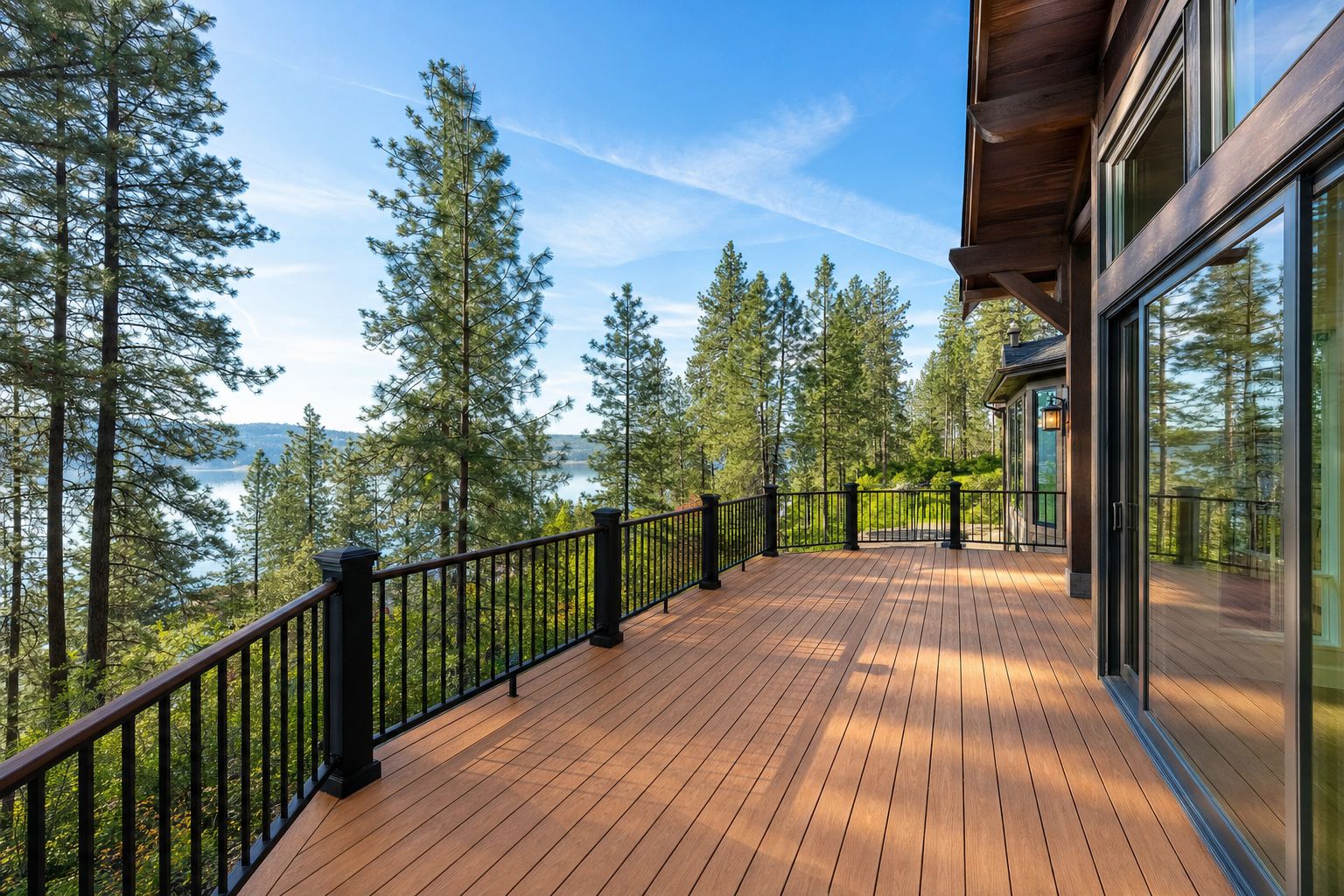
Railings can't wall off the reason you built the deck. Cable rail, slender balusters, or framed glass panels keep the sightline to the water from seated height — a detail people miss until the new top rail lands exactly at seated eye level.
Seasonal-place practicality is its own spec. Many lake properties sit empty from October to May. That argues for decking that tolerates neglect (nobody's there to sweep snow or re-stain in April), fasteners and hardware rated for wet freeze-thaw, and framing details that don't trap needles and leaf litter against wood. If the cabin is becoming a retirement house, we plan the deck for year-round use instead — bigger structural margins, room for a covered section, stairs placed where they'll actually get shoveled.
Grade and access matter on lake lots. Shoreline parcels slope, and a deck that steps down the grade toward the water often serves the site better than one tall platform on posts. Slope footings and hauling concrete down a narrow lake lane are normal parts of our estimates, not surprises.
The Frame Has to Survive February First
Every deck around Newport gets designed for the season nobody photographs. This valley takes more snow than Spokane, and a deck at a seasonal place may carry the whole winter's accumulation with no one there to clear it. Roofs shed onto decks, too — a metal roof can drop a season of snow onto a few square feet of decking in one slide.
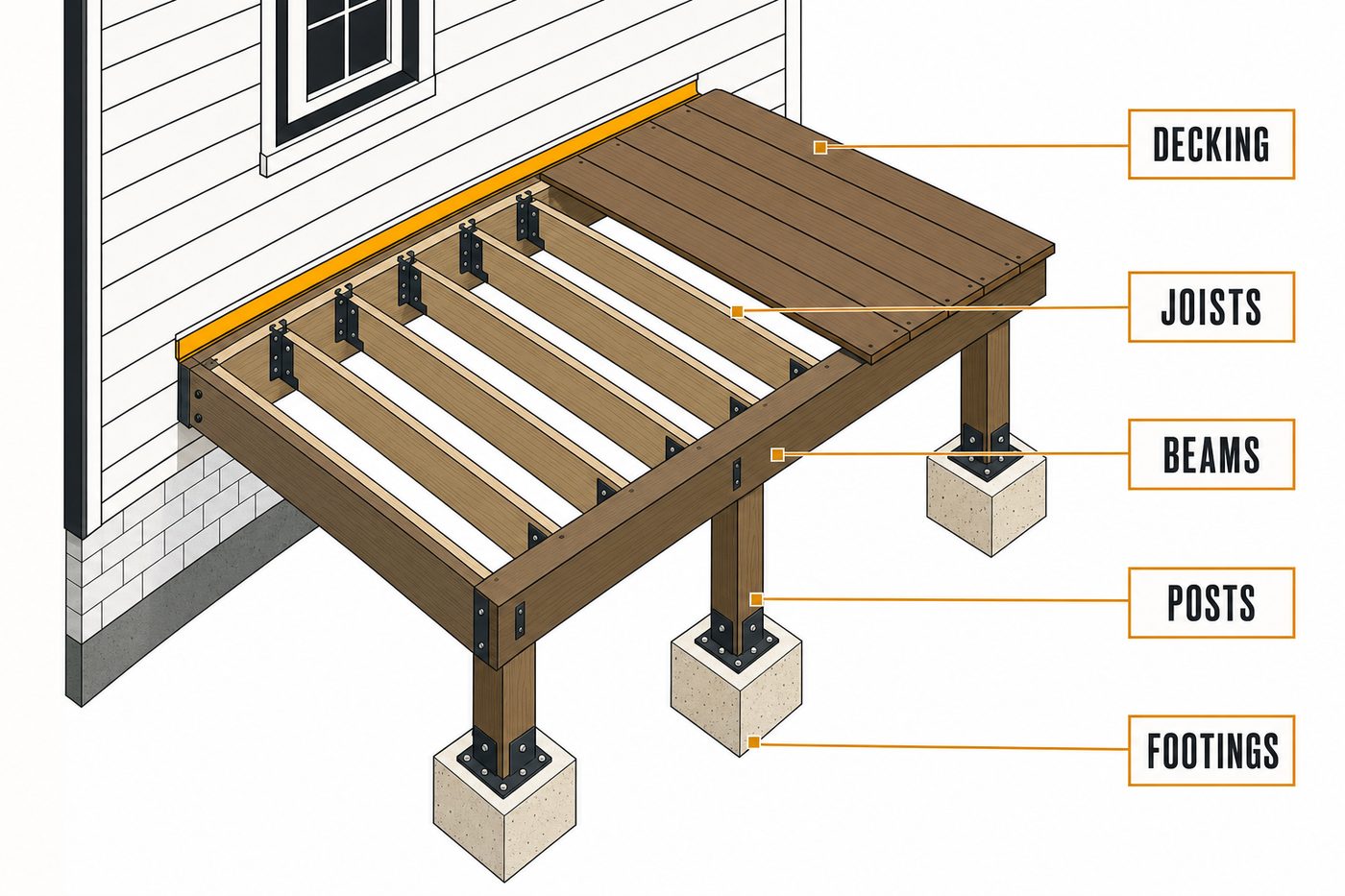
So the structure gets sized for the real load: footings dug below frost depth so heave doesn't rack the frame, posts and beams specified for snow sitting months at a time, joist spacing tightened where composite decking and drift load call for it, and ledger connections flashed and bolted correctly — the ledger is where undersized decks fail, and it's the connection we're pickiest about. Where a roofline dumps onto the deck, we frame for the impact zone or talk honestly about moving the deck edge. Pend Oreille County and the City of Newport both review structural details on permitted decks, and our drawings go in with the load math already done.
Boards, Rails, and What Holds Up at a Lake
Composite decking carries most of our lake work. It doesn't gray, splinter, or demand a spring re-stain the owner isn't there to apply, and it handles wet-dry cycling off the water without checking. Mid-tier and better composites also run cooler underfoot in lighter colors — worth choosing carefully on a west-facing water view.
Cedar still makes sense for some owners — it's the traditional Northwest deck, it costs less up front, and on a shaded town lot that gets regular care it ages gracefully. It asks for maintenance every year or two, and at an empty winter cabin that usually doesn't happen — which is how cedar decks go gray and soft.
Pressure-treated framing throughout, hidden fasteners where the budget allows, and metal or composite railing systems round out the typical spec. Stairs to a dock path or fire-pit terrace get the same footing and hardware standard — they take more abuse than any other part.
What You're Paying For
Deck pricing follows structure and finish more than raw square footage. The drivers on a Newport-area build: elevation and slope (a walk-out platform costs less than a tall or stepped structure on a grade), footing count and depth, decking tier, railing system — cable and glass cost more than balusters — stairs and landings, and any covered or shade element. Lake-lot access adds crew and material handling time on some parcels. Removal and disposal of the old deck is its own line. We put fixed numbers on all of it in a written proposal after seeing the site — no phone guesses, no vague allowances hiding change orders.
How We Run a Deck Build
- Site visit. We look at grade, sun, snow-shed lines, the house connection, and how you actually use the outdoor space — then sketch options rather than force one template.
- Design and proposal. Layout, structure, materials, and railing spec in writing, with the trade-offs explained in plain terms.
- Permit and engineering. Drawings with load details go to the City of Newport, Pend Oreille County, or the Idaho jurisdiction for Oldtown-side properties. We manage the review.
- Foundation and framing. Footings below frost line, framing bolted and flashed, ledger detailed against the house correctly — inspected before anything gets covered.
- Decking, rails, and walkthrough. Surface and railings installed, hardware checked, site cleaned, and a walk of the finished deck with you before we call it complete.
Getting It Done Before the Season You Built It For
Lake owners want decks finished by early summer, so the smart calls come in fall and winter. Design and permitting can run through the cold months, footings go in as soon as ground conditions allow, and a typical build takes one to three weeks on site depending on size, height, and railing complexity. Start the conversation in July and the deck hosts next summer; start in January and it can host this one.
Deck Questions From Around the Lakes
Can you build at a cabin we only use in summer?
Yes, and we spec for it — decking and hardware that tolerate an unattended winter, and framing sized for snow nobody will shovel.
How much snow load do decks here need to handle?
More than a generic span table assumes. The valley out-snows Spokane, and roof-shed can concentrate load. We size footings, beams, and joists for the site and submit the numbers with the permit.
Composite or cedar for a lake place?
Usually composite, for the maintenance you won't be there to do. Cedar suits owners who are on site regularly and like the ritual of caring for real wood. We'll price both if you're torn.
Will a new railing block our water view?
Not if it's designed for the sightline. Cable rail and glass panels preserve the view from seated height; we mock up rail heights on site before we build.
Do I need a permit for a deck in Newport or the county?
Attached and elevated decks generally do — City of Newport in town, Pend Oreille County outside it, Idaho for Oldtown-side addresses. Filing and inspections are part of our job either way.
Can you replace just the decking on a sound frame?
Sometimes. If footings, beams, and the ledger check out, a re-deck saves real money. If the frame was undersized for snow in the first place, we'll show you why it shouldn't carry new boards.
When should we start to have a deck by summer?
Fall or winter. Permitting and material lead times are easier off-season, and spring build slots go to the projects already designed.
Do you build stairs down to the water or a dock path?
We build stairs and landings on the deck's own footing and hardware standard. Work at or below the shoreline can involve separate rules; we'll flag what falls outside a standard deck permit.
The Local Outfit With Both Licenses
Domex Construction builds decks, siding, and windows across the Spokane–North Idaho region — 9 years in business, 32 years of combined crew experience, licensed in Washington (DAVYDCI833NC, verifiable through L&I) and Idaho (RCE-66940), and fully insured. Ask about our workmanship warranty when we visit. From Newport we serve Oldtown (ID), Priest River, Diamond Lake, Sacheen Lake, and properties throughout Pend Oreille County.
Want the deck ready before the first barbecue? Free on-site design consultations around Newport and the lakes. Give us a call or request an estimate online.
More from Domex in Newport: Siding Installation in Newport · Window Replacement in Newport · Custom Home Builder in Newport · Custom Decks — Spokane hub