
Window Replacement in Newman Lake, WA
Window replacement in Newman Lake, WA. Custom-sized units for cottage-era openings and lake views. Licensed, insured, free estimates.
$1,000 Off
Your Complete Siding Replacement
Get a Free Estimate
FREE same-day estimates on all exterior projects.








Measure ten window openings around Newman Lake and you might find one that lands on a stock size. That's the single most useful thing to know before you shop for replacement windows on this lake. Cottage builders framed openings around whatever sash a hardware order or a salvage pile supplied. Additions from later decades brought their own odd dimensions. Even the 80s and 90s lakeview homes lean on oversized fixed glass, transoms, and trapezoids that were custom the day they went in. Window replacement here is an ordering discipline as much as an installation trade, and a contractor who assumes warehouse sizes ends up forcing fits or shrinking your glass.
The houses got this way for a good reason. Newman Lake sits in the Valley's northeast corner by the Idaho line, twenty-five minutes from downtown Spokane, and that short drive is why its summer places became full-time homes decades back — each conversion and each addition leaving its own generation of windows behind. Domex Construction replaces all of them, from single cottage sashes to full-house packages, under Washington license DAVYDCI833NC.
Odd Openings and the Ordering Game
Every opening on a Newman Lake job gets measured individually — width and height at three points each, plus square, plumb, and sill condition — because in a house assembled across four decades, no two openings can be trusted to match. Units are then ordered to those exact dimensions. Custom manufacturing means real lead times, measured in weeks and varying by maker and season, so the sequence matters: we don't touch an existing window until its replacement is on hand and inspected. Your house is never left waiting on a truck.
Ordering to the opening also protects the glass area you already have. Off-size retrofits done cheaply shrink openings inch by inch — a filler strip here, a padded jamb there — and on a lake house, inches of glass are the point. Where an opening is badly out of square, we correct the framing rather than hide the problem behind trim.
Glass Choices for a House That Faces Water
Orientation does more work at Newman Lake than in a subdivision, because the lake doubles your sun. A west-facing wall takes full afternoon light plus glare bounced off the water, so those elevations argue for Low-E coatings tuned to cut solar heat gain. East-facing shoreline gets gentler morning light and can run a coating that admits more warmth for a milder winter. On the view wall itself, the pattern that works is large fixed units carrying the sightline, flanked by casements or awnings that actually catch the evening breeze coming off the water.
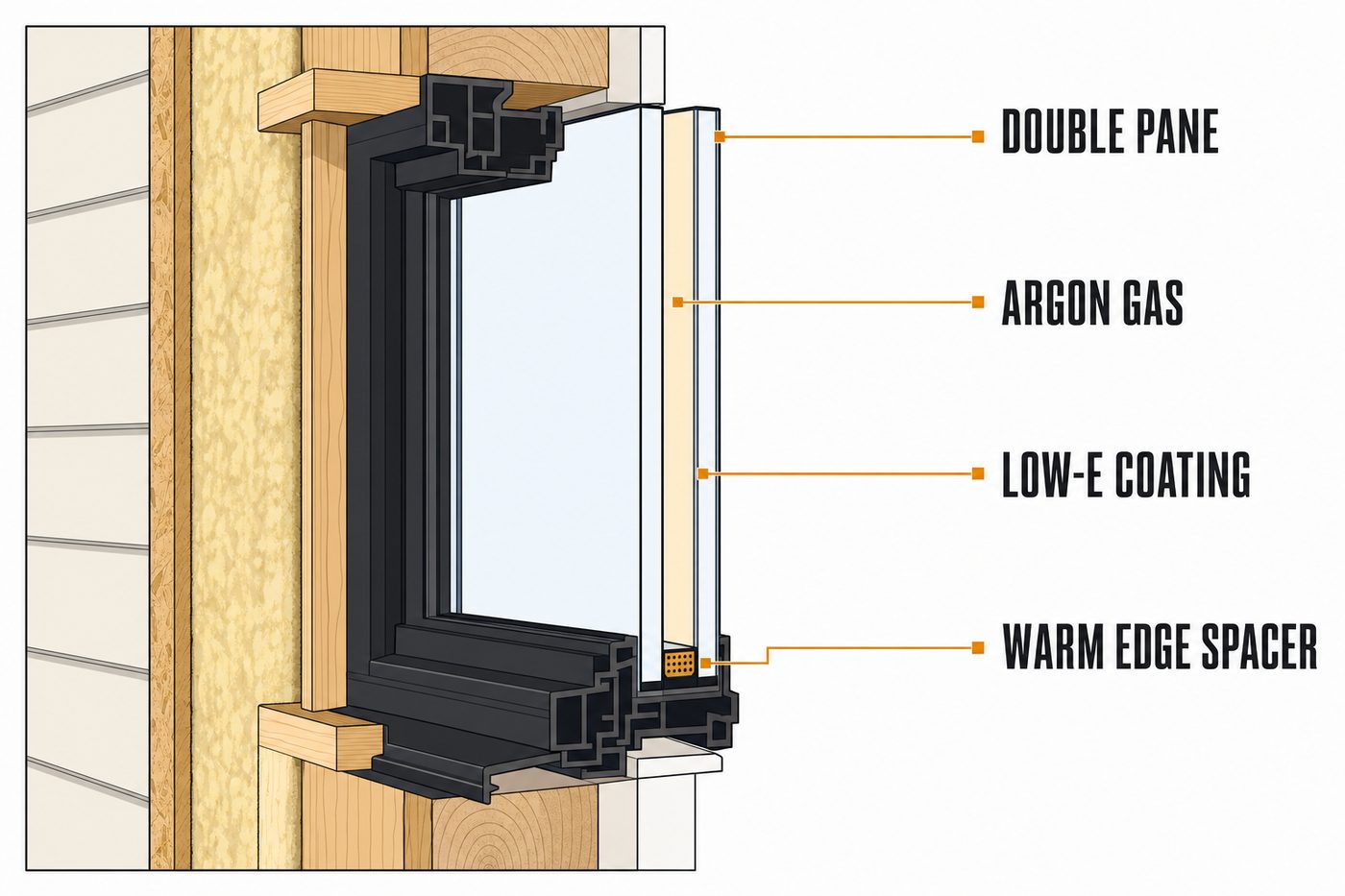
Winter matters as much as glare. Double-pane units with argon fill and warm-edge spacers keep interior glass surfaces warmer through Spokane-area cold snaps, which is what kills the draft you feel from the couch. Safety glazing goes wherever code calls for it — beside doors, near floor level, on stair landings — and we flag those spots during the measure so nothing gets ordered wrong.
The Condensation Talk We Have With Cottage Owners
Here's the counterintuitive part of upgrading an old lake place: the fog on your new glass in December isn't a defect. Original single-pane windows in a drafty cottage never showed condensation because the whole house exhaled — humidity escaped through the gaps around every sash. Replace them with sealed, gasketed units and the envelope tightens dramatically, so moisture from cooking, showers, and daily living finally has to show up somewhere. The coldest surface wins, which means the glass edges.
We raise this before installation, not after a callback. The answer is managing indoor humidity — running bath and kitchen fans, adding one where a cottage never had one — and choosing units with warmer interior glass surfaces in the first place. Homeowners who hear this in advance treat winter condensation as a dial to adjust. Homeowners who don't hear it blame the windows.
Insert or Full-Frame? The Wall's Era Decides
An insert replacement sets a new unit inside the existing frame; a full-frame replacement strips the opening to the rough framing and rebuilds sill, flashing, and trim. Around this lake, the right answer tracks the age of the wall.
Cottage-era openings usually earn full-frame. Sills that spent decades over an unheated crawl space are often soft, exterior flashing frequently never existed, and an insert would seal a new window inside an old failure. Openings in the 80s–2000s homes are better insert candidates — where frames are sound, square, and dry, an insert preserves interior trim, costs less, and installs faster. Newer custom builds typically need inserts or glass-only swaps when a seal fails. And if a re-side is anywhere in your five-year plan, full-frame while the siding is off is the cleanest work either trade will ever do — one integration of flashing, wrap, and trim instead of two compromises. We do both trades, so sequencing them is one phone call.
How a Window Project Runs Here
- Measure visit. Every opening dimensioned individually, orientation and code-glazing locations noted, insert-versus-full-frame called per opening — not per house.
- Spec and order. Glass packages, frame material, colors, and grids on paper; units ordered to the exact openings. Lead time starts now.
- Permitting. Newman Lake is unincorporated, so any required approvals run through Spokane County. Requirements differ by scope — like-for-like swaps and resized openings are treated differently — and Domex manages the determination and filing.
- Installation. One opening at a time, weathertight the same day it's opened — no plywood nights, even in January. Full-frame openings get new flashing and insulation before trim goes back on.
- Walkthrough. Every sash operated, locks and screens checked, glass inspected in raking light, care basics covered before we leave.
What Moves the Price
Unit count leads, but it isn't the whole story. Custom sizing costs more than stock — unavoidable here. Full-frame openings cost more than inserts because they buy rebuilt sills and new flashing. Large fixed lake-view units are heavy, and getting them safely to a second floor above a sloped yard takes crew and planning. Frame material — vinyl, fiberglass, wood-clad — and glass upgrades set the rest. We quote fixed pricing per opening after the measure, so you can phase the project by wall or by budget without guesswork.
Lead Times and Seasons
Custom orders put the schedule's long pole at the factory, not on your wall — which is why ordering in late winter positions you for a spring install ahead of the summer rush. Installation itself moves quickly: an experienced crew works through multiple openings a day on inserts, slower on full-frames. Winter installation is routine with one-at-a-time sequencing.
Straight Answers for Newman Lake Homeowners
Why can't I just buy stock windows and save money?
On this lake, stock sizes rarely fit without shrinking the opening or forcing the fit. Custom sizing costs more per unit but preserves your glass area and installs correctly. A few openings on newer homes do land on stock dimensions — we'll tell you which, and quote accordingly.
Can you replace just one or two windows?
Yes. Plenty of our lake work is a single failed unit or one rotten sill.
My new windows have condensation. Are they defective?
Almost certainly not. New sealed units reveal indoor humidity that old drafty sashes used to vent; manage the humidity and it settles down. Fog between the panes is different — that's a failed seal, and it's a warranty and replacement conversation.
Do I need a permit to replace windows at Newman Lake?
There's no city hall out here; Spokane County is the authority, and requirements depend on scope. We handle the determination and any filing as part of the job.
Insert or full-frame — which will you recommend?
Per opening, not per house. Sound, square, dry frames get inserts; cottage-era and moisture-damaged openings get full-frame. Expect a mix on most converted homes here.
Which glass handles afternoon lake glare best?
A solar-control Low-E coating on west-facing units. It cuts heat gain substantially while keeping the view clear — a coating choice, not a tint.
A bedroom window seems small — can the opening be enlarged?
Often yes, and sometimes code requires it: sleeping rooms need escape-size openings, and some cottage-era bedrooms fall short. Enlarging an opening is framing work we do, and we'll flag any shortfalls during the measure.
Can windows go in during winter?
Yes. One opening at a time, opened and sealed the same day, with foams and sealants rated for cold-weather cure. The house never sits exposed.
Licensed, Insured, and Close By
Domex Construction holds Washington contractor license DAVYDCI833NC (verifiable on the state L&I lookup) and Idaho RCE-66940, with full insurance behind both. Nine years running, thirty-two combined years in the field — ask about our workmanship warranty at your estimate. Our window crews cover Newman Lake, Otis Orchards, Liberty Lake, and the East Valley, and cross the Idaho line for Post Falls and Coeur d'Alene work.
Ready to measure? Free in-home estimates around Newman Lake — call and we'll bring the tape.
More from Domex in Newman Lake: Siding Installation in Newman Lake · Custom Decks in Newman Lake · Custom Home Builder in Newman Lake · Window Replacement — Spokane hub