
Window Replacement in Davenport, Washington
Window replacement in Davenport, WA: sealed against wind and dust, glass built for real winters. Licensed and insured. Free estimates.
$1,000 Off
Your Complete Siding Replacement
Get a Free Estimate
FREE same-day estimates on all exterior projects.








The old farmhouses around Davenport were built by people who needed to see weather coming. Big double-hungs face the section road, a tall window watches the drive, and the parlor glass looks out over open ground toward the horizon — because a hundred years ago, knowing what the sky was doing an hour early actually mattered. Those generous openings are one of the best things about these houses. The single-pane glass still sitting in many of them is one of the worst.
Domex Construction replaces windows throughout Davenport and Lincoln County under Washington license DAVYDCI833NC. The work here is a specific craft: fitting modern insulated units into openings that were framed by hand, have settled for a century, and take wind loads that a city window never sees.
Openings That Were Framed by Hand
Measure ten windows in a pre-war Davenport house and you may get ten different sizes. Tall, narrow proportions are common; perfectly square openings are not. Frames rack as foundations settle, sash weights hide in pockets beside the jambs, and "standard size" is a phrase the original carpenter never heard. This is why we measure every opening individually and order custom-sized units rather than forcing stock windows into openings they almost fit — the gap a stock unit leaves gets buried in filler and foam, and out here the wind finds it.
It also drives the insert-versus-full-frame decision. When the original frame is sound and square enough, an insert unit preserves interior casings and keeps cost down. When the sill is soft, the frame is racked, or the weight pockets are robbing the wall of insulation, full-frame replacement is the honest recommendation — it costs more and fixes the actual problem. Mid-century houses on the newer blocks in town usually take either path cleanly; the farmhouses are decided window by window.
The Draft Is Wind, Not Just Cold
In a sheltered neighborhood a leaky window mostly leaks heat. In open wheat country it leaks air at pressure. Sustained wind loads the windward side of a house like a slow push, forcing air through sash gaps, weight pockets, and unsealed frame perimeters — which is why a Davenport homeowner can feel a curtain move on a day the thermostat says everything is fine. Dust rides in on the same pressure. If grit collects on the sill of a closed window every summer, that's not housekeeping, that's an air path, and it's moving your heated air out all winter through the same route.
Our installs treat the perimeter as seriously as the unit. Openings get squared, gaps get low-expansion foam rather than stuffed fiberglass, exteriors get flashed and sealed against horizontal rain, and compression-style weatherstripping goes where the wind hits hardest. A mid-grade window sealed correctly beats a premium window installed loose — in this county, by a wide margin.
What Better Glass Does to a Heating Bill
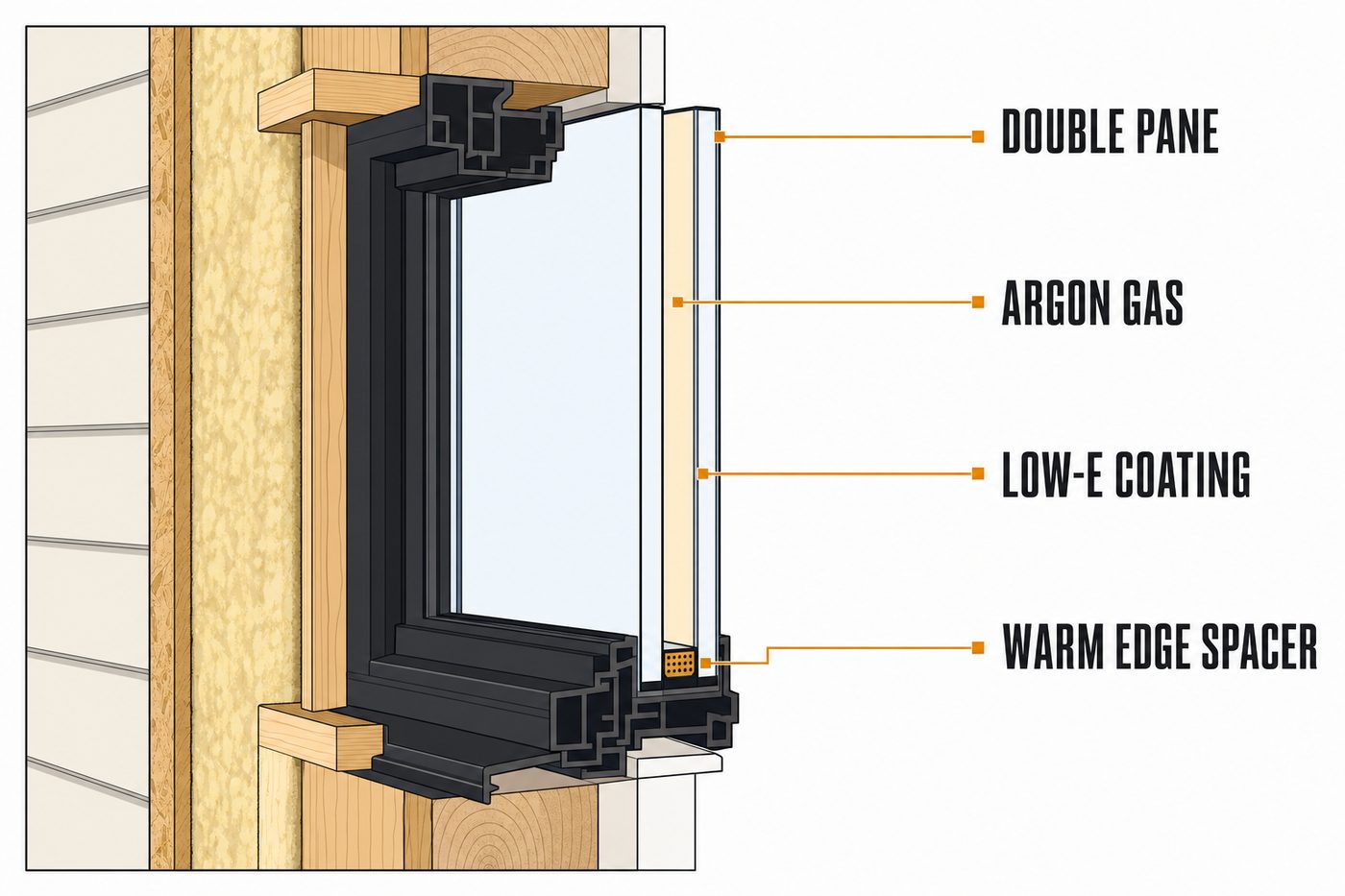
Winters here are real, and single-pane glass with aluminum storms is roughly the thermal equivalent of leaving a hole in the insulation at every opening. Modern double-pane units with low-E coatings and argon fill cut conducted heat loss dramatically, and the low-E layer works both directions: it keeps furnace heat in through the cold months and knocks down solar gain through the big south and west glass in July, when the sun comes off the fields with nothing to filter it.
Orientation is worth thinking through room by room. South-facing glass can be specified to admit winter solar warmth — free heat on clear cold days — while west windows, which take the brutal late-afternoon summer sun, often justify a harder-working coating. That kind of per-window tuning costs little and is exactly the sort of detail a measure appointment should cover.
Buying the Right Window, Not the Biggest One
Practical owners ask us where the money stops being useful, and the answer is tiered. Solid vinyl frames with a good low-E double-pane package handle this climate well and carry the best cost-to-performance ratio for most homes in town. Fiberglass or composite frames step up in stiffness and temperature stability — worth considering on big openings and windward walls, since they flex less under load and their seals live longer. Wood-clad units are mostly an appearance decision for owners restoring a farmhouse's character. Triple-pane earns its premium in the coldest rooms and on the wind side of the house; on a sheltered east wall it may never pay you back. We'll tell you which windows on your house justify the upgrade and which don't.
How a Window Job Runs With Us
- Measure and assessment. Every opening measured individually; frames checked for rot, racking, and settlement; a room-by-room talk about drafts, condensation, and which windows bother you most.
- Written proposal. Unit specs, glass packages per elevation, insert or full-frame per opening, and installation details — in writing, before any deposit.
- Ordering. Custom-sized units typically take a few weeks to manufacture; we schedule installation as the delivery date firms up.
- Installation. Openings prepared one at a time so the house is never left open, then set, shimmed plumb, foamed, flashed, and sealed inside and out.
- Final check. Every sash operated, every lock engaged, labels off, glass cleaned, and a walkthrough with you.
Permitting, where it applies, runs through City of Davenport for homes in town and Lincoln County for rural parcels — we sort out what your project needs and file it.
What Drives the Price of the Project
Window count sets the baseline, but it's rarely the whole story on older Davenport homes. Custom sizing for non-standard openings adds cost per unit. Full-frame replacements run more than inserts because they rebuild more of the wall. Frame material and glass package move each window's price, and repair work — a rotted sill, a racked jamb, a weight pocket that needs insulating — adds labor where the tear-out finds trouble. Whole-house projects price better per window than doing three now and five later, which is worth weighing if most of your glass is the same age.
Timing the Work
Manufacturing lead time, not installation, is usually the long pole — figure a few weeks between signed proposal and delivery. The install itself moves fast: a typical house is done in one to three days. We replace windows year-round; each opening is exposed only briefly, so even January work doesn't leave the house cold. High-wind days are the one thing we schedule around, since setting a large unit plumb in a gusting crosswind is a fight nobody wins. Fall books heavily from owners wanting glass done before winter, so summer commitments get the friendliest scheduling.
Answers for Davenport Homeowners
Can you match the tall, narrow windows on my farmhouse?
Yes — units are ordered to each opening's measured dimensions, so original proportions stay intact. Keeping the historic look usually costs ordering discipline, not a premium product line.
Insert or full-frame — how do I know which I need?
If your frames are sound and reasonably square, inserts preserve trim and save money. Rot, racking, or uninsulated weight pockets call for full-frame. On most older houses here it's a mix, decided opening by opening at the measure.
Will new windows actually stop the dust?
The dust is riding air infiltration, so yes — sealed frame perimeters and tight modern weatherstripping close the paths it uses. Homeowners tend to notice the quiet before they notice the clean sills.
Is triple-pane worth it in Lincoln County?
On north- and windward-facing rooms and bedrooms where cold glass is a comfort issue, often yes. Across the whole house, usually not. We spec it selectively rather than as a blanket upgrade.
What about condensation on my current windows?
Interior condensation on single-pane glass is warm indoor air hitting a cold surface — new insulated units keep the interior pane warm enough to stop it. Fog between the panes of an existing double-pane unit means a failed seal, and that unit is done.
Do windows in town need a permit?
Depending on scope, City of Davenport permitting can apply inside city limits, and Lincoln County covers rural properties. We confirm requirements and handle any filing — you don't chase paperwork.
Can you do just the worst few windows first?
Certainly. Many owners phase the work — windward side first, rest later. We'll document specs so the later phases match exactly.
Who does the installation?
Domex crews, working under our Washington license and insurance. The company is nine years in, with 32 years of combined field experience behind the people on your ladder.
Licensing and the Ground We Cover
Domex Construction is licensed in Washington (DAVYDCI833NC — look it up on the state L&I contractor registry) and fully insured, with a workmanship warranty behind the manufacturer coverage on every unit we set; ask us about it at the estimate. From Davenport we handle window work across Lincoln County, including Reardan, Harrington, Creston, Wilbur, and the farms between.
Ready to stop heating the outdoors? Free in-home window estimates in Davenport and across Lincoln County. Give us a call or request an estimate online.
More from Domex in Davenport: Siding Installation in Davenport · Custom Decks in Davenport · Custom Home Builder in Davenport · Window Replacement — Spokane hub