
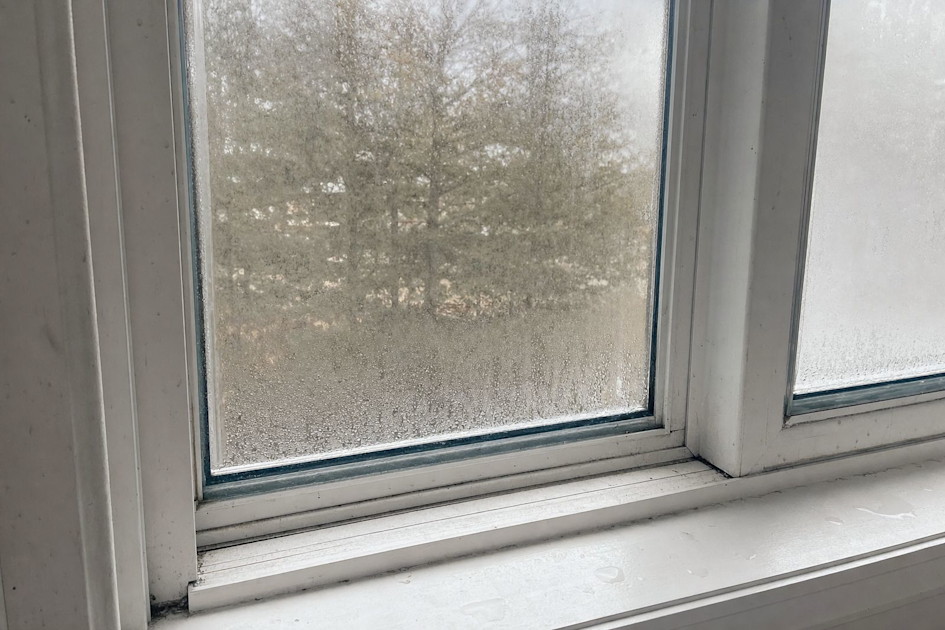


Windows rarely fail loudly. They fail the way the one in the photo above did: quietly, a little more fog each winter, a little more draft each January, until you're heating the neighborhood. After hundreds of window replacements around Spokane and North Idaho, these are the seven signs we tell homeowners to watch for — and, just as important, how to tell the difference between a window that needs a repair and a house that needs a replacement plan.
How do you know when it's time to replace your windows?
The clearest signal is a cluster. One foggy pane can often be repaired; but when several of the seven signs below show up across the house at once — fogging, interior frost, drafts, sticking sashes, rising heat bills — the windows are failing as a system, and replacement almost always beats chasing repairs one opening at a time. In our heating-dominated Inland Northwest climate, failed windows are usually a home's single biggest source of comfort complaints and wasted energy, which is why they're one of the few upgrades homeowners actually feel.
1. Fog or moisture between the panes
That haze you can't wipe off from either side means the insulated glass unit's edge seal has failed and the argon gas fill is long gone. The window still keeps rain out, but its insulating value has collapsed to little better than single glazing. This is the single most common failure we see in 1990s and 2000s builder-grade vinyl, where the sealant around the spacer simply reaches the end of its life. Once the seal is breached, no defogging "service" restores the original U-factor for good — the unit is done.
2. Frost on the inside of the glass
On a single-digit January morning, frost on the interior face of the glass or on an aluminum frame means the window is conducting cold straight into your living room. Modern low-E, argon-filled units with warm-edge (non-metal) spacers keep the interior glass surface warm enough that condensation and frost don't form under normal indoor humidity. Old aluminum frames with no thermal break are the worst offenders — the metal is a thermal bridge from outdoor air to your drywall.
3. Drafts you can feel from the couch
Hold the back of your hand near the sash on a windy day. Air movement means failed weatherstripping or a sash that no longer seats square in its frame, and no amount of caulk fixes a window that's racked out of square. We check for this at every estimate with a simple smoke-pencil or incense test around the perimeter — if the smoke pulls sideways, the seal is gone.
4. Windows that stick, or won't stay open
Vinyl that's warped in the sun, wood that's swollen with moisture, or balance springs that have let go all show up the same way: a window you fight to open, or one you prop with a stick. That's more than an annoyance. A bedroom window that won't stay open on its own fails egress — under the building code, a sleeping-room window must open far enough to get out (and a firefighter in) in an emergency, and a sash that drops shut is a safety problem, not a quirk.
5. Rot or soft spots in the frame or sill
Press a screwdriver gently into the corners of the sill. Soft, punky wood means water has been getting behind the window, and the damage rarely stops at the frame — we find rotted sheathing and wet insulation behind leaking windows on siding repair calls constantly. This is exactly why we favor full-frame replacement over quick pocket inserts when there's any sign of moisture: you can't flash a new window correctly if you never open up and inspect what's rotting behind the old one.
6. Heating bills that keep creeping
Windows are usually a home's weakest thermal link, and ours is a heating climate with thousands of heating-degree-days a year. Upgrading from failed double-pane or original single-pane glass to modern low-E units — we spec ENERGY STAR Northern-zone glazing with a U-factor at or below 0.27 — is one of the few improvements you can feel in the first billing cycle, especially on the north and west walls that take our winter wind.
7. Outside noise that's gotten louder
Traffic on a road that never used to bother you is often a seal failure you can hear before you can see it. As the gas fill leaks and the panes lose their dampening, sound transmission climbs. Laminated or dissimilar-thickness glass packages can cut it back down where road or flight-path noise is a real problem.
Should you repair or replace a failing window?
Repair when the failure is isolated and the frame is sound — a single fogged unit can sometimes take new glass, and worn weatherstripping or a broken balance is a cheap fix. Replace when the failures are spread across the house, when the frames show rot, or when the windows are original single-pane or early double-pane units whose whole generation is aging out together. At that point a whole-home package makes financial sense, and it's why we quote per-opening with a written, line-item proposal — so you can stage the work by priority instead of being pushed into all-or-nothing pressure tactics.
Frequently Asked Questions
How long do replacement windows last in the Inland Northwest?
Quality vinyl and fiberglass replacement windows generally last 20 to 30 years here, with the insulated glass seal usually being the first thing to go. Our freeze-thaw winters and hot, dry summers stress the edge seal harder than milder climates, so warm-edge spacers and a solid manufacturer glass warranty matter more in Spokane than the brochure implies.
Can foggy windows be fixed without replacing them?
Sometimes the glass unit alone can be swapped while keeping the existing frame, if the frame and sash are still square and sound. But if the frame is rotted, racked, or original single-pane, replacing just the glass is throwing good money after bad — you're rebuilding around a failing structure.
What U-factor should windows have for Spokane's climate?
For our heating-dominated climate, look for ENERGY STAR Northern-zone certification, which means a U-factor of 0.27 or lower (lower is better-insulating). We pair that with a low-E coating and argon fill and warm-edge spacers, the combination that stops interior frost and cold-glass drafts on our coldest mornings.
What's the difference between full-frame and insert (pocket) window replacement?
An insert or "pocket" replacement sets a new window inside the existing frame — faster and cheaper, but it hides whatever is happening behind the old frame. Full-frame replacement removes the window down to the rough opening so we can inspect for rot, re-flash into the weather barrier, and insulate the gap properly. We recommend full-frame anytime there's a hint of water damage, which in our experience is more often than homeowners expect.
Do new windows really lower heating bills in Spokane?
Yes, and it's one of the few upgrades you feel quickly here. Because windows are typically the weakest link in a home's thermal envelope and our winters are long, moving from failed or single-pane glass to modern low-E units shows up in the first heating season — most noticeably as rooms that finally hold their temperature instead of feeling drafty near the glass.
If you counted more than a couple of these signs around your house, request a free estimate — we serve Spokane, Spokane Valley, Coeur d'Alene, and everywhere between, and every install is flashed into the weather barrier, not caulked and forgotten.

