
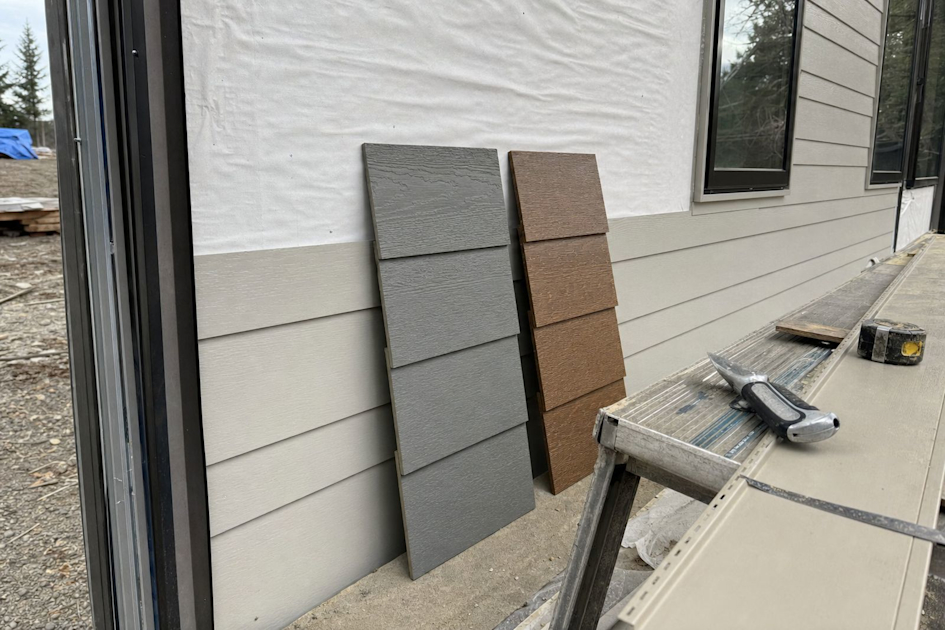


Drive through any new development in Spokane Valley or Coeur d'Alene and you'll see the same two materials on the nicest homes: James Hardie fiber cement and LP SmartSide engineered wood. We install both, we're a James Hardie Preferred contractor, and homeowners ask us to settle this debate at almost every estimate. Here's the honest, installer's-eye version — what each product actually is, how it holds up in our specific climate, and which one we'd put on our own house.
James Hardie or LP SmartSide — which is better for a Spokane home?
There's no single winner; there's a winner for your priorities. Choose James Hardie fiber cement if fire resistance, the crispest long-term paint finish, and the longest track record matter most — it's the safer pick as wildfire-smoke seasons intensify across the Inland Northwest. Choose LP SmartSide engineered wood if impact toughness, fewer seams on long walls, easier handling, and a little budget headroom matter more. Both vastly outperform the hardboard and T1-11 we tear off Spokane homes every month, so the real decision is which set of trade-offs fits your house and your neighborhood.
What are James Hardie and LP SmartSide actually made of?
James Hardie is fiber cement — Portland cement, sand, and cellulose fiber pressed and cured into dense boards (HardiePlank lap, HardiePanel sheets, HardieShingle). It is non-combustible, it doesn't feed rot or insects, and woodpeckers want nothing to do with it. Its cost is weight and brittleness: it's heavy to hang and can crack under a hard impact.
LP SmartSide is engineered wood — wood strands bonded with resins and treated all the way through with zinc borate (the SmartGuard process) for rot and termite resistance, then pressed into boards that install more like traditional lumber. It's lighter, more flexible, and far more forgiving of a hard knock, but it is a wood-based product, so correct sealing at cut edges and correct installation are what keep moisture out.
Which siding holds up better in the Inland Northwest climate?
Spokane's problem isn't constant humidity — it's the freeze-thaw cycle, wind-driven rain, and the swing from single-digit winters to 100°F summers. Both products handle that swing well, but they split on two hazards. Fire goes to Hardie: fiber cement is rated non-combustible (ASTM E136), which matters more every year as smoke and wildfire risk climb here, and increasingly matters to insurers. Impact goes to SmartSide: hail, a kid's baseball, or a string trimmer at the base of a wall will dent-and-shrug on engineered wood where a Hardie plank can crack. Hardie also holds a paint line crisply for decades because it barely moves with temperature; SmartSide expands and contracts a bit more, which is fine when it's fastened and gapped correctly and a problem when it isn't.
Why does the installer matter more than the material?
Because nearly every warranty claim we've seen denied — on either product — traces back to an installation shortcut, not a factory defect. Fiber cement must be blind-nailed on the correct schedule, gapped roughly 1/8 inch at trim and butt joints and left uncaulked where the manufacturer specifies, with a weather-resistive barrier behind it and kickout flashing where roofs meet walls. Engineered wood needs its cut edges sealed, its fasteners set flush (not overdriven into the surface), and the same disciplined flashing details. Hardie is heavy, brittle before it's hung, and unforgiving of a bad nail; SmartSide comes in 16-foot lengths that mean fewer seams on a long Spokane rambler and cuts like wood. Either way, the flashing and fastening you can't see from the street are what determine whether the wall lasts 40 years or fails in 8 — which is the whole reason a manufacturer designation like Hardie Preferred exists.
How much does James Hardie vs. LP SmartSide cost in Spokane?
Installed prices move with the material market, but the pattern is consistent: LP SmartSide typically lands about 10 to 20 percent below James Hardie for the same house, mostly because it's lighter and faster to hang. Factory-finish programs exist for both and both beat field painting for finish life — ColorPlus Technology for Hardie, and prefinished coatings like Diamond Kote for SmartSide, several of which carry long no-fade, no-flake finish warranties. When we bid a re-side we price the finished system, not just the boards: tear-off, any sheathing repair we uncover, house wrap, flashing, trim, and finish all live in the number, which is why the cheapest siding quote in town is usually the one leaving something out.
What do we recommend?
If fire resistance, resale cachet, and the longest track record top your list, go Hardie. If impact toughness, longer boards, and budget headroom matter more, SmartSide is a fantastic product — and in fact many of our own recent projects, including several in our project gallery, are SmartSide by the homeowner's choice. There's no wrong answer between two products this good; there's only the wrong installation. Insist on manufacturer-spec work either way: taped weather barrier, correct fastening, flashed penetrations and kickouts, and properly gapped joints. That's what our 24-month workmanship warranty covers on top of the manufacturer's coverage.
Frequently Asked Questions
Is James Hardie or LP SmartSide better for wildfire and smoke areas?
James Hardie has the edge for fire exposure. Fiber cement is non-combustible under ASTM E136, so it won't ignite or feed a fire the way a wood-based product can. In the Inland Northwest's worsening wildfire-smoke seasons — and for homes in wildland-urban-interface zones — that non-combustible rating is a meaningful safety and insurance advantage.
Which siding is more resistant to hail and impact damage?
LP SmartSide is tougher against impact. Its engineered-wood construction flexes and absorbs a hard hit — hail, a baseball, a string trimmer — where brittle fiber cement can chip or crack. If your home takes regular impacts or you want the most dent-resistant wall, SmartSide is the more forgiving choice.
How long does each type of siding last in Spokane?
Both are built to last 30 or more years in our climate when installed to spec, and both carry long manufacturer substrate warranties. In practice the finish and the installation quality determine real-world lifespan more than the raw material — factory-finished boards and correct flashing are what get you to the far end of that range.
Do you have to paint Hardie or SmartSide siding?
Not if you choose a factory-finish program. Hardie's ColorPlus and prefinished SmartSide coatings like Diamond Kote are baked or cured on in a controlled setting, so they hold color far longer than field paint and often carry multi-decade no-fade warranties. Unfinished or field-primed boards will need periodic repainting like any wood-based exterior.
Can you install siding over existing siding, or does it need to come off?
For a proper job in our climate, we remove the old siding down to the sheathing. That's the only way to inspect for hidden rot, install or repair the weather-resistive barrier, and flash windows and roof-wall intersections correctly. Siding installed over failing material just hides the problems that cause the next failure.
Either way, insist on manufacturer-spec installation. If you're weighing the two for your own re-side, request a free estimate and we'll bring sample boards of both to your driveway so you can see and handle them side by side.

