
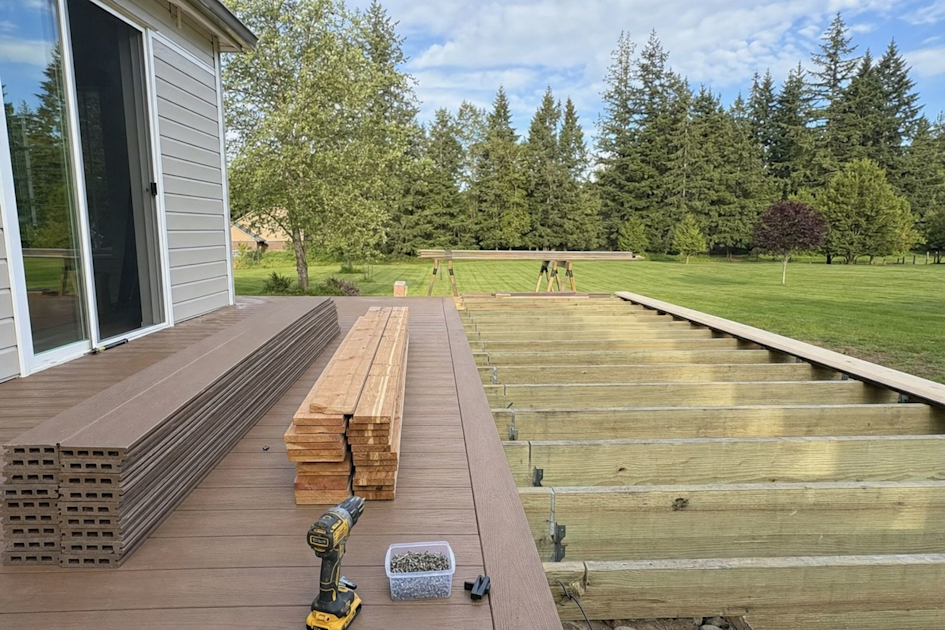


Every deck conversation in Spokane eventually arrives at the same fork: composite or cedar? We build both — decks from Liberty Lake to Post Falls, several of them in our project gallery — and the honest answer is that our four-season climate punishes each material differently. This guide is the same walk-through we give homeowners at the estimate, with the numbers and the framing details most brochures leave out.
Composite or cedar — which is better for a Spokane deck?
For most Spokane and Coeur d'Alene homeowners planning to stay in the house, capped composite is the better long-term value: its color survives our UV load, snow shovels don't scar it, and yearly upkeep is a garden hose. Cedar wins on up-front cost, natural looks, and how cool it stays underfoot in August — but only if you commit to re-oiling it every one to two seasons for the life of the deck. Neither is "better" in a vacuum; the right call depends on your sun exposure, your budget horizon, and how you feel about maintenance.
What does Spokane's four-season climate do to a deck?
Our climate is the whole ballgame. A deck here freezes and thaws dozens of times each winter, carries wet snow load for weeks, then bakes under a bone-dry July at 90–100°F. That freeze-thaw-then-desiccate cycle is far harder on decking than the steady humidity most national marketing is written for. Two forces do the damage: UV, which pulls moisture and finish out of natural wood, and moisture movement, which swells and shrinks boards until fasteners loosen. A material that shrugs off Seattle's damp can still check and cup in Spokane's high-desert sun, so we weigh every deck against our own weather, not a manufacturer's test lab in a milder state.
Is cedar decking a good choice in Spokane?
Cedar is a good choice here if — and only if — you'll maintain it. Western red cedar is naturally beautiful, stays cooler than composite in direct sun, and costs less on day one. Its enemy in our climate isn't rot; our summers are too dry for rot to lead. It's UV. Left unfinished, a cedar deck grays, checks, and splinters within a few seasons. To keep it looking like the day we built it, plan on cleaning and re-applying a penetrating UV-inhibiting oil (Penofin, Messmer's, or similar) every one to two summers, forever. We also specify clear or "select tight knot" grades over builder-grade knotty cedar for exposed surfaces, because knots are where checking and splintering start. If you love the material and the ritual, nothing else looks quite like it.
Is composite decking worth it in the Inland Northwest?
For most of our clients, yes. Modern capped composite and PVC — Trex Transcend and Enhance, TimberTech AZEK and PRO, Fiberon — are a different product from the first-generation uncapped boards that gave the category a chalky, fade-prone reputation twenty years ago. The polymer cap resists our UV, snow shovels won't tear it, and the annual maintenance really is a hose-down. The trade-offs are real and we put them on the table: dark boards get hot on a south- or west-facing deck, so we steer sun-baked exposures toward lighter tones; and composite spans less than wood, so it needs more framing underneath (more on that below). Capped PVC like AZEK is the lightest and most stain-resistant of the bunch and our first pick for full-sun, low-maintenance builds; capped mineral/poly composites like Trex give a slightly more wood-like feel for a bit less.
How much does a composite vs. cedar deck cost over 10 years?
Composite costs more on day one, then costs almost nothing. Cedar costs less on day one, then bills you every other summer — in stain, cleaner, and a weekend of labor, or in gray, splintered boards if you skip it. When you run the real ten-year total, the two land far closer than the day-one quotes suggest, and composite usually wins once your own time is worth something. There's also a framing cost baked into composite that surprises people: because most brands require joists at 16 inches on center — tightening to 12 inches on center for stairs, picture-frame borders, and any 45-degree board runs — a composite deck carries meaningfully more pressure-treated lumber than a cedar deck of the same footprint. That belongs in the written bid, not in a surprise, and it's one of the first line items we point to when a competitor's composite number looks suspiciously low.
What makes a deck last — the boards or the frame?
The frame, every time. The decking is what you see; the structure is what keeps the deck standing and safe. Whatever surface you choose, the parts that matter most are invisible six months after we finish: pressure-treated, ground-contact-rated lumber; concrete footings poured below our 24-inch frost line so heave can't lift a post; and — the detail that causes the most failures we get called to fix — the ledger connection where the deck meets the house. We lag or through-bolt the ledger with structural fasteners on the proper schedule, install lateral-load tension ties into the floor framing per current code (IRC R507), and flash the ledger with self-adhered membrane and metal Z-flashing before the siding goes back on, so water sheds out and away instead of wicking into the rim joist. A gorgeous deck bolted to a rotting ledger is a short story with a bad ending. It's the part of any bid worth reading closest, and the part our 24-month workmanship warranty stands behind.
Frequently Asked Questions
How much does a composite deck cost compared to cedar in Spokane?
Cedar is typically cheaper to install than composite up front, but composite's near-zero maintenance usually closes that gap within about seven to ten years. Because pricing swings with lumber and material markets, we quote the exact same deck design both ways so you're comparing real numbers for your project instead of brochure ranges.
Does composite decking get too hot in Spokane's summer sun?
Dark composite boards can get uncomfortable on a south- or west-facing deck during a 95°F afternoon. We reduce that by steering full-sun decks toward lighter colors and, where needed, PVC-capped boards like AZEK, which run cooler than dense mineral composites. Shade structures and board orientation help too.
How often does a cedar deck need to be sealed here?
Plan on cleaning and re-oiling a cedar deck every one to two seasons in the Inland Northwest. Our intense summer UV degrades finishes faster than in milder, cloudier climates, and skipping more than two or three seasons is when graying, checking, and splintering set in.
How deep do deck footings need to be in Spokane and Coeur d'Alene?
Deck footings in our area are poured below the roughly 24-inch frost line so seasonal freeze-thaw can't heave the posts. Local jurisdictions in Spokane County and Kootenai County set the exact depth and inspect it, and every deck we build is permitted and inspected to that standard.
Can you build a composite deck over an existing frame?
Sometimes, but only after we verify the joist spacing and the framing's condition. Most composite brands require 16-inch on-center joists (12-inch for diagonal runs and stairs), and an older cedar-era frame is often spaced wider, so it may need sistered or added joists — or full replacement — before composite can go down to spec.
Weighing the two for your own backyard? Request a free estimate and we'll price the same deck in both materials so you're comparing real numbers instead of brochures.

