
Custom Deck Builders in Sandpoint, Idaho
Custom deck builders in Sandpoint, ID. Framing sized for real Bonner County snow, decking that survives shovels and ice. Call for a free estimate.
$1,000 Off
Your Complete Siding Replacement
Get a Free Estimate
FREE same-day estimates on all exterior projects.








There's one call we get every spring after a big winter, and it's always the same story. A deck that looked fine for years came out of the melt with a sag in the middle, a gap opening at the house, or posts that punched down into the soil — and the owner wants to know what went wrong. Nine times out of ten, nothing "went wrong." The deck was simply built to a generic snow number, the kind that works fine in most of the country, and then it met a Sandpoint winter, where the load standing on those joists by February can be several times what a spec-book deck was ever asked to carry. Add a metal roof dumping its slabs onto one corner and you've concentrated that weight onto a few square feet of framing.
Domex Construction designs and builds decks in Sandpoint around that reality, under Idaho license RCE-66940. The structure gets engineered for the winter this town actually has; the surface gets chosen for how people here actually treat it.
Framing to the Winter, Not the Catalog
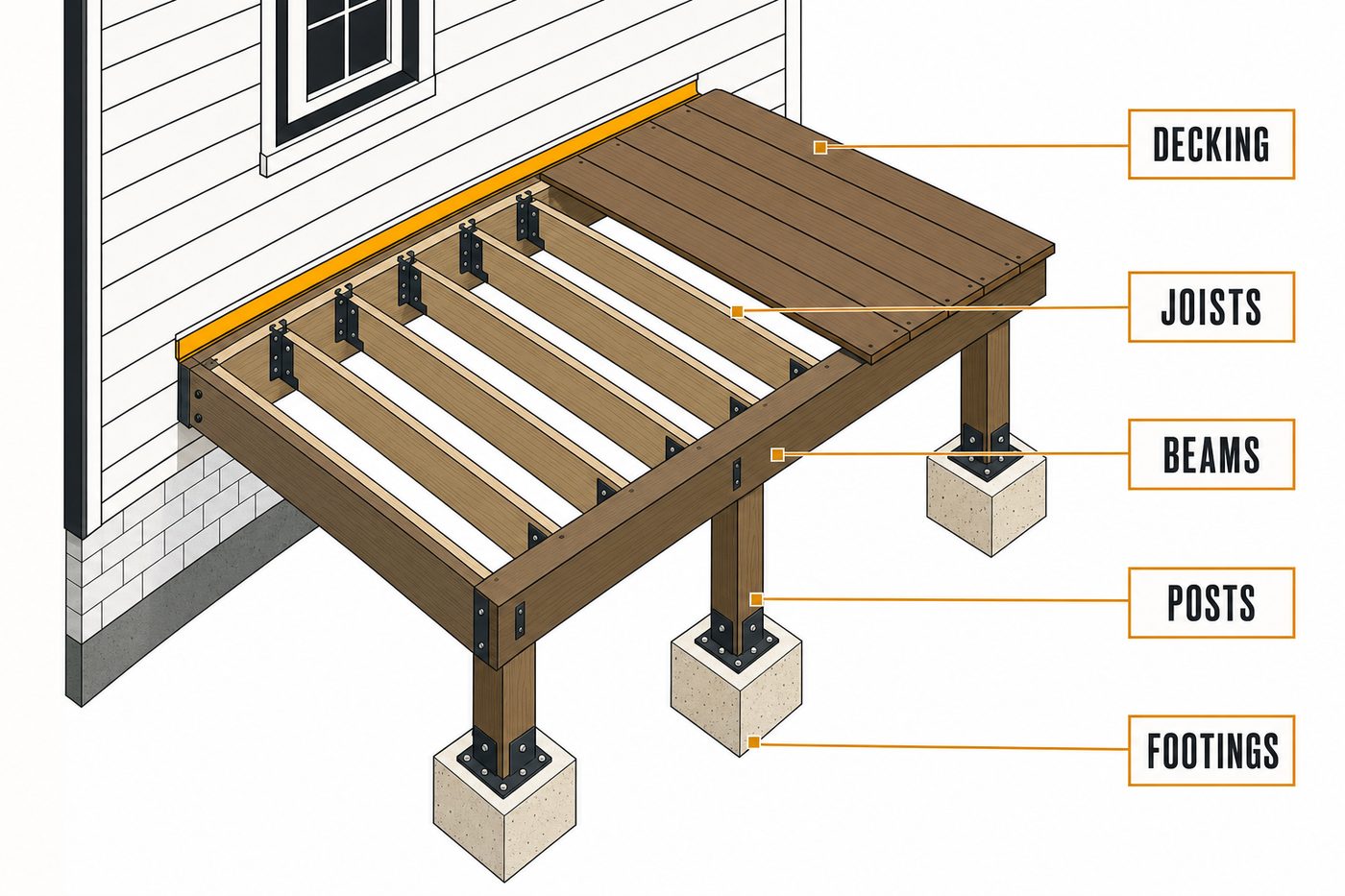
Design snow load is the first number on our deck drawings, and in Sandpoint we pull the current figure from the city and Bonner County requirements rather than defaulting to the residential live load most pre-drawn plans assume. That single number cascades through everything: beam depth, joist size and spacing, post placement, and footings poured wide enough — and below frost depth — that a winter's weight doesn't drive them into the ground. Ledger connections get equal attention, because a snow-loaded deck pulling away from the rim joist is the failure mode that actually hurts people; ours are through-bolted and flashed, with lateral hardware, and where a house's rim can't be trusted we design the deck freestanding instead.
Then there's placement. Before we draw anything, we stand in the yard and look up. If a steep roof plane sheds toward the proposed deck, we either shift the footprint, add snow retention on the roof, or size the structure for the concentrated hit — with a price attached to each route so the choice is yours. A beautiful deck parked under a roof-shed line without a plan is a short-lived deck.
Building for the View You Bought
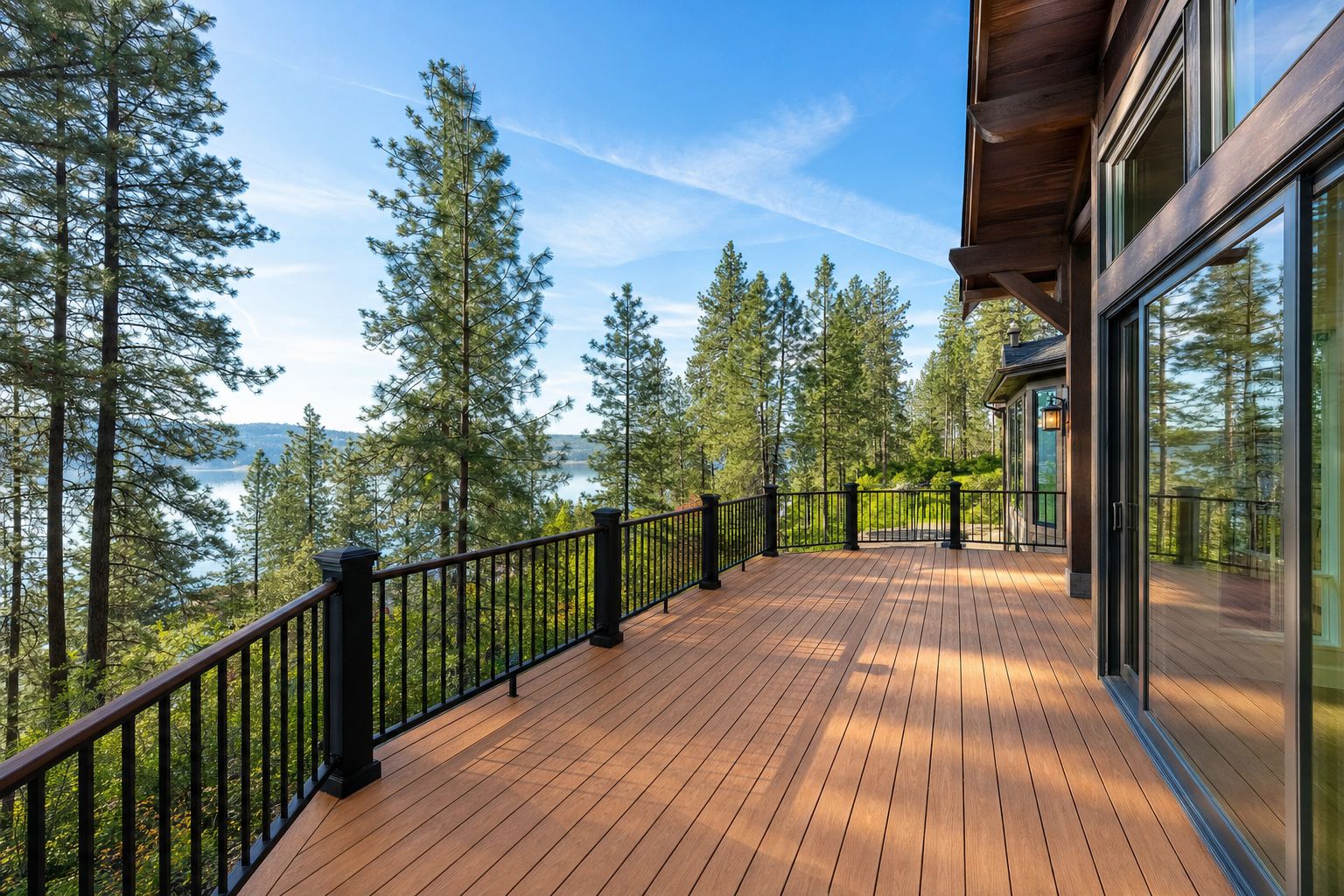
Most Sandpoint deck projects exist because of what you can see from them — the lake to the south, the mountain to the northeast — so the railing decision matters as much as the footprint. Cable rail keeps sightlines nearly invisible and handles winter without complaint. Glass panels give the cleanest view of all, and we install plenty, but we're honest about the trade: they show water spots, they need clearing after storms, and they turn into snow fences in a drifting wind. A wood or composite drink rail sacrifices a strip of view for a place to set a coffee. We mock up heights on site during the design visit so you're choosing with your own eyes, from your own chairs.
A Surface That Can Take a Shovel
Whatever the brochure photos show, a Sandpoint deck's real life includes a snow shovel scraping it forty times a winter and moisture freezing in every gap it finds. That shapes our material advice. Quality composite and PVC boards handle freeze-thaw and shovel traffic well, don't splinter, and skip the refinishing cycle — a real advantage for owners who aren't in town every month. Cedar and treated wood cost less up front and still make sense for some projects, but in this climate they demand recoating on a schedule, and skipped years show fast. Under the boards, the details do the winter work: hidden fasteners that won't back out through heave cycles, stainless hardware, gapping sized for drainage, and a slight pitch so meltwater leaves instead of glazing into a rink at the door. One habit worth adopting on day one: a plastic-edged shovel, run parallel to the boards. Your decking will look years younger for it.
What Changes a Deck Quote in Sandpoint
Footprint and height set the base — elevated view decks carry more structure per square foot than grade-level platforms. Footing count and digging conditions matter, especially on the rocky, sloped lots above the lake. Railing choice swings the price more than most people expect; glass and cable systems cost multiples of a wood rail. Stairs, benches, and privacy screens each add framing. And the design snow load itself is a cost driver unique to towns like this one: the same footprint priced for Sandpoint's winter simply contains more lumber, more hardware, and more concrete than it would fifty miles south. We put a firm number on all of it after a site visit — no per-square-foot guessing.
From Sketch to Final Fastener
- Site and design visit. Grades, views, roof-shed paths, sun angles, and how you'll actually use the space — then a drawn plan with the load math behind it.
- Written proposal. Materials, railing system, footing spec, and price, itemized so you can adjust scope before signing.
- Permit and layout. We submit drawings to the City of Sandpoint, schedule the required inspections, and stake the footprint.
- Footings and frame. Holes dug below frost, concrete placed and inspected, then the structural package — beams, joists, hardware, flashing.
- Surface, rail, walkthrough. Decking, railing, stairs, and a final review together, including the maintenance rundown for your chosen material.
The Season Is Short — Here's the Truth About It
Concrete wants open, thawed ground, so the practical footing season here runs roughly May through October, and every deck builder in Bonner County is working the same window. Owners who call us in June for a July deck are usually looking at fall. The smarter play is designing and permitting through winter so your project holds an early-season slot; framing and decking can continue in cold weather once footings are in. One more honest note: our crews drive up from Spokane–Post Falls and work Sandpoint in dedicated multi-day runs, which means your build gets consecutive focused days rather than an hour here and there — but it also means dates are set in advance and we keep them.
Deck Questions From Sandpoint Homeowners
What snow load do you design to?
The current figure adopted by the City of Sandpoint and Bonner County for your site — we confirm it at permit rather than quoting a number from memory, because it's dramatically higher than the generic load many stock plans use.
Do I need to shovel my deck in winter?
A deck we've built to local load requirements can carry a normal winter. After extreme dumps, or on older decks of unknown pedigree, shoveling is cheap insurance — parallel to the boards, plastic edge.
Is composite decking okay in this climate?
Better than okay — freeze-thaw and shovel wear are exactly the abuses composite handles best. The failures we see in cold climates are almost always fastening and framing shortcuts underneath, not the boards.
Can you build under my roof's shed line?
Sometimes, with roof snow retention or beefed framing; sometimes the right answer is moving the deck eight feet. We'll show you both prices and let the numbers decide.
Will a glass railing survive the winter?
Structurally, yes — good systems are engineered for it. Practically, expect to clear snow off it and squeegee it if you want the view it promises. Cable rail is the lower-maintenance way to keep the sightline.
When should I book a summer build?
Design and permit in winter, build in the first available slot after thaw. By midsummer the season's calendar is mostly spoken for.
Does a deck need a permit and inspections in Sandpoint?
Yes for nearly anything attached or elevated — footing and framing inspections included. We handle the drawings, the filing, and the inspector scheduling.
Can my existing deck be reinforced instead of replaced?
Sometimes. If the footings and ledger are sound, sistered joists and added beams can bring a frame up to local loads; if the foundation of the thing is undersized, reinforcement is money on borrowed time. An inspection tells us which yours is.
Who You're Hiring
Domex Construction holds Idaho contractor license RCE-66940 — check it through the Idaho Contractors Board anytime — along with Washington license DAVYDCI833NC and full insurance coverage. Nine years in business, decades of combined field experience across the crew, and a workmanship warranty we'll walk you through at the estimate.
Deck projects from this page extend to Ponderay, Dover, Kootenai, Sagle, and Priest River.
Want a deck that comes out of March flat and solid? Site visits and estimates are free. Give us a call or request an estimate online.
More from Domex in Sandpoint: Siding Installation in Sandpoint · Window Replacement in Sandpoint · Custom Home Builder in Sandpoint · Custom Decks — Spokane hub