
Custom Deck Builders in Rathdrum, Idaho
Rathdrum, ID deck builders. Wind-braced railings and pergolas, full-sun decking picked honestly. Licensed Idaho contractor. Free estimates.
$1,000 Off
Your Complete Siding Replacement
Get a Free Estimate
FREE same-day estimates on all exterior projects.








One service call repeats out of Rathdrum backyards more than any other: the railing that has started to move. The homeowner grabs the top rail on the way down the steps and it gives a quarter inch; by the time we visit, the pergola has a lean and two privacy-screen panels are somewhere past the fence. None of it was built wrong for a normal yard. It was built for a yard that does not sit on the Rathdrum Prairie, where anything vertical bolted to a deck spends the year being pushed, rocked, and pried by wind that has miles of open ground to build speed. A railing here is a small sail. A pergola is a big one. Structures that were assembled rather than engineered come loose one gust at a time.
Domex Construction builds decks, railings, and shade structures across Rathdrum under Idaho license RCE-66940, and on this ground, wind load is a design input from the first sketch.
A Frame the Wind Can't Work Loose
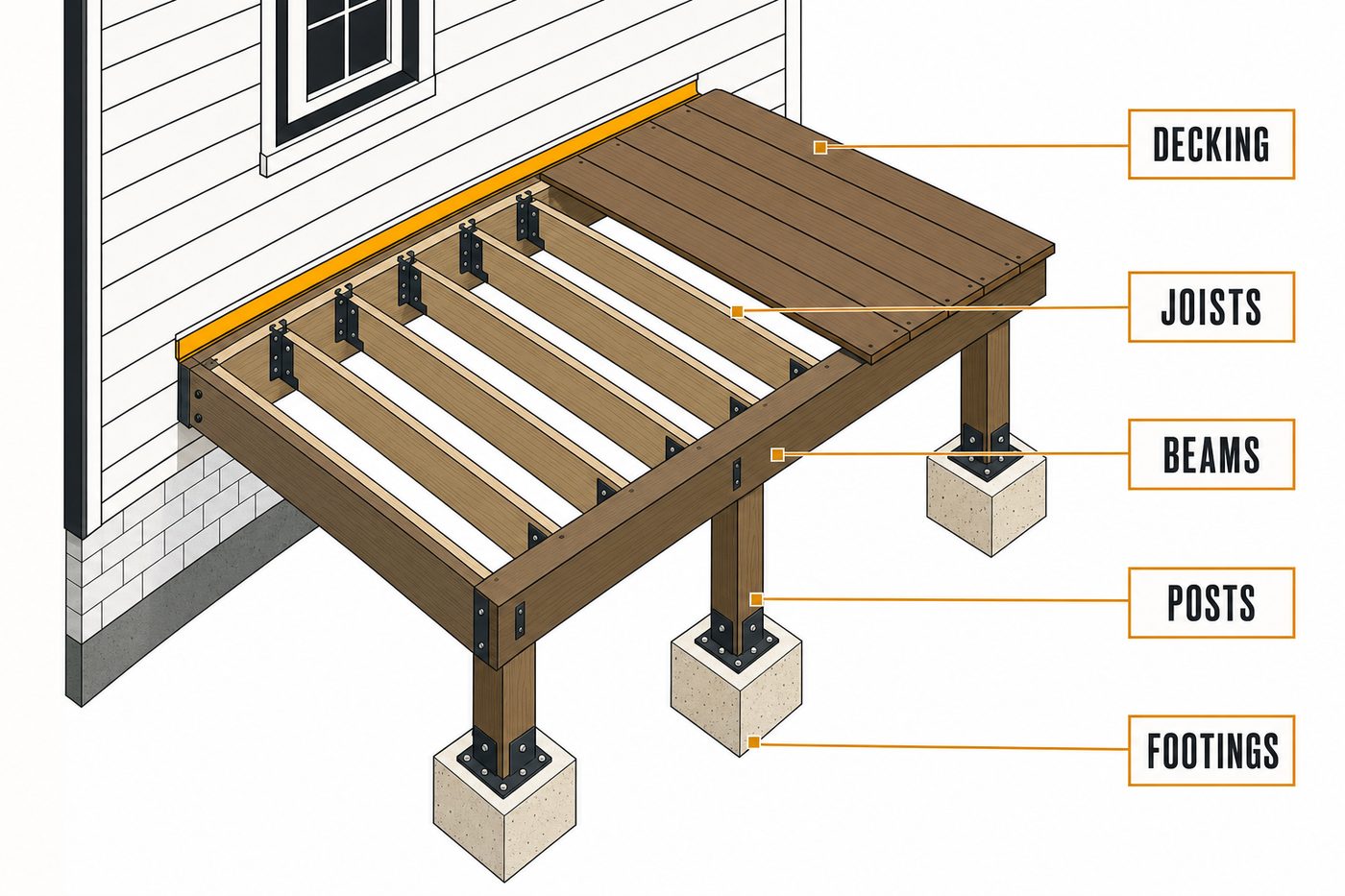
Gravity is the easy load; every deck handles gravity. Prairie wind adds two loads most builder decks around here were never detailed for: sideways racking and straight-up uplift. Our framing answers both with hardware and geometry rather than hope.
Railing posts get through-bolted to blocking inside the frame — carriage bolts clear through, not lag screws into the end grain of a rim joist. A lagged post loosens under cyclic load because every gust opens the threads a little more; a through-bolted post has nothing to back out of. Pergolas and covers get sized posts, knee braces at every post-to-beam joint to stop racking, and uplift-rated connectors from footing to rafter, because a gust hitting a roof plane pulls up on it as hard as it pushes sideways. Privacy screens, the add-on this town requests most, get treated as the wind walls they are: a solid panel catches several times the load of an open railing, so its posts and footings get sized like structure, not like trim.
Under it all, footings poured past frost depth, with mass and post bases chosen for uplift, keep a freestanding structure planted through September blows and January freezes. The frame carries snow load too — a deck that shrugs off wind but sags under a heavy winter did half its job. Good bracing disappears into the design. What you notice is just that nothing rattles.
Straight Talk on Decking in Full Sun
Rathdrum's newer neighborhoods have almost no mature shade, so your deck boards will take direct sun from mid-morning to sunset, all summer, every summer. Two honest consequences follow.
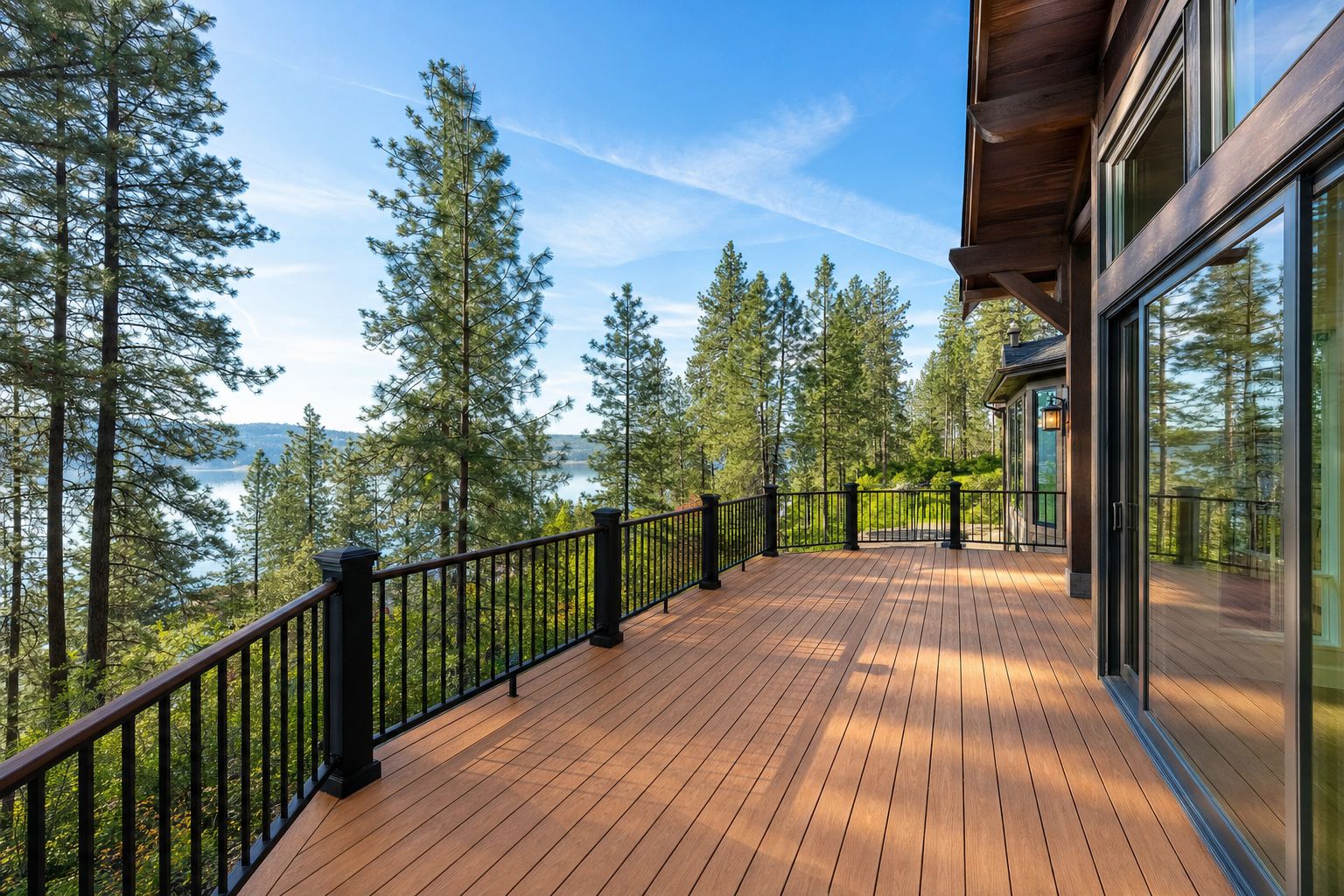
Dark composite gets hot. Genuinely hot — uncomfortable for bare feet and dog paws through the peak weeks. The fix is free: a lighter or mid-tone board runs meaningfully cooler in identical sun. We would rather steer you off a color at the estimate than have you resent the deck in July. Cedar runs cooler than dark composite in the same exposure.
Everything fades; the question is how much. Cedar and pressure-treated lumber gray quickly under this much UV unless you commit to a real refinishing schedule, and on a shadeless lot that schedule comes around fast. Quality composites hold color far better — expect a modest shift the first season, then stability. Any salesperson promising a zero-fade board on prairie sun is selling past the truth.
For most full-sun yards here, a mid-tone composite over a wind-braced frame is the combination we would put on our own houses: walkable temperature, stable color, no finishing calendar. If you want real wood, we will build it gladly and hand you the honest maintenance schedule that comes with it. Either way the framing details stay the same — joists spaced for the board you chose, surfaces sloped to drain, ledger flashed against the house so meltwater never finds your rim joist.
What the Build Looks Like From Your Side
Expect the first visit to be mostly questions about how you live outside: where the wind crosses your yard, where the afternoon sun lands, what you want blocked and what you want open. Prairie lots are flat, which simplifies the structure and raises the stakes on exposure planning. You will get a written spec with framing, decking, railing, and any shade structure detailed down to the connection hardware, and a fixed price attached to it. During the build, count on a staging area in the yard for a few days, inspections at footings and framing, and a crew that shows you the frame before boards hide it. We like homeowners seeing the blocking and bolts they paid for.
The Line Items That Shape a Deck Price
Square footage anchors the number, but the swings live elsewhere. Railings surprise people — length and style move cost more than most expect, and cable or metal systems sit well above wood balusters. A pergola or roof is effectively a second small structure with its own posts, footings, and hardware. Board choice matters: composite costs well more than pressure-treated up front and pays it back in skipped refinishing. Wind-braced privacy walls add framing a sheltered town would never need. Working in your favor, flat lots keep decks low — short posts, simple stairs, minimal bracing height — a genuine saving over slope-town builds. Tear-off and hauling an old deck adds a line. Every line is on paper before you commit.
From First Call to First Cookout
Spring fills the build calendar front-to-back, and demand for shade structures peaks right when waiting for one hurts most, so winter and early-spring calls get the best slots. Once footings pass inspection, a typical Rathdrum deck is days to a couple of weeks of site work; pergolas and multi-feature projects add to that. Deep-frozen ground pauses digging in the coldest stretch, but shoulder-season builds run fine, and a March start regularly means burgers by Memorial Day.
Step by Step, Footings to Final Sweep
- Site visit and design talk. Exposure, use, sight lines, and a candid materials conversation. Free, with no obligation attached.
- Fixed written proposal. Framing plan, hardware, board and railing selections, shade structure if any — priced as a whole.
- Permit and layout. Deck work in town goes through City of Rathdrum permitting; we file, then lay out and dig.
- Footings and frame. Concrete below frost depth, inspected, then joists, blocking, bracing, and flashing — the part of the deck you never see and always feel.
- Decking, railing, and walkthrough. Boards down, rails torqued, site raked and swept, and a final lap around the deck with you.
FAQs From the Backyard
Can a pergola really hold up on an open prairie lot?
Yes — braced, through-bolted, and anchored with uplift-rated hardware into real footings. The failed ones we replace were pinned together like furniture and asked to behave like buildings.
My railing wobbles. Is that dangerous or just annoying?
Treat it as dangerous. A moving rail is a connection that is already failing, and rails are what people lean on. Sometimes we can retrofit through-bolts and blocking; sometimes the rot or the framing behind it argues for more.
Which decking color should I pick for bare feet?
Lighter and mid-tones. On a shadeless Rathdrum lot the surface-temperature gap between a pale board and a dark one is the difference between using the deck at 3 p.m. and looking at it.
Wood or composite for this sun?
Composite if you want to skip the refinishing treadmill that full UV imposes on wood. Cedar if you love wood enough to maintain it and want a cooler surface. We price both and pressure you toward neither.
Do decks need a permit in Rathdrum?
In-town projects run through City of Rathdrum permitting, with inspections at footings and framing. We carry the paperwork; properties outside city limits go through Kootenai County instead.
Can you add a privacy screen to the deck I already have?
If the existing frame and footings can take the wind load a solid panel adds — we check before we bolt sail area onto anyone's structure. Sometimes the answer is yes with reinforcement.
Does the frame really need to handle snow if it handles wind?
Both, independently. Winter drops real snow on this prairie, and a roof or pergola sheds drift loads onto the deck around it. Our framing math includes the season the marketing photos leave out.
How soon can you start?
Depends on the season you call in. Winter callers pick their week; June callers pick from what is left. The estimate is free either way.
The Name on the Permit
Every Domex deck in town goes in under Idaho license RCE-66940 — check it yourself through the Idaho Contractors Board — with full insurance behind it and Washington license DAVYDCI833NC covering our west-side work. Nine years in business, 32 years of combined crew experience, and a workmanship warranty worth asking about at your estimate. Rathdrum crews also build across the prairie in Post Falls, Hayden, Spirit Lake, and Twin Lakes.
Featured Nearby Project
Want a backyard the wind can't take apart? Free deck estimates across Rathdrum. Give us a call or request an estimate online.
More from Domex in Rathdrum: Siding Installation in Rathdrum · Window Replacement in Rathdrum · Custom Home Builder in Rathdrum · Custom Decks — Spokane hub