
Window Replacement in Airway Heights, Washington
Window replacement in Airway Heights: fix fogged builder glass, stop plateau drafts, prep for sale. Licensed WA contractor. Free estimates.
$1,000 Off
Your Complete Siding Replacement
Get a Free Estimate
FREE same-day estimates on all exterior projects.








Every spring, orders come down at Fairchild and a slice of Airway Heights gets ready to sell. PCS season drives more remodeling here than any magazine trend does, and windows sit near the top of the pre-listing punch list — because fogged glass and sticking sashes are exactly what a buyer's inspector photographs. A failed seal costs a seller twice: once in the repair credit, once in the impression it leaves.
The other half of our window work is homeowners who are staying put and simply done with drafty rooms on a windy plateau. Airway Heights is one of Washington's fastest-growing cities, its subdivisions largely date from the 2000s onward, and the builder-grade windows that went in with those houses are now reaching the age where they quit. Domex Construction replaces them across the city under Washington license DAVYDCI833NC.
The Year-Fifteen Problem
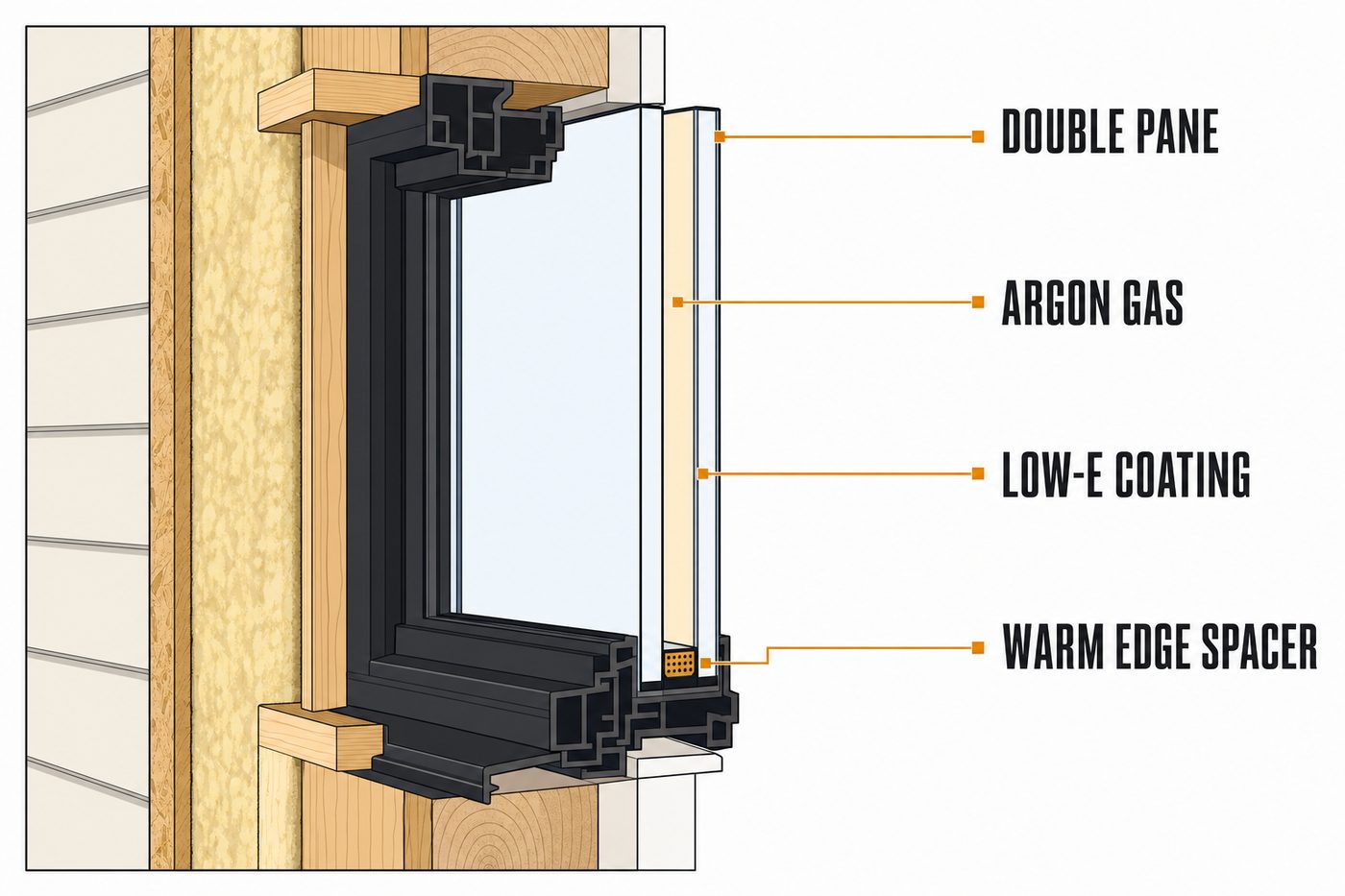
An insulated glass unit — the sealed double-pane sandwich in every modern window — has a working life, and for the builder-grade units common in 2000s construction that life tends to end between years fifteen and twenty. The perimeter seal gives out, the argon fill escapes, moist air gets in, and you see it as fog or mineral haze between the panes that no cleaning reaches.
Airway Heights shortens that clock. Full-sun exposure heats and cools the glass hard every day, and each cycle flexes the seal — installers call it thermal pumping. South- and west-facing units fail first, often years before the shaded side. If one window in the living room has fogged, its neighbors on the same wall are usually not far behind, which matters when you're deciding between replacing one unit and replacing a wall's worth.
Drafts You Can Hear
Seal failure is visible; air infiltration you mostly feel. Plateau wind pressurizes one side of a house and pulls suction on the other, and it finds every weakness a window has: compressed weatherstripping, sliders that no longer pull tight against the jamb, locks that close but don't cinch, and the shimmed gap around the frame that the builder foamed lightly or not at all. On a gusty night you get whistling, cold spots by the couch, and blinds that move with the windows shut.
Replacement fixes this at two layers. The new unit itself seals tighter — modern multi-point locks and fresh weatherstripping do real work — and the installation is where we earn the difference, because we insulate and seal the frame gap properly instead of trusting trim to hide it. In a wind market, the perimeter detail matters as much as the glass.
Selling Soon or Staying Put — Two Different Jobs
These call for different scopes, and we bid them differently.
Pre-sale packages target what inspection will flag: fogged units, cracked glass, windows that won't open (inspectors test them), and missing hardware. Where frames are sound, replacing only the failed units is often the right value play, and we'll build the package around your listing date rather than pushing a whole-house job you won't be there to enjoy. Stay-put upgrades justify the fuller scope: whole-house replacement done once, matched frames and glass throughout, better energy performance every month you live there, and a quieter interior — worth real money on the plateau, between the wind itself and aircraft traffic out of Fairchild. Doing the whole house at once also costs less per opening than replacing in dribs over five years.
Glass for a Treeless Lot
On a shaded city lot, glass selection is a footnote. On an open West Plains lot, it decides how the house feels in July.
The number to know is solar heat gain coefficient — how much of the sun's heat the glass lets through. West-facing rooms here cook in late afternoon, so for west and south glass we typically spec a low-E coating tuned for low solar gain; it knocks the heat load down without darkening the view. North glass can run a different low-E that keeps more free winter warmth. Argon fill and warm-edge spacers round out the package, cutting conducted heat loss and the cold-morning condensation ring at the glass edge. None of it is expensive relative to the window itself — just a spec detail builder packages skipped.
Insert or Full-Frame, and How the Swap Goes
- Measure and assess. We check every opening, verify the frames are square and sound, and confirm which windows qualify for insert replacement (new unit into the existing frame) versus full-frame (everything out to the rough opening — required where frames are damaged or water has gotten behind them).
- Written proposal. Frame material, glass package per orientation, insert versus full-frame per opening, and count — itemized so a pre-sale package is easy to trim or grow.
- Ordering. Windows are built to measurement, not pulled off a shelf.
- Permit and installation. Where the scope requires it, permitting runs through the City of Airway Heights and we handle the filing. Install day is methodical: one opening at a time, old unit out, new unit set, leveled, fastened, insulated, sealed, and trimmed before the next comes out — the house is never left open.
- Final check. Every sash operated, every lock cinched, labels off, glass cleaned, site swept.
What You're Paying For
Window count sets the base. From there: insert versus full-frame (full-frame costs more and is sometimes unavoidable), frame material (vinyl leads in this market and performs well; fiberglass costs more and moves less in temperature swings), the glass package, egress and tempered-glass code requirements in bedrooms and near doors, and second-story access. We give fixed written quotes after measuring — in a value-conscious town we'd rather itemize honestly than bury the math.
Lead Times and the PCS Clock
Custom-built windows carry a manufacturing lead time of several weeks between measurement and install, so the calendar works backward: if the house lists in June, the measure appointment belongs in early spring. Installation itself moves fast — most whole-house jobs finish in one to three days, and small pre-sale packages in a single day. Tell us your report date or listing date at the first call and we'll tell you plainly what's achievable before it.
Window Questions We Hear Most
Can a fogged window be fixed without replacing the whole window?
Sometimes the glass unit alone can be swapped inside a sound frame — a legitimate pre-sale fix. If the frame or hardware is also worn, a full replacement window is usually the better spend. We quote both when both are viable.
Will an inspector really flag foggy glass?
Reliably, yes — failed seals, cracked panes, and inoperable sashes are standard inspection-report items, and buyers use them to negotiate.
Do new windows actually cut the wind noise?
Yes. Tighter units plus a properly sealed frame perimeter make the biggest difference; upgraded glass packages add more. It's one of the first things plateau homeowners comment on after install.
Should I replace all the windows at once or in stages?
Staying long-term, all at once costs less per window and keeps the house matched. Selling soon, stage it: fix what inspection will flag and leave the rest.
Which frame material makes sense here?
Quality vinyl is the workhorse for this market — good thermal performance, no repainting in full sun. Fiberglass is the upgrade for those who want maximum stability and lifespan. We install what fits your plans for the house.
Why do my windows drip condensation on winter mornings?
Interior moisture meeting cold glass. New units with warm-edge spacers and better glass run warmer at the edges, which reduces it sharply — though bathroom and kitchen ventilation still matter.
Is a permit required for window replacement in Airway Heights?
Requirements depend on scope — like-for-like inserts and full-frame or size changes are treated differently. Jobs in city limits run through City of Airway Heights permitting, and we manage whatever the scope requires.
My west rooms overheat every afternoon. Can glass really fix that?
It can do most of the job. Low-solar-gain low-E on the west wall cuts the heat coming through the glass substantially — the difference is obvious the first hot week.
Licensed, Insured, Local
Domex Construction carries Washington license DAVYDCI833NC (verifiable through L&I), full insurance, 9 years in business, and 32 years of combined crew experience across siding, windows, and decks — which matters on full-frame jobs, where window work becomes flashing-and-siding work. Ask about our workmanship warranty at the estimate.
Beyond Airway Heights, this page's crews serve Cheney, Medical Lake, the neighborhoods around Fairchild AFB, and the wider West Plains west of Spokane.
Fogged glass, drafty rooms, or a listing date coming fast? Free estimates, honest lead times. Give us a call or request an estimate online.
More from Domex in Airway Heights: Siding Installation in Airway Heights · Custom Decks in Airway Heights · Custom Home Builder in Airway Heights · Window Replacement — Spokane hub